answer.
Ask question
Login Signup
Ask question
All categories
  • English
  • Mathematics
  • Social Studies
  • Business
  • History
  • Health
  • Geography
  • Biology
  • Physics
  • Chemistry
  • Computers and Technology
  • Arts
  • World Languages
  • Spanish
  • French
  • German
  • Advanced Placement (AP)
  • SAT
  • Medicine
  • Law
  • Engineering
Elina [12.6K]
2 years ago
10

Neef Corporation has provided the following data for its two most recent years of operation: Selling price per unit $ 84 Manufac

turing costs: Variable manufacturing cost per unit produced: Direct materials $ 12 Direct labor $ 5 Variable manufacturing overhead $ 4 Fixed manufacturing overhead per year $ 432,000 Selling and administrative expenses: Variable selling and administrative expense per unit sold $ 5 Fixed selling and administrative expense per year $ 61,000 Year 1 Year 2 Units in beginning inventory 0 3,000 Units produced during the year 12,000 9,000 Units sold during the year 9,000 10,000 Units in ending inventory 3,000 2,000 The net operating income (loss) under absorption costing in Year 2 is closest to:
Business
1 answer:
BaLLatris [955]2 years ago
5 0

Answer:

The net operating income under absorption costing in Year 2 is closest to: $75,000

Explanation:

Year 1

Unit Cost (Absorption Costing) = All Manufacturing Costs (Fixed and Variable)

                                                   = $12 + $5 + $4 + $ 432,000/ 12,000

                                                   = $57

Year 2

Unit Cost (Absorption Costing) = All Manufacturing Costs (Fixed and Variable)

                                                   = $12 + $5 + $4 + $ 432,000/ 9,000

                                                   = $69

<u>Income Statement for Year 2 Under absorption costing.</u>

Sales (10,000 × $ 84)                                                                     $840,000

Less Cost of Sales :

Opening Stock (3,000 × $57)                                $171,000

Cost of Goods Manufactured (9,000 × $69)       $621,000

Less Closing Stock (2,000 × $69)                       ($138,000)      ($654,000)

Gross Profit                                                                                     $186,000

Less Expenses :

Selling and administrative expenses :

Variable ( 10,000 ×  $ 5)                                                                ($50,000)

Fixed                                                                                               ($ 61,000)

Net Income / (Loss)                                                                         $75,000

You might be interested in
Smithson Company uses a job-order costing system and has two manufacturing departments— Molding and Fabrication. The company pro
vazorg [7]

Answer:

Instructions are below.

Explanation:

1)

<u>a) First, we need to calculate the total estimated overhead:</u>

Total overhead= 1,100,000 + (5*50,000)= 1,350,000

<u>Now, we can determine the overhead rate:</u>

Predetermined manufacturing overhead rate= total estimated overhead costs for the period/ total amount of allocation base

Predetermined manufacturing overhead rate= 1,350,000/50,000

Predetermined manufacturing overhead rate= $27 per machine hour

<u>b) </u>

Job D-75:

Total cost= direct material + direct labor + allocated overhead

Total cost= 700,000 + 360,000 + 27*20,000

Total cost= $1,600,000

Job C-200:

Total cost= 550,000 + 400,000 + 27*30,000

Total cost= $1,760,000

c) Selling price= 150% of manufacturing costs

Job D-75= 1,600,000*1.5= $2,400,000

Job C-200= 1,760,000*1.5= $2,640,000

d) COGS= beginning finished inventory + cost of goods manufactured - ending finished inventory

COGS=  0 + (1,600,000 + 1,760,000) - 0

COGS= $3,360,000

<u>2) </u>

<u>a) </u>

Molding= (800,000/20,000) + 5= $45 per machine hour

Assembly= (300,000/30,000) + 5= $15 per machine hour

<u>b) </u>

Job D-75:

Total cost= 700,000 + 360,000 + 45*20,000

Total cost= $$1,960,000

Job C-200:

Total cost= 550,000 + 400,000 + 15*30,000

Total cost= $1,400,000

<u>c) </u>

Job D-75= 1,960,000*1.5= $2,940,000

Job C-200= 1,400,000*1.5= $2,100,000

<u>d)</u> COGS= 0 + (1,960,000 + 1,400,000) + 0

COGS= $3,360,000

4 0
2 years ago
Kamal has a history of back problems, but his old insurance policy would not cover him for this condition because he had it befo
HACTEHA [7]
Preexisting condition. It was how insurance companies would not cover many conditions.
4 0
2 years ago
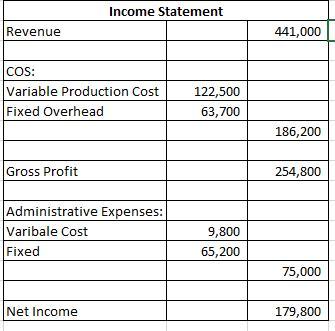
Aces Inc., a manufacturer of tennis rackets, began operations this year. The company produced 6,000 rackets and sold 4,900. Each
BigorU [14]

Answer:

Refer To The attached screen shot. It contains the Income Statement Prepared under Absorption Costing.

Explanation:

Absorption Costing assumes that the Manufacturing Costs include Direct Material, Direct Labor, Variable Overhead, and Fixed Overhead. Whereas, Selling and Administrative Expenses are classified as period Costs. These period costs are recognized in the period in which they are incurred. On the other hand, the manufacturing costs are recognized when the goods on which the costs were incurred are sold. That's why we don't recognize $78,000 as a Fixed Overhead because these overhead costs were incurred to produce 6,000 rackets. We have to calculate the fixed overhead cost per unit and multiply it with the units sold.

I hope I made it clear. If you have any queries, feel free to contact me.

Thanks.

7 0
2 years ago
A grocery store sells an imported specialty cheese for $11 and its own store–brand cheese for $5. write two equivalent expressio
Leni [432]
<span>Since we only bought one cheese, the amount  of money needed to pay for it could be identifiable by the price of one cheese (no need to use variable). The groceries are the opposite since we do not posses any information regarding their prices, so we could replace it with a variable.

The expression could be written as: 

11 + 5 + g and 5 + 11 +g

or

(11 + 5) + g and 11 + (5 + g)</span>
3 0
2 years ago
A firm selling its product for $25,000 has overproduced, increasing inventory by 40,000 units at a cost of $15,000 per unit. Wha
mario62 [17]

Answer:

Increasing Inventory by 40,000 units at a cost of $15,000 per unit

The Cost of producing 40,000 units extra = $40,000 *$15,000 = $600,000,000

Conclusion: As this is an additional cost incurred by the firm by increasing inventory by 40,000 unit at $15,000 per unit, it will be term as cash outflow.  The impact of the inventory change on cash flow is outflow.

8 0
2 years ago
Other questions:
  • The rate of ___________ has been fluctuating wildly this week.
    5·1 answer
  • In the period 2011, Lott Inc. performed services for $120,000 and billed its customers. The company subsequently collected $82,0
    13·1 answer
  • HBR CASE STUDY AND
    5·1 answer
  • As is common payroll procedure for most employers, Penelope's company _____________ her paycheck semimonthly into her checking a
    8·1 answer
  • Agile project management is superior to traditional project management in which of the following situations?
    5·1 answer
  • Green Planet Corp. has (a) 5,000 shares of noncumulative 10% preferred stock with a $2 par value and (b) 17,000 shares of common
    10·1 answer
  • Jacob, the vice president of Money-Makers, is reviewing the development program for the company's middle managers. He notes that
    10·1 answer
  • Consider a Caribbean cruise route served by two cruise​ lines, Carnival and Royal Caribbean. Both lines must choose whether to c
    11·1 answer
  • Karl’s Sporting Goods started as a small shop catering to the fly-fishing crowd but as requests were made for different and vari
    14·1 answer
  • CDF Appliances has assembly plants in Atlanta and Fort Worth where it produces a variety of kitchen appliances, including a 12-c
    15·1 answer
Add answer
Login
Not registered? Fast signup
Signup
Login Signup
Ask question!