answer.
Ask question
Login Signup
Ask question
All categories
  • English
  • Mathematics
  • Social Studies
  • Business
  • History
  • Health
  • Geography
  • Biology
  • Physics
  • Chemistry
  • Computers and Technology
  • Arts
  • World Languages
  • Spanish
  • French
  • German
  • Advanced Placement (AP)
  • SAT
  • Medicine
  • Law
  • Engineering
morpeh [17]
2 years ago
3

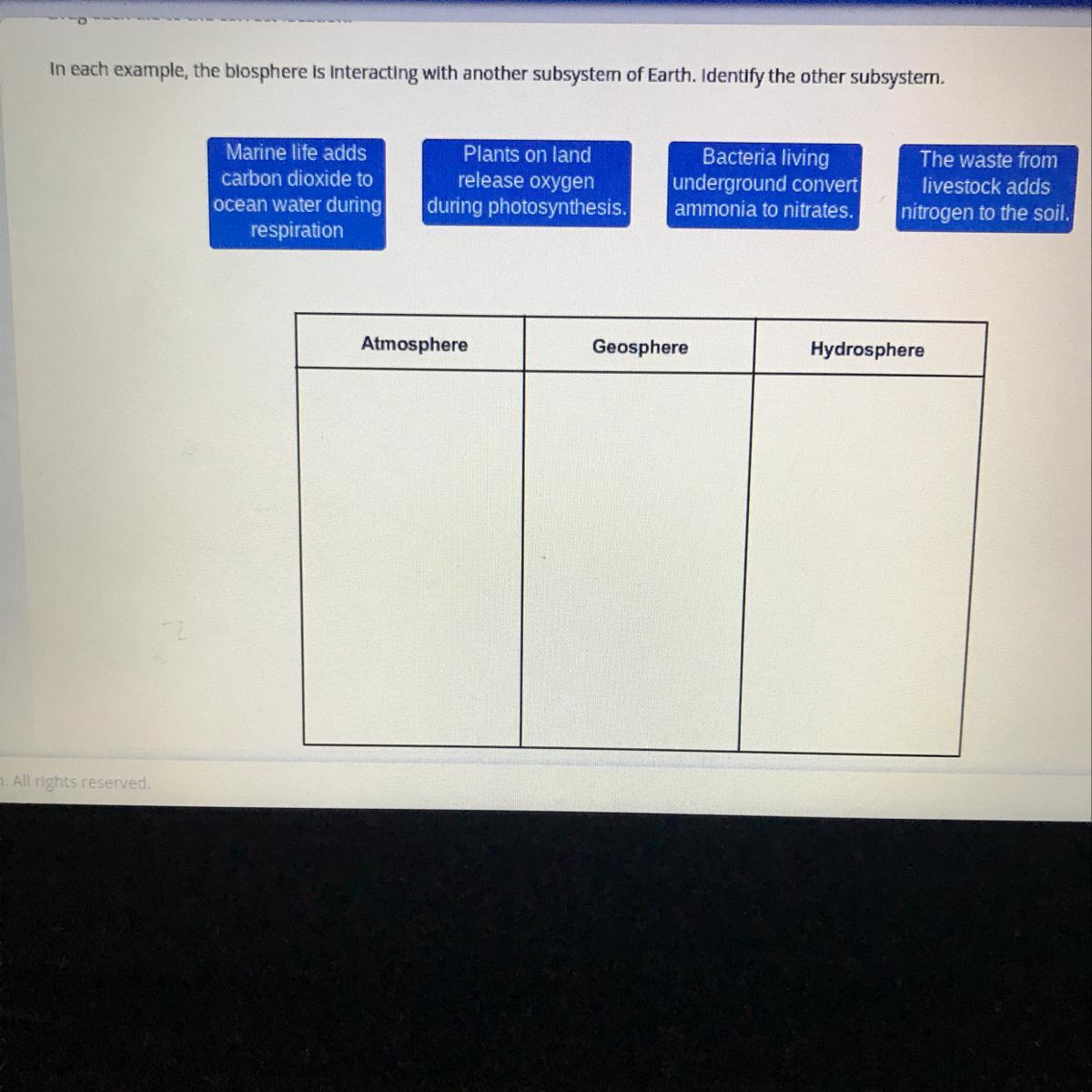
In each example, the blosphere is Interacting with another subsystem of Earth. Identify the other subsystem.

Biology
1 answer:
galben [10]2 years ago
6 0

The answers are:

Atmosphere: Plants on land  release oxygen  during photosynthesis.

Geosphere: Bacteria living  underground convert  ammonia to nitrates.   The waste from  livestock adds  nitrogen to the soil.

Hydrosphere: Marine life adds  carbon dioxide to  ocean water during  respiration

Explanation:

Living beings including animals, plants, and bacteria are part of the biosphere of Earth; additionally, these interact with other systems of Earth such as the atmosphere, geosphere,  or hydrosphere. In the case of the atmosphere, which refers to the gases above the surface of Earth, this has an interaction with living beings due to the exchange of gases between both systems. An example of this is plants because they take carbon dioxide from the atmosphere and release oxygen as part of photosynthesis.

On the other hand, the geosphere comprises soil, rocks, minerals, and in general, all that composes the solid non-living parts of Earth. Additionally, there is an interaction between the geosphere and biosphere can occur due to the exchange of substances as it occurs in the case of bacteria converting ammonia to nitrates or in the case of livestock releasing nitrogen.

Finally, the hydrosphere includes all bodies of water such as rivers, oceans, or lakes. Also, there is an interaction between this and living organisms through the exchange of substances, which includes marine life adding carbon dioxide to oceans.

You might be interested in
Which structure of a paramecium holds a "reserve copy" of all the cell's genes?
nadya68 [22]
<span>The structure of a paramecium that holds a "reserve copy" of all the cell's genes is the micro nucleus.
</span>The micro nucelus is one of the <span>two kinds of </span>nuclei the paramecium has. The other is the<span>  large ellipsoidal </span>nucleus<span> called a macronucleus. Every paramecium must have at least one small </span>nucleus<span> called a </span>micronucleus. The micronucleus is a storage site for the germline genetic material of the organism.
4 0
2 years ago
Read 2 more answers
Which of the following correctly rank the steps in erythrocyte glucose transport by GLUT1? I. Glucose binding results in a confo
3241004551 [841]

Answer:

Following are the correctly rank steps:  

1. The binding of glucose takes place with the transporter on one side of the membrane.  

2. The binding of glucose leads to a conformational change, which opens the site of binding on the contrary side of the membrane.  

3. The dissociation of glucose takes place.  

4. The transporter moves back to the beginning conformation.  

3 0
2 years ago
A sperm cell and an egg cell fuse to form which structure? fetus gamete zygote stem cell
miskamm [114]

A sperm cell and an egg cell fuse to form which structure?

zygote

zygote = a diploid cell resulting from the fusion of two haploid gametes; a fertilized ovum

NOT FETUS

6 0
2 years ago
Read 2 more answers
HELP NOW PLEASE!!!! IM BEGGIN Assuming the bull’s eye is the accepted value, which diagram shows results that are accurate and p
babunello [35]

Answer:

I know im like 2 years late but the answer is d.

Explanation:

It'll always be the one where they are all together and all at or close to the exact target

4 0
2 years ago
Read 2 more answers
The word "cycle" in cell cycle refers to the ________________ of growth, dna duplication, and cell division that occurs in eukar
xeze [42]
The word "cycle" in cell cycle refers to the regular pattern of growth, DNA duplication, and cell division that occurs in eukaryotic cells.
The cell cycle is the term that describes the development and growth of a cell, after its formation and until its reproduction (division into two daughter cells). In eukaryotic cells (cells that include a nucleus) the cell cycle is comprised of two major phases, the interphase and the mitosis. During interphase, the cell grows larger and duplicates its genetic material. During mitosis, the cell divides its genetic material and cytoplasm, creating two daughter cells.
7 0
2 years ago
Other questions:
  • What causes hydrogen bonding between water molecules?
    12·1 answer
  • Organisms that live in the tundra have developed unique adaptations that aid in their survival. Ursus maritimus has a variety of
    14·2 answers
  • The vertebrates in which blood flows directly from respiratory organs to body tissues without first returning to the heart are t
    14·2 answers
  • A client who was recently diagnosed with carcinoma of the pancreas and is having a procedure in which the head of the pancreas i
    5·1 answer
  • The vitamin necessary for fibrinogen and prothrombin formation (found in green vegetables and released by intestinal bacteria) i
    6·1 answer
  • Which feature is an example of behavioral adaptation? A. turtles’ shells B. nocturnal nature in rodents C. cacti’s ability to st
    10·2 answers
  • Which of these is a characteristic of index fossils?
    10·1 answer
  • Question 8. Many groups of animals have defensive spines. Examples include porcupines, sea urchins, and hedgehogs. What informat
    15·1 answer
  • Amylase is an enzyme that converts carbohydrate polymers into monomers. Glycogen synthase is one of the enzymes involved in conv
    9·1 answer
  • Read each of the sentences that describe a phase of meiosis. Place each sentence into the correct box.
    5·1 answer
Add answer
Login
Not registered? Fast signup
Signup
Login Signup
Ask question!