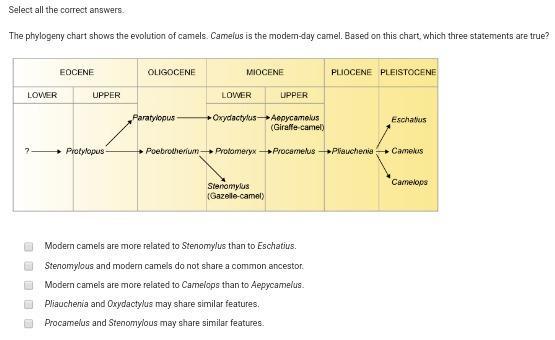
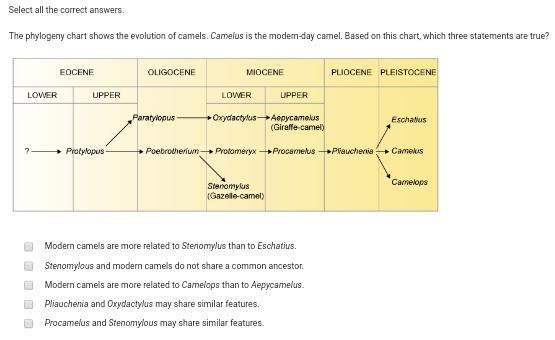
Answer and Explanation: <u><em>Note:</em></u><em> Yoy will find the chart in the attached file. </em>
In phylogenetic trees, two species are more related if they have a recent common ancestor. On the other hand, two species will be less related if their common ancestor is not a recent one and is located far away in the tree.
In the phylogenetic tree, the taxonomic groups of interest are located in the extremes of the lines called branches.
<em>A)</em><em> Modern camels are </em><u><em>more related to Stenomylus</em></u><em> </em><u><em>than to Eschatius</em></u><em>. FALSE. </em>In the graph, you can see modern camel more related to <em>Eschatius, </em>with whom they share a most recent common ancestor (<em>Pliauchenia). Modern camels </em>and <em>Eschatius </em>might share a common ancestor with <em>Stenomylus</em>, but it is located far away in the tree (<em>Poebrotherium</em>).
<em>B) </em><em>Stenomylous and modern camels </em><u><em>do not share</em></u><em> a common ancestor. FALSE. </em>As we have already mentioned, these two species might share a common ancestor, but it was present much earlier in evolution. Here we refer to <em>Poebrotherium,</em> who diverged into <em>Stenomylous and Protomeryx. </em>The last one then evolved and went through many changes, making a place to <em>Camelus,</em> <em>Eschatius, and Camelops. </em>
<em>C) </em><em>Modern camels are more related to Camelops than to Aepycamelus. </em><u><em>TRUE</em></u><em>. </em>You can see in the chart that they both evolved from <em>Pliauchenia, while Aepycamelus </em>evolved from <em>Oxydactylus. Modern camels and Aepycamelus </em>share a common ancestor, but far away in evolution.<em> </em>
<em>D) </em><em>Pliauchenia and Oxydactylus may share similar features. </em><u><em>TRUE. </em></u>These two taxonomic groups share a common ancestor named <em>Protyloptus</em>. This one was the original group in the tree, so the subsequent groups might have suffered many changes before they originated <em>Pliauchenia and Oxydactylus.</em> So these two groups might be very different from each other, but as they have a common ancestor, they might also share similar features
<em>E)</em><em> Procamelus and Stenomylous may share similar features. </em><u><em>TRUE. </em></u><em> </em>In this case, it occurs the same thing as we described above. These two groups share a common ancestor named <em>Poebrotherium</em> that diverged to form <em>Stenomylous and Protomeryx. </em>Then <em>Procamelus</em> evolved from<em> Protomeryx</em>. So this statement is also correct because both mentioned groups might share similar features as they both evolved from <em>Poebrotherium.</em>