answer.
Ask question
Login Signup
Ask question
All categories
  • English
  • Mathematics
  • Social Studies
  • Business
  • History
  • Health
  • Geography
  • Biology
  • Physics
  • Chemistry
  • Computers and Technology
  • Arts
  • World Languages
  • Spanish
  • French
  • German
  • Advanced Placement (AP)
  • SAT
  • Medicine
  • Law
  • Engineering
m_a_m_a [10]
2 years ago
14

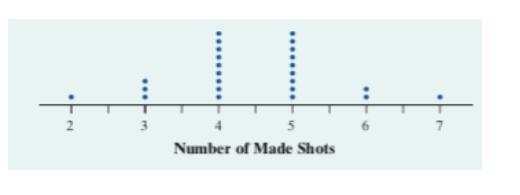
A basketball player claims to make 47% of her shots from the field. We want to simulate the player taking sets of 10 shots, assu

ming that her claim is true. Twenty-five repetitions of the simulation were performed. The simulated number of makes in each set of 10 shots was recorded on the dot plot below.
What is the approximate probability that a 47% shooter makes 5 or more shots in 10 attempts

Mathematics
1 answer:
Molodets [167]2 years ago
8 0

Answer:

0.9 or 90%

Step-by-step explanation:

The probability of shot is 47%

The probability of no shot is 100 -47 = 53%

The dot plot is made from the 10 repeated shots which recorded 25 scores.

The number of dots on the fifth tick is 9 of 10 shots

therefore; 9/10 = 0.9, which 90 in percentage.    

You might be interested in
A student wants to determine if pennies are really fair when flipped, meaning equally likely to land heads up or tails up. He fl
Verdich [7]

Answer:

For this case we want to determine  if pennies are really fair when flipped, meaning equally likely to land head up or tails, so then the correct system of hypothesis are:

Null hypothesis: p=0.5

Alternative hypothesis: p \neq 0.5

Step-by-step explanation:

Previous concepts

A hypothesis is defined as "a speculation or theory based on insufficient evidence that lends itself to further testing and experimentation. With further testing, a hypothesis can usually be proven true or false".  

The null hypothesis is defined as "a hypothesis that says there is no statistical significance between the two variables in the hypothesis. It is the hypothesis that the researcher is trying to disprove".  

The alternative hypothesis is "just the inverse, or opposite, of the null hypothesis. It is the hypothesis that researcher is trying to prove".  

Solution to the problem

For this case we want to determine  if pennies are really fair when flipped, meaning equally likely to land head up or tails, so then the correct system of hypothesis are:

Null hypothesis: p=0.5

Alternative hypothesis: p \neq 0.5

7 0
2 years ago
If e = 9 cm and f = 40 cm, what is the length of g?
rewona [7]

(9,40,41) is a Pythagorean Triple, farther down the list than teachers usually venture.

Answer: D. 41 cm

There's a subset of Pythagorean Triples where the long leg is one less than the hypotenuse,

a^2+b^2 = (b+1)^2

a^2 + b^2 = b^2 + 2b +1

a^2=2b+1

So we get one for every odd number, since the square of an odd number is odd and the square of an even number is even.

b = (a^2 - 1)/2

a=3, b=(3^2-1)/2=4, c=b+1=5

a=5, b=(5^2-1)/2 =12, c = 13

a=7, b=24, c=25

a=9, b=40, c=41

a=11, b=60, c=61

a=13, b=84, c=85

It's good to be able to recognize Pythagorean Triples when we see them.  

Otherwise we'd have to work the calculator:

√(9² + 40²) = √1681 = 41

8 0
2 years ago
water will be both added to and drained from a bathtub at the same time for 5 minutes. the total amount of water added to the ba
Leto [7]
There would be 12 litres in the tub after 4 minutes
6 0
2 years ago
There are two calculus classes at your school. Both classes have a class average of 75.5. The first class has a standard deviati
romanna [79]

Answer:

idk sorry

Step-by-step explanation:

6 0
2 years ago
For a certain type of copper wire, it is knownthat, on the average, 1.5 flaws occur per millimeter.Assuming that the number of f
mario62 [17]

Answer:

The probability that no flaws occur in a certain portion of wire of length 5 millimeters =  1.1156 occur / millimeters

Step-by-step explanation:

<u>Step 1</u>:-

Given data A copper wire, it is known that, on the average, 1.5 flaws occur per millimeter.

by  Poisson random variable given that λ = 1.5 flaws/millimeter

Poisson distribution P(X= r) = \frac{e^{-\alpha } \alpha ^{r} }{r!}

<u>Step 2:</u>-

The probability that no flaws occur in a certain portion of wire

P(X= 0) = \frac{e^{-1.5 } \(1.5) ^{0} }{0!}

On simplification we get

P(x=0) = 0.223 flaws occur / millimeters

<u>Conclusion</u>:-

The probability that no flaws occur in a certain portion of wire of length 5 millimeters = 5 X P(X=0) = 5X 0.223 = 1.1156 occur / millimeters
5 0
2 years ago
Other questions:
  • The Revenue for the week is $2000, and labor cost consists of two workers earning $8 per hour who work 40 hours each, what is la
    15·1 answer
  • Bob and carol want to hire able refinishing to sand and refinish the dining room floor to match the floor in the living room. ab
    5·1 answer
  • Yvette is booking a 2-night stay at a hotel. The rate is $89 per room plus tax. If state tax is 6%, city tax is 2%, and municipa
    14·2 answers
  • Half of Ethan's string is equal to 2/3 of Kayla's string. The total length of their strings is 10 feet. How much longer is Ethan
    7·2 answers
  • What is the probability that a daughter of this mating will be a hemophiliac? Express your answer as a fraction using the slash
    6·1 answer
  • You find a certain stock that had returns of 8 percent, −3 percent, 12 percent, and 17 percent for four of the last five years.
    7·2 answers
  • Ainsley works for the owners of a bookstore. Her starting salary was 24,500, and she gets a 3% raise each year. Write an equatio
    6·1 answer
  • GHLJ and GSTU are both parallelograms. Why is<br> ∠L ≅ ∠T?2
    13·2 answers
  • A business school professor uses multiple choice tests. Each question on his exams has five possible answers which are assumed t
    13·1 answer
  • Claili has 35 flowers and 7 vases she wants to put the same number of flowers in each vase which question can calli use ro find
    14·1 answer
Add answer
Login
Not registered? Fast signup
Signup
Login Signup
Ask question!
