answer.
Ask question
Login Signup
Ask question
All categories
  • English
  • Mathematics
  • Social Studies
  • Business
  • History
  • Health
  • Geography
  • Biology
  • Physics
  • Chemistry
  • Computers and Technology
  • Arts
  • World Languages
  • Spanish
  • French
  • German
  • Advanced Placement (AP)
  • SAT
  • Medicine
  • Law
  • Engineering
Sunny_sXe [5.5K]
1 year ago
3

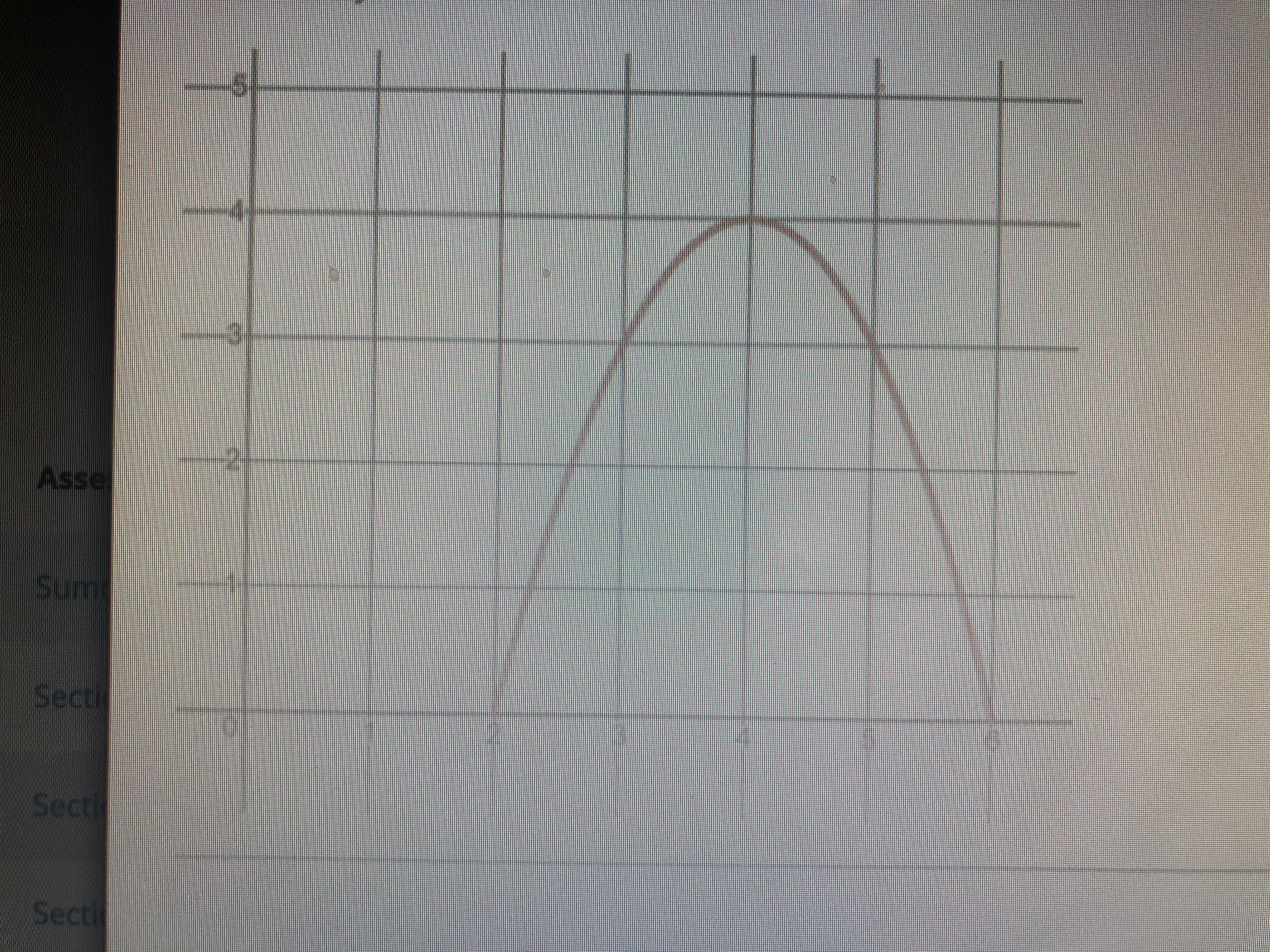
The graph models the path of a soccer ball, showing the vertical distance, in yards, as a function of the horizontal distance, i

n yards.

Mathematics
2 answers:
o-na [289]1 year ago
8 0
Let f(x)=-3x^3 + 21x^2 + 4x+4. what is the valu of f(-4)? can anyone answer this please
Aneli [31]1 year ago
3 0

2 is less than or equal to x is less than or equal to 4

You might be interested in
Complete the following multiplication exercises.
olga2289 [7]
43x7=301
12x9=108
10x6=60
9x7=63
7x5=35
6x3=18
0x8=8
30x3=90
11x8=88
73x2=219
83x5=415
16x8=128
392x7=2,744
29x4=116
761x9=6,849
4,829x6=28,974
12x7=84
25,500x4=102,000
4 0
2 years ago
Read 2 more answers
843219 to the power of 100 is multiplied out,what is its units digit?
kondaur [170]

Answer:

1

Step-by-step explanation:

We will consider only the last digit multiplication and the pattern.

When we multiply 843,219 with 843,219, we have

9 * 9 = 81 [1 is important]

1 * 9 = 9

9 * 9 = 81 [1 is important]

So when we multiply them out with each other, we have a pattern of

9, 1, 9, 1 ... goes on

So if we multiply 100 times, what will be the last digit of the series 9, 1, 9, 1 .... it will be 1

hence, last digit is 1

5 0
2 years ago
Read 2 more answers
Andrea rolls a number cube twice. She determines P(even, then odd) = . Which statements are accurate? Check all that apply. Andr
ValentinkaMS [17]
The answers for edunuity are 1,3,5,6 you're welcome.
3 0
2 years ago
Read 2 more answers
A men's softball league is experimenting with a yellow baseball that is easier to see during night games. One way to judge the e
sergiy2304 [10]

Answer:

There cannot be equal errors in both and yellow has fewer errors.

Step-by-step explanation:

we can do paired t test for these two colours

H_0: \bar = \bar y\\H_a: \bar <  \bar y\\

(one tailed test)

df = 9

The data can be tabulated as follows:

Yellow white


5 7

2 6

6 8

7 5

2 9

5 11

3 8

8 3

4 6

9 10

t-Test: Paired Two Sample for Means  


Yellow white

Mean 5.1 7.3

Variance 5.877777778 5.788888889

Observations 10 10

Pearson Correlation -0.139051655  

Hypothesized Mean Difference 0  

df 9  

t Stat -1.908439275  

P(T<=t) one-tail 0.044341411  

t Critical one-tail 1.833112923  

P(T<=t) two-tail 0.088682822  

t Critical two-tail 2.262157158  

Since p value one tailed = 0.0443 and it is <0.05 our significance level, we reject null hypothesis.

There cannot be equal errors in both and yellow has fewer errors.

5 0
2 years ago
Alice and Bob each choose at random a number between zero and two. We assume a uniform probability law under which the probabili
Mnenie [13.5K]

Answer / Step-by-step explanation:

Before we start to answer this question, it would be nice to understand some basic definition and principles:

Random: This refers to an unpredictable pattern of arrangement.  Without a specific aim or logical procedural pattern.

Uniform Probability distribution: This is a type of probability distribution in which the outcomes of distribution irrespective of the pattern or distance results in equally likely outcomes.

Uniform distribution is one of the widely used distributions although it's one of the simplest ones. The idea behind this distribution is that, unlike the other distributions, the likelihood of the any outcome in the distribution range is the same.

Now that we have a brief knowledge of the key terms within the question, hence, to start answering the question,

(a) Starting with 0 for Alice, Bob can choose any number starting from   1 /  3 . As Alice increases, Bob has to increase his starting point as well. Therefore, after Alice passes  1 /  3 , Bob can start choosing numbers from 0. This creates 2 triangles with sides  1  / 3 . The area of them gives us the probability.

Therefore, : P = 2 ( 1/3 1/3 1/3)

                        = 4/9

(b) We can find the probability of having both the numbers less than  1  / 3 . Then we subtract this probability from 1.

We have: P = 1 - 1/3 . 1/3

                     = 8/9

(c) This is basically impossible as the area of a dot is negligible.

(d) It means that Alice needs to select a number between  1  / 3  and 1.

Therefore: P = 1 - 1 /3

                    = 2 / 3

8 0
2 years ago
Other questions:
  • Solve the equation y′ + 3y = t + e^(−2t).
    14·1 answer
  • Laura's gross annual salary is $44184. What is the maximum amount of rent she can afford to pay?
    8·1 answer
  • $53,000 is placed in an investment account that grows at a fixed rate of 2% (compound growth) per year. how much is in the accou
    8·1 answer
  • 18.Find the value of x rounded to the nearest tenth.
    13·2 answers
  • A student is training for the swim team during July and August one summer. She swims one hour every day, while averaging 800 met
    9·2 answers
  • Kyle is renting a jetski for the day. If he can rent the jetski in 1-hour increments, what is the minimum number of hours must h
    12·1 answer
  • The number of pounds of dog food that a pet store has is represented by the equation y = negative 15 x + 430, where x represents
    13·2 answers
  • A local library claims it has 2.73x10³ books. If there are 42 people in the building, how many books per capita are there?
    12·1 answer
  • Please solve the following :<br> 2.25x + 15 = 9.5x + 0.5
    6·2 answers
  • The area of a sign in the shape of a square is 219 square inches. Which measurement is closest to the side length of
    5·2 answers
Add answer
Login
Not registered? Fast signup
Signup
Login Signup
Ask question!