answer.
Ask question
Login Signup
Ask question
All categories
  • English
  • Mathematics
  • Social Studies
  • Business
  • History
  • Health
  • Geography
  • Biology
  • Physics
  • Chemistry
  • Computers and Technology
  • Arts
  • World Languages
  • Spanish
  • French
  • German
  • Advanced Placement (AP)
  • SAT
  • Medicine
  • Law
  • Engineering
Varvara68 [4.7K]
2 years ago
14

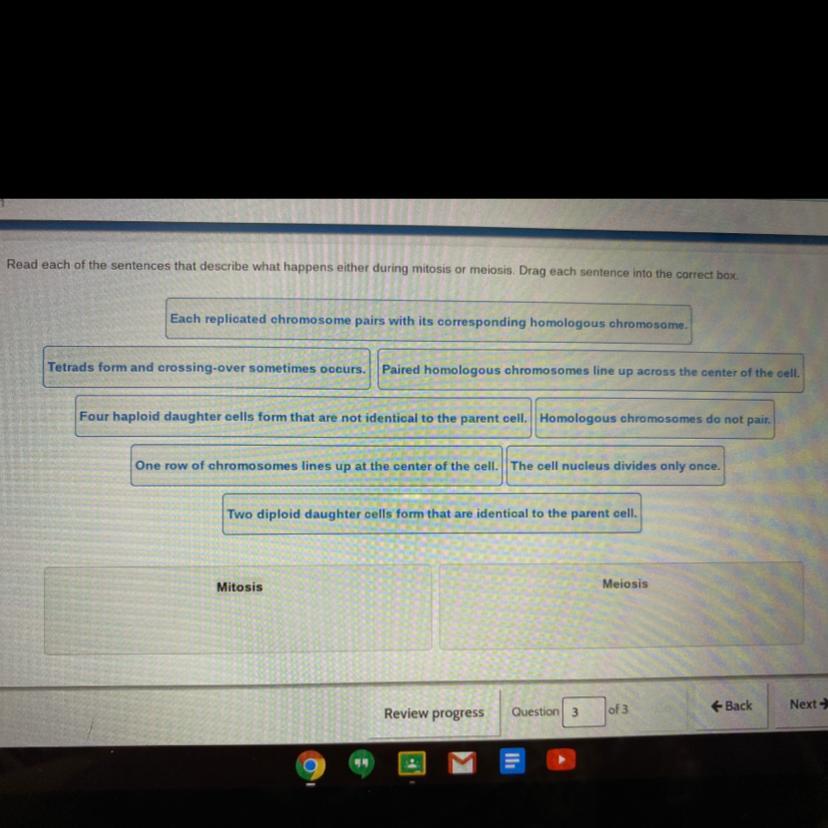
Read each of the sentences that describe what happens either during mitosis or meiosis. Drag each sentence into the correct box.

Biology
1 answer:
kiruha [24]2 years ago
4 0

Answer:

MEIOSIS:

- Each replicated chromosome pairs with its corresponding homologous chromosome

- Tetrads form and crossing over sometimes occur

- Paired homologous chromosome line up across the center of the cell.

- Four haploid daughter cells form that are not identical to the parent cell

MITOSIS:

- Homologous chromosomes do not pair

- One row of chromosomes line up at the center of the cell.

- The cell nucleus divides only once

- Two diploid daughter cells form that are identical to the parent cell.

Explanation:

Mitosis and Meiosis are the two cellular divisions that occur in living organisms. Mitosis is the kind of cell division that produces two diploid daughter cells that are genetically identical to the parent cell while Meiosis produces four haploid daughter cells (gametes) that are genetically different from the parent cell.

Based on the general description of the two cell divisions above, the following events take place in them respectively:

1) MEIOSIS:

- Each replicated chromosome pairs with its corresponding homologous chromosome (similar but non-identical chromosome from each parent).

- Tetrads form and crossing over sometimes occur. Tetrads are the structures that form when two homologous chromosomes pair while crossing over is the exchange of chromosome segment between two non-sister chromatids of homologous chromosomes. These two only occur during meiosis.

- Paired homologous chromosome line up across the center of the cell during metaphase I of meiosis.

- Four haploid daughter cells form that are not identical to the parent cell. Note that meiosis reduces the chromosomal number of the parent cell by half.

2) MITOSIS:

- Homologous chromosomes do not pair during mitosis.

- One row of replicated chromosomes (sister chromatids) line up at the center of the cell during metaphase.

- The cell nucleus divides only once in mitosis as opposed to twice during meiosis.

- Two diploid daughter cells form that are identical to the parent cell. Note that mitosis retains the chromosomal number of the parent cell.
You might be interested in
The role of enzymes in biological systems is to catalyze chemical reactions. In 1894, chemist Emil Fischer proposed the lock and
ycow [4]
Provided that there's no diagram, most molecules have particular areas on the molecules, called the "active area" that act as a lock to a particular substrate's molecular structure, providing the key. 
An enzyme's active area is only able to be "unlocked" by a certain substrate's "key". 
6 0
2 years ago
Read 2 more answers
In the male reproductive system, the pituitary hormone _____ stimulates Leydig cells to secrete testosterone, and the pituitary
Katena32 [7]

Answer:

<u>Luteinizing hormone </u>(LH) stimulates Leydig cells to secrete testosterone

<u>Follicle stimulating hormone (FSH)</u> stimulates Sertoli cells to secrete protein and other molecules required for spermatogenesis

Explanation:

Under the influence of gonadotropin-releasing hormone, the anterior pituitary releases luteinizing hormone (LH) and follicle-stimulating hormone (FSH). In males, LH stimulates interstitial cells of testes (Leydig cell) to secrete the hormone testosterone. FSH acts indirectly to stimulate spermatogenesis by causing the release of androgen-binding protein (ABP) from the Sertoli cells. The function of ABP is to maintain the higher concentrations of testosterone to stimulate the final steps of spermatogenesis in the seminiferous tubules.

6 0
2 years ago
As a mechanism of evolution, natural selection can be most closely equated with __________.
olga_2 [115]
As a mechanism of evolution, natural selection can be most closely equated with UNEQUAL REPRODUCTIVE SUCCESS.

Mechanism of evolution refers to micro-evolution that involves mutation, gene flow and natural selection. Unequal reproductive success is also related to other processes of micro evolution such as natural selection. The organisms that can reproduce unequally and survive even in adverse condition, increase in numbers. 
<span />
3 0
2 years ago
In the product 6O2, what does the coefficient mean? There are 12 molecules of O2, There are 8 molecules of O2, There are 6 molec
mars1129 [50]
There are 6 molecules of O2.


"O2" is the formula for one molecule oxygen, which has 2 atoms.

The subscript (small) "2" tells you how many atoms are in the molecule.

The coefficient is the big number tells you the number of molecules.

In 6O2, there are 12 atoms in total (6 molecules of 2 atoms each).
7 0
2 years ago
Read 2 more answers
What does the surface of a calm lake have in common with a contour line?
zlopas [31]

Answer;

-They are all at the same elevation

Explanation;

-Contour line on a topographical map that detail changes in elevation. This line connects points of equal elevation. Contour lines are used in Topography to show the elevation of the land on a map. When looking at a map the contour lines look very similar to how a calm lake would appear.

5 0
2 years ago
Read 2 more answers
Other questions:
  • Describe 2 flowers that differ greatly
    7·2 answers
  • Which type of plate boundary experiences shallow earthquakes at places where rocks are undergoing shear stress?
    13·2 answers
  • Which is a waxy, water-repelling outer covering of a plant?
    6·2 answers
  • List two sources within a medical record where the information about present or recent illnesses is most likely to be found.
    8·1 answer
  • A landscaper wants to plant shrubs that require a soil ph of 7.0 near some evergreen trees. which ph would indicate that the soi
    7·1 answer
  • Compare and contrast polysaccharides and nucleic acids in terms of monomer diversity and how the monomers are joined together. D
    13·2 answers
  • How could an error during transcription affect the protein that is produced
    7·2 answers
  • In a species of salamander, the allele for the spotted trait is recessive to the allele for the solid trait. Suppose that a coas
    12·1 answer
  • If a person consumed large quantities of deep yellow/orange or dark green foods that are dietary sources of carotenoids, the foo
    10·1 answer
  • Ten grams of hamburger were added to 90 ml of sterile buffer.
    5·1 answer
Add answer
Login
Not registered? Fast signup
Signup
Login Signup
Ask question!
