answer.
Ask question
Login Signup
Ask question
All categories
  • English
  • Mathematics
  • Social Studies
  • Business
  • History
  • Health
  • Geography
  • Biology
  • Physics
  • Chemistry
  • Computers and Technology
  • Arts
  • World Languages
  • Spanish
  • French
  • German
  • Advanced Placement (AP)
  • SAT
  • Medicine
  • Law
  • Engineering
AnnyKZ [126]
2 years ago
7

This question involves a simulation of a two-player game. In the game, two simulated players each start out with an equal number

of coins. In each round, each player chooses to spend either 1, 2, or 3 coins. Coins are then awarded to each player according to the following rules.
Same rule: If both players spend the same number of coins, player 2 gains 1 coin.
Off-by-one rule: If the players do not spend the same number of coins and the positive difference between the number of coins spent by the two players is 1, player 2 is awarded 1 coin.
Off-by-two rule: If the players do not spend the same number of coins and the positive difference between the number of coins spent by the two players is 2, player 1 is awarded 2 coins.

The game ends when the specified number of rounds have been played or when a player’s coin count is less than 3 at the end of a round.

The CoinGame class is shown below. You will write two methods in the CoinGame class.

public class CoinGame

{

private int startingCoins; // starting number of coins

private int maxRounds; // maximum number of rounds played


public CoinGame(int s, int r)

{

startingCoins = s;

maxRounds = r;

}


/** Returns the number of coins (1, 2, or 3) that player 1 will spend.

*/

public int getPlayer1Move()

{

/* implementation not shown. */

}


/** Returns the number of coins (1, 2, or 3) that player 2 will spend, as described in part (a).

*/

public int getPlayer2Move(int round)

{

/* to be implemented in part (a) */

}


/** Plays a simulated game between two players, as described in part (b).

*/

public void playGame()
{

/* to be implemented in part (b) */

}

}

In the simulation, player 2 will always play according to the same strategy. The number of coins player 2 spends is based on what round it is, as described below.

(a) You will write method getPlayer2Move, which returns the number of coins that player 2 will spend in a given round of the game. In the first round of the game, the parameter round has the value 1, in the second round of the game, it has the value 2, and so on. The method returns 1, 2, or 3 based on the following rules.

If round is divisible by 3, then return 3.
If round is not divisible by 3 but is divisible by 2, then return 2.
If round is not divisible by 3 and is not divisible by 2, then return 1.
Complete method getPlayer2Move below by assigning the correct value to result to be returned.

/** Returns the number of coins (1, 2, or 3) that player 2 will spend, as described in part (a).

*/

public int getPlayer2Move(int round)

{

int result;

return result;

}

Write the method playGame, which simulates a game between player 1 and player 2, based on the rules and example shown at the beginning of the question. Both player 1 and player 2 start the game with startingCoins coins. Computer player 1 spends 1, 2, or 3 coins based on the value returned by the method getPlayer1Move(). Computer player 2 spends 1, 2, or 3 coins based on the value returned by the method getPlayer2Move().

The game ends when maxRounds rounds have been played or when a player’s coin count is less than 3 at the end of a round.

At the end of the game, the winner is determined according to the following rules.

If both players have the same number of coins at the end of the game, the method prints "tie game".
If player 1 has more coins than player 2, the method prints "player 1 wins".
If player 2 has more coins than player 1, the method prints "player 2 wins".
(b) Assume that getPlayer2Move works as specified, regardless of what you wrote in part (a) . You must use getPlayer1Move and getPlayer2Move appropriately to receive full credit.

Complete method playGame below.

/** Plays a simulated game between two players, as described in part (b).

*/

public void playGame()
Computers and Technology
1 answer:
Vlada [557]2 years ago
7 0

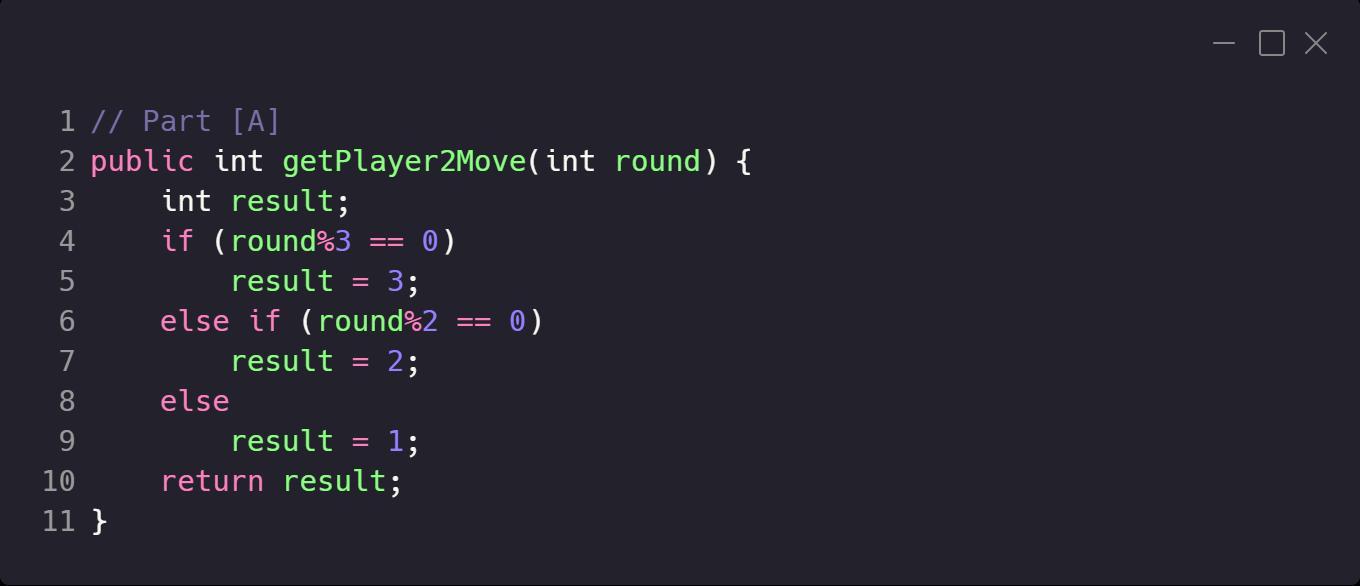
[A] Let's simplify the <em>getPlayer2Move </em>rules first.

  • If round is divisible by 3, then return 3

if a number is divisible by another number that means the remainder of the division is 0. We can write the code as follows:

if (round%3 == 0)

result = 3;

  • If round is not divisible by 3 but is divisible by 2, then return 2.

Same as the previous one, we are going to use the remainder operation. We can use an else-if condition here.

else if (round%2 == 0)

result = 2;

  • If round is not divisible by 3 and is not divisible by 2, then return 1.

An else would work fine here.

else

result = 1;

<em>The full code of part A is attached below.</em>

[B]

<em>playGame </em>method:

Let's have a quick look at the game rules first:

  • If both players spend the same number of coins, player 2 gains 1 coin.

This can be translated to <em>if player1Spending == player2Spending</em>, then player2 gets a coin.

  • If the players do not spend the same number of coins and the positive difference between the number of coins spent by the two players is 1, player 2 is awarded 1 coin.

If the absolute value of <em>(player1Spending - player2Spending == 1) </em>then player2 gets awarded.

  • If the players do not spend the same number of coins and the positive difference between the number of coins spent by the two players is 2, player 1 is awarded 2 coins.

We can either use an else statement or a separate conditional statement here, but I'll go for the else statement.

We can use a while loop to detect when the game ends, either a player's coins is less than 3 OR when the maxRounds have been played.

You might be interested in
Marco makes $65,000 a year as a graphic designer. He makes a charitable donation of $1,000 each year. He also has $5,000 of busi
iogann1982 [59]
The correct answer is $59,000. 
5 0
2 years ago
Read 2 more answers
+10 points~~~Which option is used in emails to inform the recipient that they should exercise discretion in accordance with shar
Alexxx [7]

Answer:

Sensitivity Levels

Explanation:

Sensitivity Level is option use in email to inform the recipient that they should exercise discretion in accordance with sharing the content of the message.

8 0
2 years ago
Your computer has gradually slowed down. What's the most likely reason?
sweet-ann [11.9K]
It could be old ... could be your connection to the internet... could be a virus. You can go to walmart or your super store and buy a usb for your computer. There are ones that can speed up your computer. I had to buy it for mine and it worked. It might be over 20 dollars depends on where you go.
8 0
2 years ago
HELP ASAP U GET BRAINLIEST
Korolek [52]
B) <span>tool bar

i hope helped ^-^</span>
7 0
2 years ago
Read 2 more answers
If the object instance is created in a user program, then the object instance can access both the public and private members of
rewona [7]

Answer:

False

Explanation:

The private member of a class is not accessible by using the Dot notation ,however the private member are those which are not accessible inside the class they are accessible outside the class  .The public member are accessible inside the class so they are accessible by using the dot operator .

<u>Following are the example is given below in C++ Language </u>

#include<iostream>   // header file

using namespace std;  

class Rectangle

{    

   private:  

       double r; // private member  

   public:      

       double  area()  

       {     return 3.14*r*r;  

       }        

};  

int main()  

{    

  Rectangle r1;// creating the object  

   r1.r = 3.5;  

 double t= r1.area(); // calling

cout<<" Area is:"<<t;  

   return 0;  

}  

Output:

compile time error is generated

<u>The correct program to access the private member of class is given below </u>

#include<iostream>   // header file

using namespace std;  

class Rectangle

{    

   private:  

       double r; // private member  

   public:      

       double  area()  

       {    

r1=r;

double t2=3.14*r2*r2;

return(t2); // return the value  

       }        

};  

int main()  

{    

  Rectangle r1;// creating the object  

   r1.r = 1.5;  

 double t= r1.area(); // calling

cout<<" Area is:"<<t;  

   return 0;  

}  

Therefore the given statement is False

5 0
2 years ago
Other questions:
  • The piston engine uses the ________ to convert the reciprocating motion of the piston into rotary motion.
    13·1 answer
  • Suppose you develop an app and want to generate revenue but do not want to maintain the app. What would be your best choice?
    9·1 answer
  • Which of the following would be a considered a want rather than a need for most people?
    15·1 answer
  • A ____ partition contains the data necessary to restore a hard drive back to its state at the time the computer was purchased an
    8·2 answers
  • Jason is working on a web page that includes Q&amp;A interactions. Which option should Jason select to engage users in the inter
    9·2 answers
  • Manny is a personal trainer. He gives his client an endurance test each week. He would like to illustrate how much the client ha
    7·2 answers
  • Consider a single-platter disk with the following parameters: rotation speed: 7200 rpm; number of tracks on one side ofplatter:
    10·1 answer
  • Pick a 3D game you enjoy or know about. Pick a scene from that game that has at least one character in it and describe the scene
    9·1 answer
  • Suggest how the following requirements might be rewritten in a quantitative way. You may use any metrics you like to express the
    7·1 answer
  • Write code which takes two inputs from the user, a number of sides followed by a side length, then creates a regular polygon wit
    10·2 answers
Add answer
Login
Not registered? Fast signup
Signup
Login Signup
Ask question!
