answer.
Ask question
Login Signup
Ask question
All categories
  • English
  • Mathematics
  • Social Studies
  • Business
  • History
  • Health
  • Geography
  • Biology
  • Physics
  • Chemistry
  • Computers and Technology
  • Arts
  • World Languages
  • Spanish
  • French
  • German
  • Advanced Placement (AP)
  • SAT
  • Medicine
  • Law
  • Engineering
Delvig [45]
2 years ago
8

Cylinders A and B are similar solids. The base of cylinder A has a circumference of 4π units. The base of cylinder B has an area

of 9π units.
The dimensions of cylinder A are multiplied by what factor to produce the corresponding dimensions of cylinder B?
Mathematics
2 answers:
victus00 [196]2 years ago
7 0

Answer:

The factor is \frac{3}{2}.

Step-by-step explanation:

Given : Cylinders A and B are similar solids.

The base of cylinder A has a circumference of  4\pi units.

The base of cylinder B has an area of  9\pi units.

To find :  The dimensions of cylinder A are multiplied by what factor to produce the corresponding dimensions of cylinder B?

Solution :

Let x be the factor.

So, according to question,

\text{Dimension of cylinder A}\times x = \text{Dimension of cylinder B}   ........[1]

The dimension refer here are radius of both cylinders.

In cylinder A,

Circumference of base is 4\pi units.

Circumference of base of cylinder is C=2\pi r

4\pi=2\pi r

r=2

The dimension of cylinder A is r=2

In cylinder B,

Area of cylinder is 9\pi units.

Area of base of cylinder is A=\pi r^2

9 \pi=\pi r^2

r^2=9

r=3

The dimension of cylinder B is r=3

Substitute in [1]

2x=3

x=\frac{3}{2}

Therefore, The factor is \frac{3}{2}.

Ronch [10]2 years ago
5 0
The base of cylinder b has an are of 9 unites
You might be interested in
The figure shows the layout of a symmetrical pool in a water park. What is the area of this pool rounded to the tens place? Use
k0ka [10]

Answer:

2489ft^{2}

Step-by-step explanation:

The pool are is divided into 4 separated shapes: 2 circular sections and 2 isosceles triangles. Basically, to calculate the whole area, we need to find the area of each section. Due to its symmetry, both triangles are equal, and both circular sections are also the same, so it would be enough to calculate 1 circular section and 1 triangle, then multiply it by 2.

<h3>Area of each triangle:</h3>

From the figure, we know that <em>b = 20ft </em>and <em>h = 25ft. </em>So, the area would be:

A_{t}=\frac{b.h}{2}=\frac{(20ft)(25ft)}{2}=250ft^{2}

<h3>Area of each circular section:</h3>

From the figure, we know that \alpha =2.21 radians and the radius is R=30ft. So, the are would be calculated with this formula:

A_{cs}=\frac{\pi R^{2}\alpha}{360\°}

Replacing all values:

A_{cs}=\frac{(3.14)(30ft)^{2}(2.21radians)}{6.28radians}

Remember that 360\°=6.28radians

Therefore, A_{cs}=994.5ft^{2}

Now, the total are of the figure is:

A_{total}=2A_{t}+2A{cs}=2(250ft^{2} )+2(994.5ft^{2})\\A_{total}=500ft^{2} + 1989ft^{2}=2489ft^{2}

Therefore the area of the symmetrical pool is 2489ft^{2}

3 0
2 years ago
List at least three (3) characteristics of carbon that make it a unique element.
lutik1710 [3]
1.) Carbon Compounds are the backbone of all organic compounds that are the basic building blocks of all living things.

2.) The diamond allotropic form of carbon is the hardest substance known. 

3.) Carbon has the ability to form covalent bonds with other carbon atoms forming continuous chains, branches, and loops 
7 0
2 years ago
Read 2 more answers
Ariana starts with 100 milligrams of a radioactive substance. The amount of the substance decreases by 20% each week for a numbe
Kruka [31]

Answer:

  D.  It is the product of the initial amount and the decay factor after w weeks.

Step-by-step explanation:

We are told that Ariana starts with 100 milligrams of the substance. The number 100 in the expression likely represents this amount, <em>the initial amount</em>. It is multiplied by another number, so is part of a product. (It is not part of a difference, and is not something that is raised to a power.)

The factor (1 -0.2) represents the fraction remaining at the end of a week. That number raised to the power w will represent the fraction remaining at the end of w weeks. This fraction can reasonably be referred to as "the decay factor after w weeks."

Hence, the expression represents ...

  <em>the product of the initial amount and the decay factor after w weeks</em>

6 0
2 years ago
A baker decorates 424242 cupcakes in 303030 minutes. She decorates cupcakes at a constant rate. How many cupcakes can the baker
Lelu [443]
Hey. Let me help you on this one.

In this problem, we have a constant rate of baker decorating cupcakes, and it gives us both values - cupcakes, and minutes.

In order for us to solve this question, we will need to simplify this ratio in order to make denominator, which is going to be 303030 minutes, equal to one. This can be done by property of division.

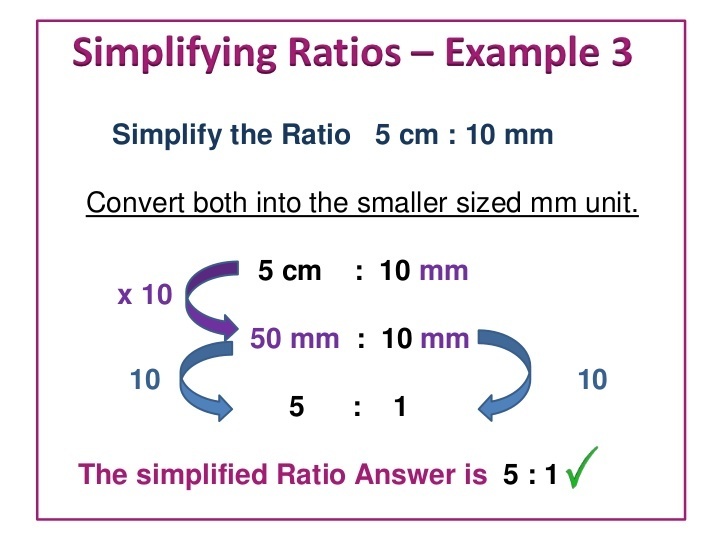
I will also be attaching an image that might help you with your studies. I recommend looking over it if you have trouble simplifying ratios. 

Alright, let's set up a ratio for this problem. It should be cupcakes over minutes, since this is the rate of change and our main focus here is the time. We are also doing this because amount of minutes is less than the amount of cupcakes, meaning that simplification will be much easier and actually make more sense.

\frac{424242}{303030}

So, now that we have this ratio, all we have to do is simplify it. We need to have 3030303 simplified into one; however, all we do with denominator has to be done with the numerator - the number above. 

In order for us to transform 303030 into one, we will need to divide it by 303030. This division will simplify the denominator, but we must not forget about numerator as well.

424242/303030=42/30=1.4

Awesome. Now, we have the fixed ratio of 1.4 over 1, or simply 1.4 cupcakes per minute.

Answer: Baker will decorate 1.4 cupcakes per minute if the constant rate is kept.

6 0
2 years ago
Read 2 more answers
4 glue sticks cost $7.76<br><br> Which equation would help determine the cost of 13 glue sticks?
Elza [17]

Answer:

y=1.94x

13 glue sticks cost $25.22.

Step-by-step explanation:

4 blue sticks cost $7.76, this means that one glue stick costs

$7.76/4 = $1.94.

Let y be the cost of the glue sticks, and x be the number of glue sticks; then

\boxed{y=1.94x}

We can use this equation to find the cost of 13 glue sticks; we just put x=13\ into our equation and it gives:

y=1.94(13)=25.22

So 13 glue sticks cost $25.22.

4 0
2 years ago
Read 2 more answers
Other questions:
  • Tina and Nonly wanted to s whose car gets better gas mileage, so they each drove 210 miles and recorded how much gas they used.
    6·2 answers
  • What is the equation for the linear model in the scatter plot obtained by choosing the two points to the closest line?
    5·1 answer
  • What conclusions can be made about the series ∞ 6 cos(πn) n n = 1 and the integral test?
    14·1 answer
  • If y varies inversely with x and y=2 when x=8 what is K the constant of proportionality
    13·1 answer
  • Jovie is maintaining a camp fire. She has kept the fire steadily burning for 101010 hours with 151515 logs. She wants to know ho
    6·1 answer
  • The New Mexico Division of Fish and Wildlife keeps track of the silvery minnow population in the Rio Grande River. They tagged 5
    10·1 answer
  • Carolyn
    12·2 answers
  • Sheree Smith purchased a digital camera for $367.99. She received a manufacturer's $45 mail-in rebate and a
    14·1 answer
  • The weight of a USB flash drive is 30 grams and is normally distributed. Periodically, quality control inspectors at Dallas Flas
    9·1 answer
  • 1. A certain truck traveling at 55 miles per hour gets 4.5 miles per gallon of diesel fuel consumed. Traveling at 60 miles per h
    14·1 answer
Add answer
Login
Not registered? Fast signup
Signup
Login Signup
Ask question!