answer.
Ask question
Login Signup
Ask question
All categories
  • English
  • Mathematics
  • Social Studies
  • Business
  • History
  • Health
  • Geography
  • Biology
  • Physics
  • Chemistry
  • Computers and Technology
  • Arts
  • World Languages
  • Spanish
  • French
  • German
  • Advanced Placement (AP)
  • SAT
  • Medicine
  • Law
  • Engineering
Salsk061 [2.6K]
2 years ago
11

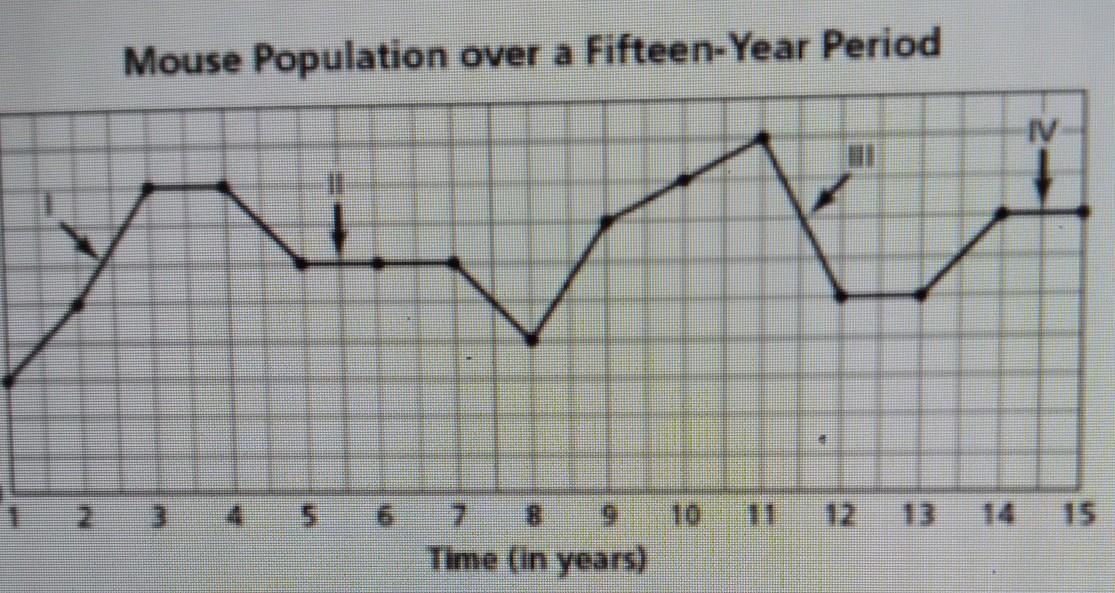
The graph below shows the population of mice living in a certain area over fifteen years Which numeral on the graph points to a

time when the birth rate exceeded the death rate of the mice?
I

II

III

IV​​

Biology
2 answers:
vlada-n [284]2 years ago
5 0

Answer:

l

Explanation:

because it has a positive slope meaning the overall growth is positive

irga5000 [103]2 years ago
5 0

Answer:

I

Explanation:

In section I, the graph has a positive slope.

Birth rate - death rate = positive, the birth rate is more than the death rate

Sections II and IV have a balanced population where the birth and death rate are the same

In section III the death rate exceeds the birth rate

You might be interested in
Can you be framed by your own DNA? How might an individual’s own cells lead to false verdicts of guilt. In your explanation, pro
Rudiy27

Answer:Framed By Your Own Cells: How DNA Evidence Imprisons The Innocent ... But due to the touch-transfer properties of DNA, determining how those cells ... If we were to swab the man's hand for DNA, we might find the man's DNA, his ... Touch-transfer DNA "could falsely link someone to a crime" and forensic ...

Explanation:

6 0
2 years ago
1. Unlike catastrophism, _______ states that mountains formed slowly over time. 2. William Smith was working as a surveyor in th
Viefleur [7K]

Answer:

uniformitarianism, Fossil groups, 48 million years ago.

Explanation:

  • Uniformitarianism is the doctrine of uniformity that assumes that same environmental laws and process operate till date that has also occurred on the past but not with the same uniformity. Unlike the atmospheric that is short-lived and sudden changes over the period of time.
  • William Smith was a geologist who has noticed a certain type of fossil in a certain layer of sedimentary and igneous rock. A similar layer of strata could be found in the areas that were further apart.
  • The Permian period was from 229 to 251 million years and was the last period of the paleozoic era and is recorded for the last major extinction in the history of life in earth and it lasted for 48 million years.
7 0
2 years ago
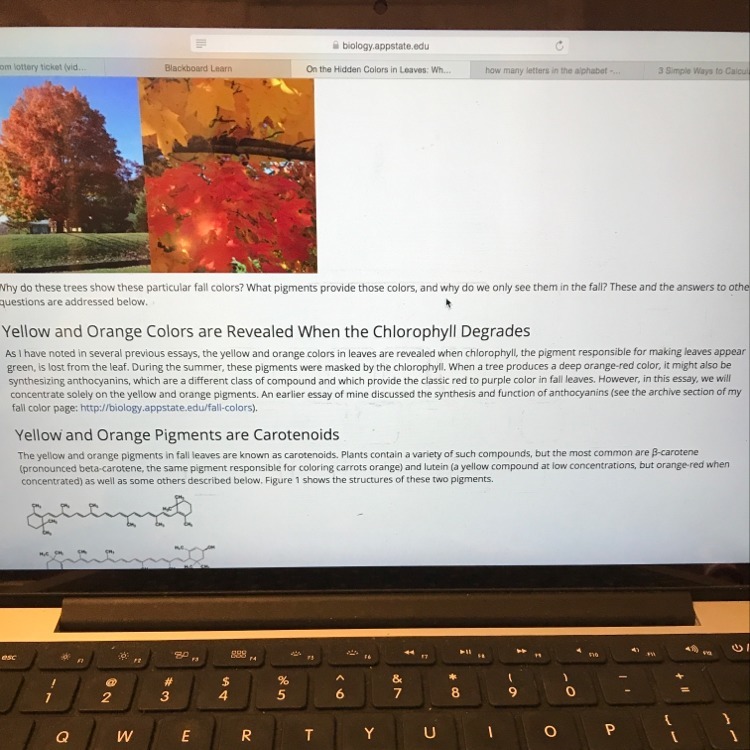
Carotenoids are red, orange, or yellow pigments found in many plants. Usually we see these accessory pigments only in the fall.
____ [38]
C is the answer because these accessory pigments on mass by the chlorophyll, which is responsible for producing food for the tree

5 0
2 years ago
The heterotroph hypothesis of the origin of life states that basic organic building blocks formed from inorganic molecules under
azamat

Answer:

1) abiotic synthesis of small organic molecules (monomers)

2) joining of monomers into polymers

3) packaging of these molecules into protobionts, droplets with membranes that maintained a distinct internal chemistry

4) origin of self-replicating molecules that eventually made inheritance possible

Explanation:

8 0
2 years ago
Y-: yellow S-: star yy: black ss: starless
Ede4ka [16]

Answer:

1. heterozygous yellow and star

2. 37

3. 1/8

4. 168

5. 1/4

Explanation:

Given ,

In f1 generation a cross is made between a true breeding black star bellied sneetch mated with a true breeding yellow starless sneetch

yySS x YYss

It is taken as - Y (yellow) is dominant over y (black)

and S (star) is dominant over s (starless)

1. F1 Generation

Genotype of parents yySS X YYss

gametes - yS, yS, Ys, Ys

All 16 offspring will have genotype YySs

phenotype would be heterozygous yellow and star

2. F2 generation cross

YySs X YySs

YS        Ys         yS        ys

YS YYSS YYSs YySS YySy

Ys YYSs YYss YySs Yyss

yS YySS YySs yySS yySs

ys YySs Yyss yySs yyss

Genotype of offspring are –  

YYSS – 1

YYSs – 2

YySS – 2

YySs – 4

YYss- 1

Yyss- 2

yySS – 1

yySs- 1

yyss- 1

2. Out of 16, 2 are black star bellied sneetches . Which means only 1/8 are black star bellied sneetches

So out of 300, 37 are black star bellied sneetches

3. Only 2 out of 16 are true breeding. i.e 1/8

4. 9 out of 16 are yellow star bellied sneetches, so out of 300, 168 are yellow star bellied sneetches

5. 4 out of 16 are true breeding yellow. Thus, ¼ are true breeding
7 0
2 years ago
Other questions:
  • How do prokaryotic cells get energy?
    10·2 answers
  • A 10% glucose solution is placed in the thistle tube. The thistle tube is placed in a beaker that contains a 5% glucose solution
    12·2 answers
  • "based on the information provided about the regulation of testosterone secretion, propose a testable hypothesis to explain how
    5·1 answer
  • Two students are doing an experiment. They mix 40 grams of baking soda with 23 grams of vinegar inside a closed container and wa
    7·2 answers
  • A student use colored balls and sticks to make a model of the compound ammonia. Below is a picture of the model. What kind of mo
    8·2 answers
  • Identify the parts of this chemical reactions A+B AB
    6·1 answer
  • While sampling marine plankton in a lab, a student encounters large numbers of fertilized eggs. The student rears some of the eg
    12·1 answer
  • Initial number of finches
    15·1 answer
  • Classify each action as belonging to genetics, genomics, or both. Genetics Genomics Both.
    8·1 answer
  • Six white-tailed deer and six sika deer were enclosed in a pasture for observation during an eight-year study in central Texas.
    6·1 answer
Add answer
Login
Not registered? Fast signup
Signup
Login Signup
Ask question!