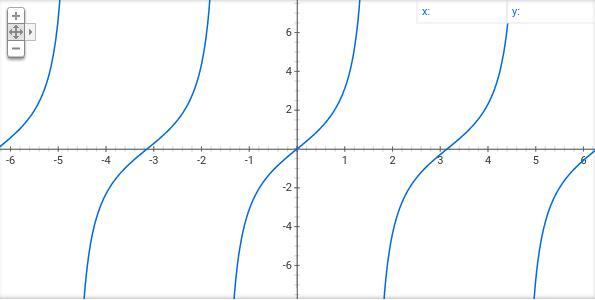
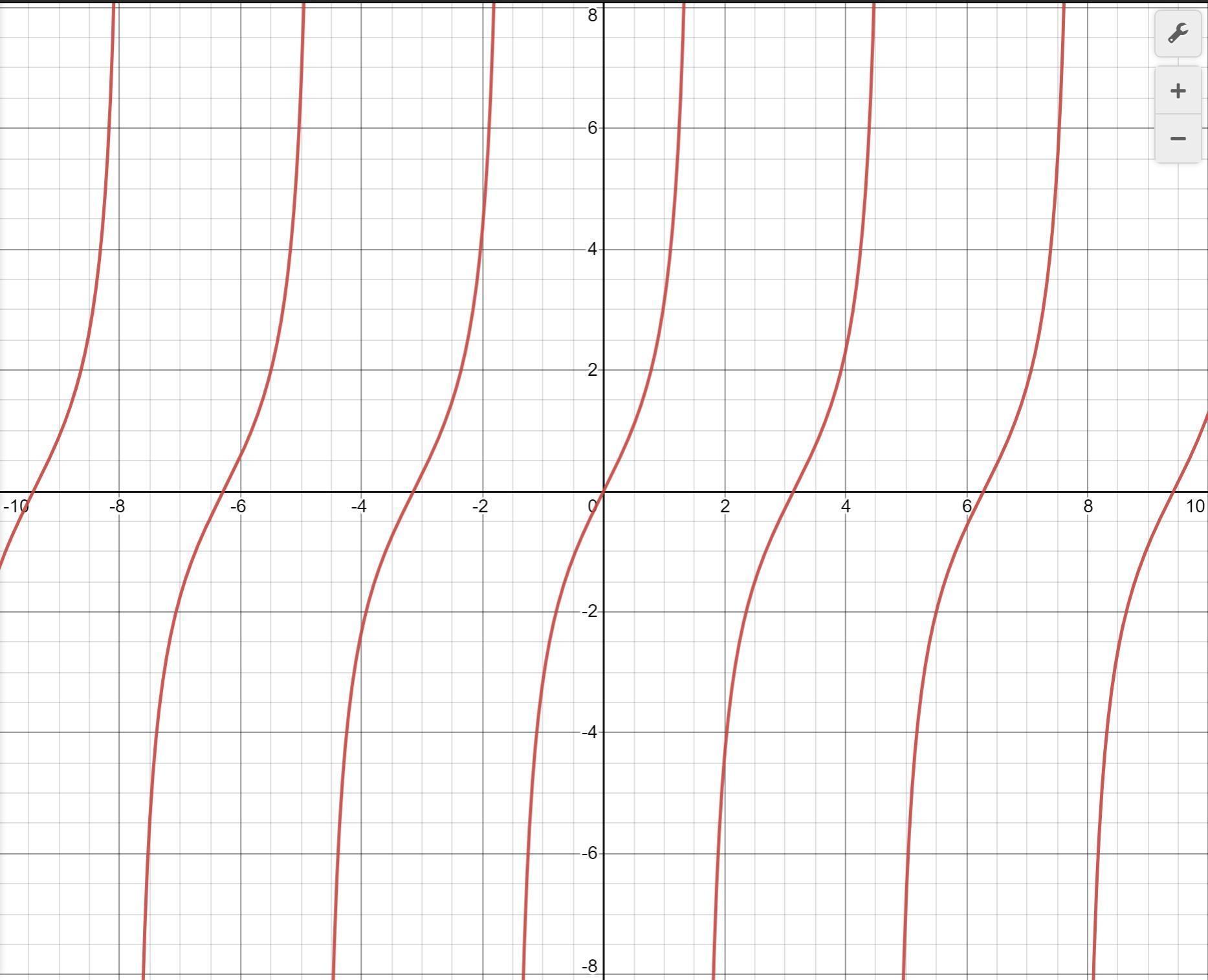
Find the asymptotes
For any y=tan(x), vertical asymptotes occur at x =  +
+  , where
  is an integer.
Use the basic period for y=tan(x),  , to find the vertial asymptotes for y= 2 tan (x). Set the inside of the tangent function, bx+c, for y = a tan (bx+c) + d equal to - to find where the vertical asymptote occurs for y=2tan(x).

Set the inside of the tangent function x equal to
x=
the basic period for y=2tan(x) will occur at (- ), where -pi/2 and pi/2 are vertical asymptotes.

Find the period  to find where the vertical asymptotes exist.
The absolute value is the distance between a number and zero. The distance between 0 and 1 is 1.

Divide  by 1
by 1
The vertical asymptotes for y = 2 tan (x) occur at  and every
  , and where n is a integer.
There are only vertical asymptotes for tangent and contagent functions.
Vertical asymptotes :  for any integer n.
No horizontal asymptotes
No oblique asymptotes
use a form for a tan (bx-c)+d to find variables used to find the amptitude , period, phase shift, and vertical shift.
a=2
b=1
c=0
d=0
Since the graph of the function tan does not have a maximum or minimum value, there can be no value for amplitude.
Amplitude : None
Find the period of 2 tan (x)
The period of the function can be caculated using

Replace b with 1 in the formula for period.

The absolute value is the distance between a number and zero . The distance between 0 and 1 is 1.
Divide by 1
Find the phase shift using the formula 
Phase Shift:
Replace the values of c and b in the equation for phase shift
Phase shift: 0/1
Divide 0 by 1
Phase Shift; 0
Find the vertical shift d.
vertical shift: 0
List the properties of the trigonometric function
Amplitude; none
period:
Phase shift: 0 ( 0 to right )
Vertical shift: 0
The trig function can be graphed using the amplitude , period, phase shift, vertical shift, and the points.
Vertical asymptotes : x= pi/2+pi n for any integer n.
Amplitude: None
Period:
Phase Shift: 0 ( 0 to the right)
Vertical Shift: 0