answer.
Ask question
Login Signup
Ask question
All categories
  • English
  • Mathematics
  • Social Studies
  • Business
  • History
  • Health
  • Geography
  • Biology
  • Physics
  • Chemistry
  • Computers and Technology
  • Arts
  • World Languages
  • Spanish
  • French
  • German
  • Advanced Placement (AP)
  • SAT
  • Medicine
  • Law
  • Engineering
jasenka [17]
2 years ago
10

A liquid has a volume of 34.6 ml and a mass of 46.0 g. what is the density of the liquid?

Chemistry
1 answer:
Minchanka [31]2 years ago
5 0

The density of a substance can simply be calculated by dividing the mass by the volume:

density = mass / volume


Therefore calculating for the density since mass and volume are given:

density = 46.0 g / 34.6 mL

density = 1.33 g / mL

You might be interested in
What is the mass of a sample of water containing 3.55×10²² molecules of h2o?
ad-work [718]
6,02×10²³ -------------- 18g
3,55×10²² --------------  xx=\frac{3,55*10^{22}*18g}{6,02*10^{23}}=10,61*10^{22-23}g=10,61*10^{-1}g=1,061g


6 0
2 years ago
Read 2 more answers
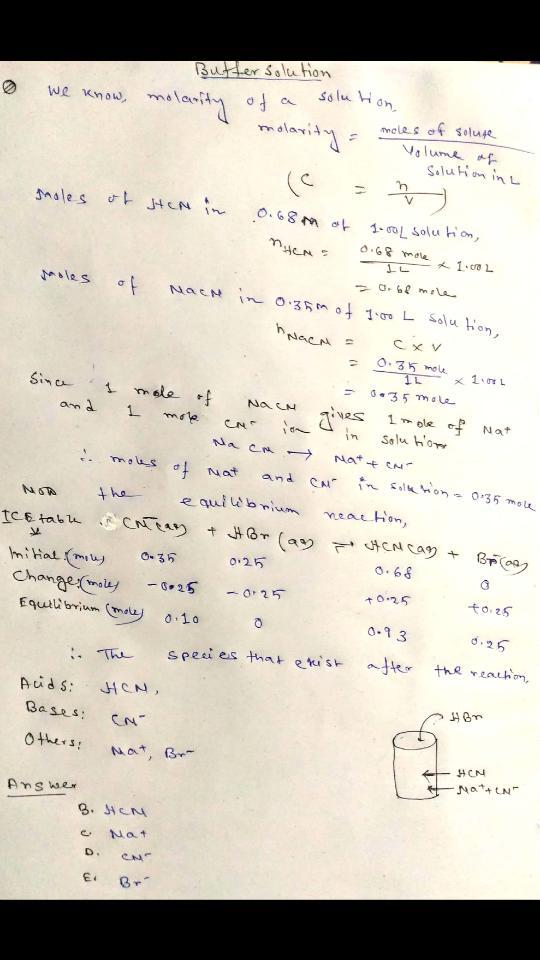
g A 0.25 mol sample of HBr is added to a 1.00 L buffer solution consisting of 0.68 M HCN and 0.35 M NaCN. Identify all species t
salantis [7]

Answer:

See explaination for details and diagram

Explanation:

We can say that Chemical reaction is a process in which one or more substances, the reactants, are converted to one or more different substances, the products. Substances are either chemical elements or compounds.

A chemical reaction rearranges the constituent atoms of the reactants to create different substances as products.

See attachment for the buffer of the chemical reaction.

7 0
2 years ago
A. The measured pH of a 0.100 M HCl solution at 25 degrees Celsius is 1.092. From this information, calculate the activity coeff
ra1l [238]

Answer:

activity coefficient \mathbf{\gamma =0.809}

activity coefficient \mathbf{\gamma = 0.791}

The change in pH in part A = 0.092

The change in pH in part B =  0.102

Explanation:

From the given information:

pH of HCl solution = 1.092

Activity of the pH solution [a] = 10^{-1.092}

[a] = 0.0809 M

Recall that [a] = \gamma × C

where;

\gamma  = activity coefficient

C = concentration

Making the activity coefficient the subject of the formula, we have:

\gamma = \dfrac{[a]}{C}

\gamma = \dfrac{0.0809 \ M}{0.100  \ M}

\mathbf{\gamma =0.809}

B.

The pH of a solution of HCl and KCl = 2.102

[a] = 10^{-2.102}

[a] = 0.00791 M

activity coefficient \gamma = \dfrac{0.00791 \ M}{0.01 \ M}

\mathbf{\gamma = 0.791}

C. The change in pH in part A = 1.091 - 1.0 = 0.092

The change in pH in part B = 2.102 -2.00 = 0.102

3 0
2 years ago
A student pours exactly 26.9 mL of HCl acid of unknown molarity into a beaker. The student then adds 2 drops of the indicator an
Assoli18 [71]
a.
Acids react with bases and give salt and water and the products.

Hence, HCl reacts with NaOH and gives NaCl salt and H₂O as the products. The reaction is,
            HCl(aq) + NaOH(aq) → NaCl(aq) + H₂O(l)

To balance the reaction equation, both sides hould have same number of elements.

Left hand side,                                             Right hand side,
             
H atoms = 2                                               H atoms = 2
            Cl atoms = 1                                               Cl atoms = 1
            Na atoms = 1                                               Na atoms = 1 
           O atoms = 1                                                   O atoms = 1

Hence, the reaction equation is already balanced.

b. 
Molarity (M)= moles of solute (mol) / Volume of the solution (L)
 
          HCl(aq) + NaOH(aq) → NaCl(aq) + H₂O(l)

Molarity of NaOH = <span>0.13 M
</span>Volume of NaOH added = <span>43.7 mL
Hence, moles of NaOH added = 0.13 M x 43.7 x 10</span>⁻³ L
                                                 = 5.681 x 10⁻³ mol

Stoichiometric ratio between NaOH and HCl is 1 : 1

Hence, moles of HCl = moles of NaOH
                                    = 
5.681 x 10⁻³ mol

5.681 x 10⁻³ mol of HCl was in <span>26.9 mL.

Hence, molarity of HCl = </span>5.681 x 10⁻³ mol / 26.9 x 10⁻³ L
                                     = 0.21 M
6 0
2 years ago
4.8g of calcium is added to 3.6g of water. The following reaction occurs
notka56 [123]
Q1)
the number of moles can be calculated as follows
number of moles = mass present / molar mass
number of moles is the amount of substance.
4.8 g of Ca was added therefore mass present of Ca is 4.8 g
molar mass of Ca is 40 g/mol 
molar mass is the mass of 1 mol of Ca
therefore if we substitute these values in the equation 
number of moles of Ca = 4.8 g / 40 g/mol = 0.12 mol
0.12 mol of Ca is present 

q2)
next we are asked to calculate the number of moles of water present 
again we can use the same equation to find the number of moles of water
number of moles = mass present / molar mass
3.6 g of water is present 

sum of the products of the molar masses of the individual elements by the number of atoms 
H - 1 g/mol and O - 16 g/mol 
molar mass of water = (1 g/mol x 2 ) + 16 g/mol = 18 g/mol 
molar mass of H₂O is 18 g/mol 
therefore number of moles of water  = 3.6 g / 18 g/mol = 0.2 mol 
0.2 mol of water is present 

8 0
2 years ago
Other questions:
  • Which statement explains why sulfur is classified as a Group 16 element?
    5·2 answers
  • What mass of silver ag which has an atomic mass of 107.87 amu contains the same number of atoms contained in 10.0g of boron b wh
    6·2 answers
  • What is this volume (2.49 × 10⁴ L) in cubic meters?
    6·1 answer
  • heated blocks of iron used to be warm bed. A 1600g brick of iron heated to 155c would release how many joules of heat energy as
    15·1 answer
  • Two students made the Lewis dot diagrams of NH3. The diagrams are as shown.
    12·1 answer
  • Hydrogen is unique among the elements because __________. 1. It has only one valence electron. 2. It is the only element that ca
    7·1 answer
  • For a hydrogen atom, which electronic transition would result in the emission of a photon with the highest energy?
    11·1 answer
  • Natasha and Reanna observe a large airplane in the troposphere. Which experimental setup below would best determine how changing
    6·2 answers
  • What geologic processes helped to form gold ore, oil, and aquifers?
    12·1 answer
  • What volume in<br><br> L<br><br> of a 0.724 M Nal solution contains 0.405 mol of Nal ?
    10·1 answer
Add answer
Login
Not registered? Fast signup
Signup
Login Signup
Ask question!