answer.
Ask question
Login Signup
Ask question
All categories
  • English
  • Mathematics
  • Social Studies
  • Business
  • History
  • Health
  • Geography
  • Biology
  • Physics
  • Chemistry
  • Computers and Technology
  • Arts
  • World Languages
  • Spanish
  • French
  • German
  • Advanced Placement (AP)
  • SAT
  • Medicine
  • Law
  • Engineering
andrew-mc [135]
2 years ago
6

If a sample containing 2.00 mL of nitroglycerin (density=1.592g/mL) is detonated, how many total moles of gas are produced?

Chemistry
1 answer:
fgiga [73]2 years ago
6 0

The overall balanced chemical reaction for this is:

Detonation of Nirtoglycerin <span>
4 C3H5N3O9 --> 12 CO2 + 6 N2 + O2 + 10 H2O </span>


Therefore:

2.00 mL x 1.592 g/mL = 3.184 g <span>
3.184 g / 227.1 /mol = 0.0140 mol nitroglycerin 
4 moles --> 12 + 6 + 1 + 10 = 29 moles of gas 
<span>0.0140 mol x (29/4) = 0.1017 moles of gases or (0.102 mol) </span></span>

You might be interested in
You want to determine ΔH o for the reaction Zn(s) + 2HCl(aq) → ZnCl2(aq) + H2(g) To do so, you first determine the heat capacity
Assoli18 [71]

Answer:

(A) The heat capacity of the calorimeter is therefore = −2.1428KJ÷13.5°C

= −0.1587KJ/°C


(B) ΔHo for the reaction Zn(s) + 2HCl(aq) → ZnCl2(aq) + H2(g) = –15.42KJ

Explanation:

Solution


Calculate the heat actually evolved.

                 q = mcΔt


Finding the mass of the reactants in grams we have.


Use density. (50 mL + 50 mL ) = 100 mL of solution.


100 mL X 1.04g/mL     = 104 grams of solution. (mass = Volume X Density)


Find the temperature change.


       Δt =tfinal - tinitial = 30.4°C – 16.9°C = 13.5°C


    q = mcΔt

       = 104grams × 3.93J/g°C  × 13.5°C = 5.51772×10³J


       = 5.51772 × 10³ J


This is the heat lost in the reaction between HCl and NaOH, therefore q = -5.52 × 10³ J.


this is an exothermic heat producing reaction.

 To calculate the total heat of the reaction or heat per mole we have


50.0 mL of HCl X 2.00 mol HCl /(1000 mL HCl ) = 0.100 mol HCl


The same quantity of base, 0.100 mole NaOH, was used.

The energy per unit mole is given by


i.e. molar enthalpy = J/mol = -5.52 × 10³J / 0.100 mol

            = -5.52 × 10⁴ J/mol

            = -55177.2 J/mol

            = -55.177 kJ/mol


Therefore, the enthalpy change for the neutralization of HCl and NaOH, that is the enthalpy, heat, of reaction is ΔH = -55.177 kJ/mol

Heat absorbed by the calorimeter = −57.32kJ − 55.177 kJ = −2.1428KJ

The heat capacity of the calorimeter is therefore = −2.1428KJ÷13.5°C

= −0.1587KJ/°C


(B) For the ZnCl we have


Calculate the heat actually evolved.

                            q = mcΔt


Finding the mass of the reactants in grams we have.


Use density.  100 mL of solution of HCl


100 mL X 1.015g/mL        = 101.5 grams of solution. (mass = Volume X Density)


Find the temperature change.


       Δt =tfinal - tinitial = 20.5°C – 16.8°C = 3.7 °C


    q = mcΔt

       = 101.5grams × 3.95J/g°C  × 3.7°C = 1483.422×103J


       = -1483.422×103J


This is the heat lost in the reaction between HCl and NaOH, therefore q = -1.483 × 10³ J.


this is an exothermic heat producing reaction.

 To calculate the total heat of the reaction or heat per mole we have


100.0 mL of HCl X 1.00 mol HCl /(1000 mL HCl ) = 0.100 mol HCl


The energy per unit mole is given by


i.e. molar enthalpy = J/mol = -1.483 × 10³J / 0.100 mol

                                         = -1.483 × 10⁴ J/mol

                                         = -14834.22 J/mol

                                         = -14.834 kJ/mol


Therefore, the enthalpy change for the neutralization of HCl and NaOH, that is the enthalpy, heat, of reaction is ΔH = -14.834 kJ/mol

ΔHo for the reaction Zn(s) + 2HCl(aq) → ZnCl2(aq) + H2(g)

= -14.834 kJ –(0.1587KJ/°C×3.7°C) = -15.42KJ

ΔHo for the reaction Zn(s) + 2HCl(aq) → ZnCl2(aq) + H2(g) = –15.42KJ

5 0
2 years ago
an element x has two naturally occurring isotopes: X-79 (abundance+50.69%, mass +78.918amu) and X-81 (abundance+49.31% mass+80.9
Lana71 [14]
The answer would be B. Brimone. I had the same question before, but let me know if it is not right. Cause certain schools have the same questions but different answers for them.
6 0
2 years ago
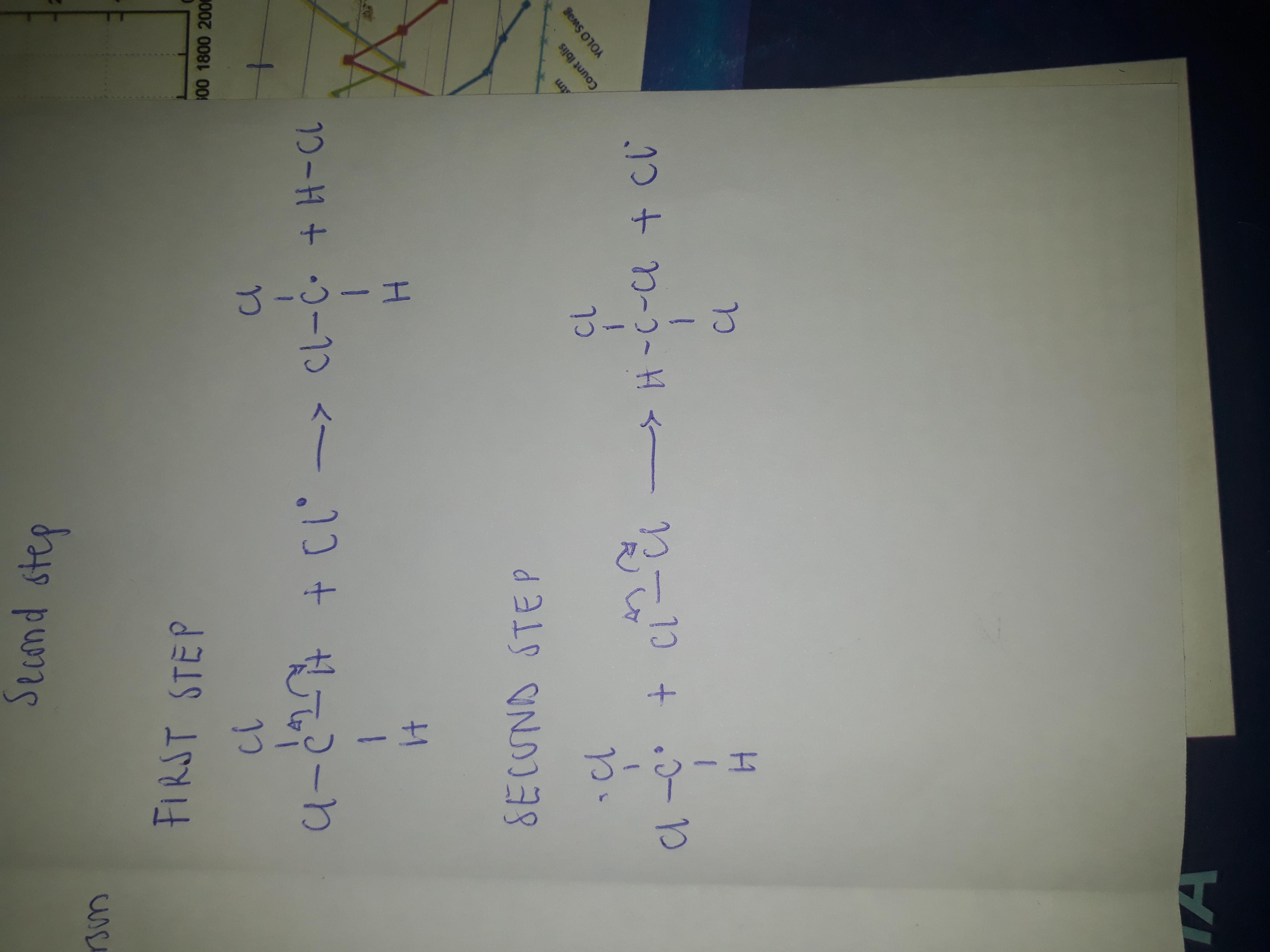
Which of the following represents a propagation step in the monochlorination of methylene chloride (CH2Cl2)?a. CHCl3 + Cl. Right
svetlana [45]

Answer:

B = CHCl2 + Cl2 --> CHCl3 + Cl

Explanation:

Free radical halogenation is a chlorination reaction on Alkane hydrocarbons. This involves the splitting of molecules into radicals/ unstable molecules in the presence of sunlight/ U.V light which ensures bonding of the molecules.

Free radical chlorination is divided into 3 steps which are:

The initiation step

The propagation step

The termination step

So in reference to the question, propagation step involves two steps.

The first step is where the molecule in this case the methylene chloride(CH2Cl2) loses a hydrogen atom and then bond with a chlorine atom radical to give a nethylwnw chloride radical and HCl.

The second step involves the reaction of this methylene chloride got in the first step with chlorine molecule to form trichloride methane and a chlorine radical.

You would find in the attachment the 2 step mechanism.

3 0
2 years ago
Why it is impossible for an isolated atom to exist in the hybridized state?
kakasveta [241]

Hybridization refers to the mixing of atomic orbitals in an atom. The number of hybrid orbitals needs to be equal to the number of orbitals that have involved in prior to mixing.  

The isolated atoms cannot prevail in a hybridized state as the atom in an isolated state do not form any kind of bond with the other atom, due to which the atomic orbitals do not go through the process of hybridization.  


7 0
2 years ago
3. According to the label on a bottle of concentrated hydrochloric acid, the contents are 36.0% HCl by mass and have a density o
velikii [3]

Answer:

a) 11.64 M

b) 43 mL

c) 1.7 kg

Explanation:

a) Let's use a basis of the calculus of 1000 mL (1 L) of the concentrated solution. If the solution has 1.18 g/mL, it has:

1.18*1000 = 1180 g.

The mass of HCl will be then:

mHCl = 1180*0.36 = 424.8 g

The molar mass of HCl is 36.5 g/mol, so the number of moles is the mass divided by the molar mass:

nHCl = 424.8/36.5 = 11.64 mol

The molarity is the number of moles divided by the volume in L:

Molarity = 11.64 M

b) To prepare a solution by dilution of a concentrated one, we can use the equation:

C1V1 = C2V2

Where C is the concentration, V is the volume, 1 is the concentrated solution, and 2 the final solution. So:

11.64*V1 = 2.00*0.250

V1 = 0.0429 L ≅ 43 mL

c) The neutralization will happen by the equation:

HCl + NaHCO₃ → NaCl + CO₂ + H₂O

So, 1 mol of NaHCO₃ is needed to react with 1 mol of HCl. At 1.75 L, the number of moles of the acid is:

nHCl = 1.75*11.64 = 20.37 mol

The molar mass of NaHCO₃ is 84 g/mol so the mass needed is the molar mass multiplied by the number of moles:

m = 84*20.37 = 1,711.08 g

m = 1.7 kg

6 0
2 years ago
Other questions:
  • What changes if the degree (amount) of intermolecular bonds of a substance are changed?
    7·2 answers
  • What is the function of an arrow ( -7) and a plus sign ( ) in a chemical equation?
    12·1 answer
  • A mixture of 60 mol % n-propylcyclohexane and 40 mol % n-propylbenzene is distilled through a simple distillation apparatus; ass
    7·1 answer
  • A flexible plastic container contains 0.860g of helium has in a volume of 19.2L if 0.205g of helium is removed at contact pressu
    15·1 answer
  • Which sentence best explains the high melting point, boiling point, and surface tension of water? A. The hydrogen atom on each w
    15·2 answers
  • According to the equation above, how many moles of potassium chlorate, KClO3, must be decomposed to generate 1.0 L of O2 gas at
    9·1 answer
  • The acids and bases shown right cover a range of pH values. Use what you know about acids, bases, and concentration to label the
    6·2 answers
  • The mass of an atom comes from _____. A. the nucleus B. the neutrons C. the electro​​​​ns D. the protons
    15·1 answer
  • 3. Scott and James work at a grocery store. After the grocery store closed, they were playing a game with a shopping cart and Sc
    6·1 answer
  • Heating a particular ether with HBr yielded a single organic product. Which of the following conclusions can be reached?
    15·1 answer
Add answer
Login
Not registered? Fast signup
Signup
Login Signup
Ask question!