answer.
Ask question
Login Signup
Ask question
All categories
  • English
  • Mathematics
  • Social Studies
  • Business
  • History
  • Health
  • Geography
  • Biology
  • Physics
  • Chemistry
  • Computers and Technology
  • Arts
  • World Languages
  • Spanish
  • French
  • German
  • Advanced Placement (AP)
  • SAT
  • Medicine
  • Law
  • Engineering
Jobisdone [24]
2 years ago
8

A tobacco plant is heterozygous for the genes for long stems (Ss), large leaves (Ll), and fibrous roots (Rr). It is crossed with

another tobacco plant with genotype ss ll rr. How many of the 80 offspring of this mating will be heterozygous for all three genes? These genes are not linked. Hint: create three separate Punnett squares and use the product rule

Biology
1 answer:
Ainat [17]2 years ago
7 0
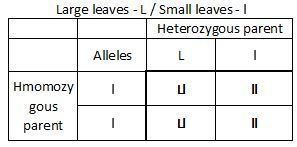
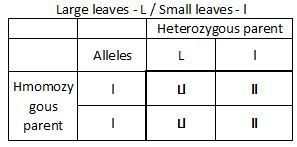
Firstly, start by doing Punnett squares for each of the characteristics. Attached are the three Punnet squares, made by me, as they should look in end.

For each of the Punnet squares, one characteristic each, we find that half of the offspring will be heterozygous for that characteristic.
Therefore, according to the product rule, you should now multiply the quantity of heterozygous for each characteristic and then obtain the total part of the offspring that's fully heterozygous.

\frac{1}{2}Ss×\frac{1}{2}Ll×\frac{1}{2}Rr=\frac{1}{8}SsLlRr

Total offspring×\frac{1}{8}=10
There is 10 plants in the total offspring that are heterozygous for all the considered three genes.

You might be interested in
Which of the following statements correctly determines the process when following the scientific method?
crimeas [40]

Answer:

A) Formulate question,conduct research,propose hypothesis,test hypothesis

Explanation:

The scientific method is pertinent to the success of a scientific experiment. The scientific method is a sequential steps of processes involved in an experimentation. The correct order of steps that determines the process when following the scientific method are:

1) Formulate question: Asking a question about what has been previously observed is the key to starting a scientific method.

2) Conduct research: Research is done based on a previous observation that has been made by in order to gather necessary information.

3) Propose hypothesis: A hypothesis is a predictive statement or explanation to an asked question about the experiment that can be tested. It usually goes in an IF, THEN format.

4) Test hypothesis: As stated in the previous step, a hypothesis must be testable, which is done by conducting an experiment. The outcome of the experiment proves or disproves the hypothesis.

6 0
2 years ago
A gene may be described as
Tju [1.3M]

Answer:

The correct answer for the fill in the blank is - A sequence of bases on the DNA that codes for a trait.

Gene is described as a segment of DNA ( deoxyribonucleic acid) that codes for a particular protein, which in turn corresponds to a trait/ characteristic of the living organism.

Gene is first transcribed into mRNA ( messenger RNA) through a process called transcription. mRNA is then converted into protein through a process called translation.

The protein thus formed corresponds to a particular trait ( like eye color, hair color).

i hope this helps

3 0
2 years ago
Read the passage from Heracles. Heracles was the son of Zeus, a god, and Alcmene, a mortal. Zeus's wife, Hera, hated the child,
Salsk061 [2.6K]

Answer:

based on the passage, the ancient greeks believed that their gods had the power to control over people's lives and were overall very powerful.

Explanation:

5 0
2 years ago
Read 2 more answers
A scientist is studying the population of a particular species of beetle in an ecosystem. The beetles currently have an estimate
mr_godi [17]

Answer:

Year Population

1         11,500

2         12,075

3         12,679

4         13,313

5         13,978

6         14,677

Explanation:

5 0
2 years ago
1. You are studying an integral membrane protein of the plasma membrane. It has a single transmembrane domain and the N-terminal
Drupady [299]

Answer:

A 22 to 25 amino acid sequence present in the central section of the protein, which gives rise to an alpha helix in the membrane is known as the stop-transfer anchor sequence. The sequence plays an essential function in targeting the protein towards the plasma membrane. On the other hand, it also ceases targeting of the protein towards the endoplasmic reticulum, which was started by the signal peptide.  

Thus, the process of translation of the remaining of the protein occurs within the cytosol due to the tethering of the transmembrane domain. In the stop-transfer anchor sequence, the hydrophobic amino acids present are isoleucine and valine. After mutation, these amino acids get converted into arginine and lysine, thus, hydrophilic amino acids replace hydrophobic amino acids in the sequence.  

Due to this, the transmembrane domain cannot be targeted towards an integral part of the plasma membrane by the short transfer anchor sequence, and therefore, now the translocation of the protein will take place towards the endoplasmic reticulum as initiated by the signal peptide at the beginning.  
3 0
2 years ago
Other questions:
  • Coach Taylor is trying to explain the negative side effects smoking has to athletic performance. Which of these options include
    8·1 answer
  • When two species compete for the same ecological niche, they cannot coexist because they are competing for the exact same resour
    7·1 answer
  • Indicate the stages of life on the timeline including the definite articles. do not repeat any labels. note that items 2-6 refer
    7·2 answers
  • Identify each adaptation as structural or behavioral adaptations.
    10·1 answer
  • Robert’s fraternal twin sister Desiree has a diagnosis of schizophrenia. Armend’s identical twin brother, Nigel, also has a diag
    12·1 answer
  • Ten grams of hamburger were added to 90 ml of sterile buffer.
    5·1 answer
  • Diatoms are marine organisms with unique cell walls that contain the element silicon. Which of the following are two common elem
    9·1 answer
  • Consider two mammalian cells, one in G1 and the other in G0 (stationary) phase. If they are stimulated to pass the restriction p
    15·1 answer
  • Look at the bean from Days 4-6. Use these data to explain how natural selection changed the number of dark red walking beans ove
    7·1 answer
  • The diagram below represents levels of organization in living things. Which term would best represent X?
    11·1 answer
Add answer
Login
Not registered? Fast signup
Signup
Login Signup
Ask question!