answer.
Ask question
Login Signup
Ask question
All categories
  • English
  • Mathematics
  • Social Studies
  • Business
  • History
  • Health
  • Geography
  • Biology
  • Physics
  • Chemistry
  • Computers and Technology
  • Arts
  • World Languages
  • Spanish
  • French
  • German
  • Advanced Placement (AP)
  • SAT
  • Medicine
  • Law
  • Engineering
harkovskaia [24]
2 years ago
15

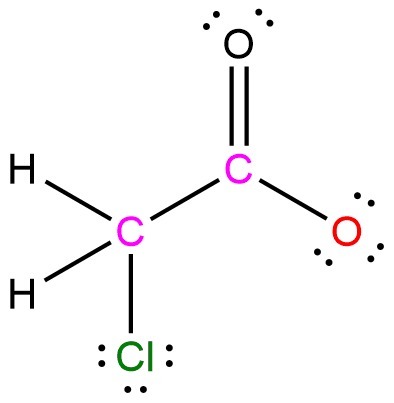
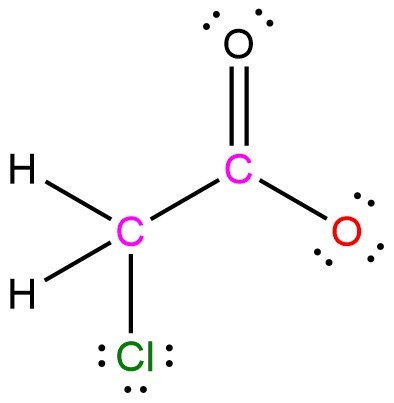
Write the lewis structure for ch2clcoo−. assign a formal charge for any atom with a non-zero formal charge.

Chemistry
1 answer:
Murljashka [212]2 years ago
8 0
The Lewis structure of Chloroacetate (H₂CClCO₂) is given below. In structure it is shown that carbon has a double bond with one oxygen atom and two single bonds with CH₂Cl and O⁻.

Formal Charge;
                        Formal charge is caculated as,

Formal charge  =  # of valence e⁻ - [# of lone pair of e⁻ + 1/2 # of bonded e⁻]

Formal charge on Oxygen (Highlighted Red);

Formal charge  =  6 - [ 6 + 2/2]

Formal charge  =  6 - [6 + 1]

Formal charge  =  6 - [7]

Formal charge  =  -1

You might be interested in
4.8g of calcium is added to 3.6g of water. The following reaction occurs
notka56 [123]
Q1)
the number of moles can be calculated as follows
number of moles = mass present / molar mass
number of moles is the amount of substance.
4.8 g of Ca was added therefore mass present of Ca is 4.8 g
molar mass of Ca is 40 g/mol 
molar mass is the mass of 1 mol of Ca
therefore if we substitute these values in the equation 
number of moles of Ca = 4.8 g / 40 g/mol = 0.12 mol
0.12 mol of Ca is present 

q2)
next we are asked to calculate the number of moles of water present 
again we can use the same equation to find the number of moles of water
number of moles = mass present / molar mass
3.6 g of water is present 

sum of the products of the molar masses of the individual elements by the number of atoms 
H - 1 g/mol and O - 16 g/mol 
molar mass of water = (1 g/mol x 2 ) + 16 g/mol = 18 g/mol 
molar mass of H₂O is 18 g/mol 
therefore number of moles of water  = 3.6 g / 18 g/mol = 0.2 mol 
0.2 mol of water is present 
8 0
2 years ago
Cacodyl, which has an intolerable garlicky odor and is used in the manufacture of cacodylic acid, a cotton herbicide, has a mass
Papessa [141]

Answer:

The molecular formula of cacodyl is C₄H₁₂As₂.

Explanation:

<u>Let's assume we have 1 mol of cacodyl</u>, in that case we'd have 209.96 g of cacodyl and the<u> following masses of its components</u>:

  • 209.96 g * 22.88/100 = 48.04 g C
  • 209.96 g * 5.76/100 = 12.09 g H
  • 209.96 g * 71.36/100 = 149.83 g As

Now we convert those masses into moles:

  • 48.04 g C ÷ 12 g/mol = 4.00 mol C
  • 12.09 g H ÷ 1 g/mol = 12.09 mol H
  • 149.83 g As ÷ 74.92 g/mol = 2.00 mol As

Those amounts of moles represent the amount of each component in 1 mol of cacodyl, thus, the molecular formula of cacodyl is C₄H₁₂As₂.

3 0
2 years ago
Which of the following compounds has polar covalent bonds: NaBr, Br2, HBr, and CBr4?
svetlana [45]

Answer: Option (e) is the correct answer.

Explanation:

A bond that is formed when an electron is transferred from one atom to another results in the formation of an ionic bond.

For example, NaBr will be an ionic compound as there is transfer of electron from Na to Br.

Whereas a bond that is formed by sharing of electrons is known as a covalent bond.

For example, CBr_{4} will be a covalent compound as there is sharing of electron between carbon and bromine atom.

Also, when electrons are shared between the combining atoms and there is large difference in electronegativity of these atoms then partial charges develop on these atoms. As a result, it forms a polar covalent bond.

For example, in a HBr compound there is sharing of electrons between H and Br. Also, due to difference in electronegativity there will be partial positive charge on H and partial negative charge on Br.  

Thus, we can conclude that out of the given options HBr is the only compound that has polar covalent bonds.

8 0
2 years ago
In a first order reaction 40% of reactant gets converted into product in 30 minutes. What time would it require to convert 75% i
e-lub [12.9K]
56 minutes and 15 seconds I believe
5 0
2 years ago
Valproic acid, used to treat seizures and bipolar disorder, is composed of C, H, and O. A 0.165-g sample is combusted to produce
sergeinik [125]

Answer:

The empirical formula is = C_4H_8O

The formula of Valproic acid = C_8H_{16}O_2

Explanation:

Mass of water obtained = 0.166 g

Molar mass of water = 18 g/mol

Moles of H_2O = 0.166 g /18 g/mol = 0.00922 moles

2 moles of hydrogen atoms are present in 1 mole of water. So,

<u>Moles of H = 2 x 0.00922 = 0.01844 moles </u>

Molar mass of H atom = 1.008 g/mol

<u>Mass of H in molecule = 0.01844 x 1.008 = 0.018588 g </u>

Mass of carbon dioxide obtained = 0.403 g

Molar mass of carbon dioxide = 44.01 g/mol

Moles of CO_2 = 0.403 g  /44.01 g/mol = 0.009157 moles

1 mole of carbon atoms are present in 1 mole of carbon dioxide. So,

<u>Moles of C = 0.009157 moles </u>

Molar mass of C atom = 12.0107 g/mol

<u>Mass of C in molecule = 0.009157 x 12.0107 = 0.11 g </u>

<u>Given that the Valproic acid only contains hydrogen, oxygen and carbon. </u>So,

Mass of O in the sample = Total mass - Mass of C  - Mass of H

Mass of the sample = 0.165 g

<u>Mass of O in sample = 0.165 - 0.11 - 0.018588 = 0.036412 g  </u>

Molar mass of O = 15.999 g/mol

<u>Moles of O  = 0.036412  / 15.999  = 0.002276 moles</u>

<u></u>

<u>Taking the simplest ratio for H, O and C as: </u>

<u>0.01844 : 0.002276 : 0.009157</u>

<u> = 8 : 1 : 4</u>

The empirical formula is = C_4H_8O

Molecular formulas is the actual number of atoms of each element in the compound while empirical formulas is the simplest or reduced ratio of the elements in the compound.

Thus,  

Molecular mass = n × Empirical mass

Where, n is any positive number from 1, 2, 3...

Mass from the Empirical formula = 4×12 + 8×1 + 16= 72 g/mol

Molar mass = 144 g/mol

So,  

Molecular mass = n × Empirical mass

144 = n × 72

<u>⇒ n = 2</u>

The formula of Valproic acid = C_8H_{16}O_2

7 0
2 years ago
Other questions:
  • Which of the following compounds has the highest pKa value? A)CCl3CH2NH2
    6·1 answer
  • A balloon contains 7.36 g of oxygen gas (O2). How many oxygen molecules are in the balloon?
    8·1 answer
  • Elements that’s are gases, brittle &amp; poor conductors at room temperature are
    13·1 answer
  • A sealed vessel contains 0.200 mol of oxygen gas, 0.100 mol of nitrogen gas, and 0.200 mol of argon gas. The total pressure of t
    10·1 answer
  • Your lab partner named this compound 3-methyl-4-n-propylhexane, but that is not correct.
    9·1 answer
  • A 0.944 M solution of glucose, C6H12O6, in water has a density of 1.0624 g/mL at 20∘C. What is the concentration of this solutio
    10·1 answer
  • What is the ph of the solution prepared by dissolving 0.927 mol hcl in enough water to make a 150 l aqueous solution?
    11·1 answer
  • The following questions refer to the gas-phase decomposition of ethylene chloride. C2H5Cl ® products Experiment shows that the d
    12·1 answer
  • Which process is based on repulsion of oil and water?
    13·2 answers
  • Is humidity a extensive or intensive property
    15·2 answers
Add answer
Login
Not registered? Fast signup
Signup
Login Signup
Ask question!