answer.
Ask question
Login Signup
Ask question
All categories
  • English
  • Mathematics
  • Social Studies
  • Business
  • History
  • Health
  • Geography
  • Biology
  • Physics
  • Chemistry
  • Computers and Technology
  • Arts
  • World Languages
  • Spanish
  • French
  • German
  • Advanced Placement (AP)
  • SAT
  • Medicine
  • Law
  • Engineering
Alexxandr [17]
2 years ago
3

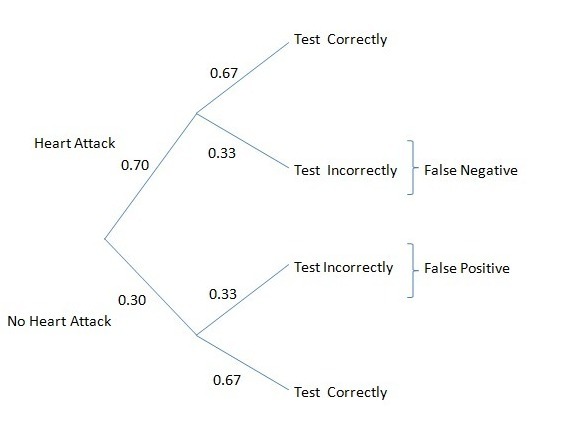
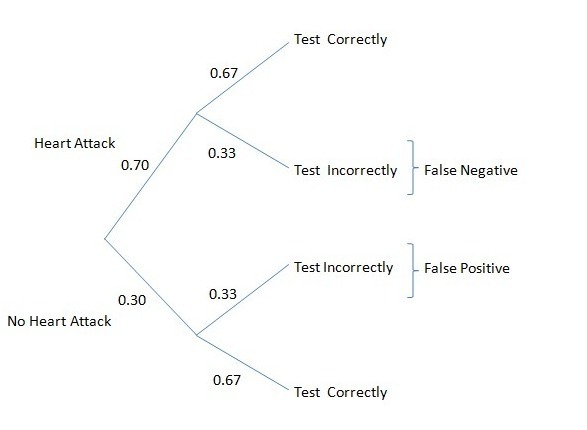
On discovering that her family had a 70% risk of heart attack, Erin took a treadmill test to check her own potential of having a

heart attack. The doctors told her that the reliability of the stress test is 67%. The test predicted that Erin will not have a heart attack. What is the probability after the test was taken that she will have a heart attack?
A. 0.4051

B. 0.5010

C. 0.4653

D. 0.6632

Mathematics
2 answers:
Elis [28]2 years ago
6 0

Answer:

<em>The probability that she will not have a heart attack and the test predicts that she will is </em><em>0.4653 or 46.53% </em>

Step-by-step explanation:

Hint- This a conditional probability problem where Bayes theorem should be applied.

Applying Bayes theorem,

P(\text{No heart attack}\ |\ \text{Correctly tested})=

\dfrac{P(\text{Correctly tested}\ |\ \text{No heart attack})\cdot P(\text{No heart attack})}{P(\text{Correctly tested})}

P(\text{Correctly\ tested}\ |\ \text{No\ heart\ attack})=67\%=0.67

P(\text{No\ heart\ attack})=1-P(\text{heart\ attack})=1-0.7=0.3

P(\text{Correctly\ tested})=[P(\text{No\ heart\ attack})\times P(\text{Correctly\ tested})]+[P(\text{Heart\ attack})\times (\text{Incorrectly\ tested})]

=[0.3\times 0.67]+[0.7\times 0.33]=0.432

Putting the values,

P(\text{No\ heart\ attack}\ |\ \text{Correctly\ tested})=\dfrac{0.67\times 0.3}{0.432} =0.4653

∴ There is a probability of 0.4653 or 46.53% chance that she will not have a heart attack even though the test predicts that she will.


Anna71 [15]2 years ago
3 0
On discovering that her family had a 70% risk of heart attack, Erin took a treadmill test to check her own potential of having a heart attack. The doctorstold her that the reliability of the stress test is 67%. The test predicted that Erin will not have a heart attack. The probability after the test was taken that she will have a heart attack is "B. 0.501."
You might be interested in
P=100a÷t solve for a
pishuonlain [190]

<u><em>a=1/100pt is the correct answer.</em></u> First you had to multiply by t from both sides of equation, and it gave us, ⇒ pt=100a. And then you had to flip an equation, and it gave us, ⇒100a=pt. You can also divide by one-hundred (100) from both sides of equation, and it gave us, \frac{100a}{100}=\frac{pt}{100}. And finally, and it gave us the answer is a=1/100pt is the final answer. Hope this helps! And thank you for posting your question at here on brainly, and have a great day. -Charlie

8 0
2 years ago
Read 2 more answers
"Immediately after a ban on using hand-held cell phones while driving was implemented, compliance with the law was measured. A r
sergiy2304 [10]

Answer:

(a) Null Hypothesis, H_0 : p_1-p_2=0  or  p_1= p_2  

    Alternate Hypothesis, H_A : p_1-p_2\neq 0  or  p_1\neq p_2

(b) We conclude that there is a statistical difference in these two proportions measured initially and then one year later.

Step-by-step explanation:

We are given that a random sample of 1,250 drivers found that 98.9% were in compliance. A year after the implementation, compliance was again measured to see if compliance was the same (or not) as previously measured.

A different random sample of 1,100 drivers found 96.9% compliance."

<em />

<em>Let </em>p_1<em> = proportion of drivers that were in compliance initially</em>

p_2<em> = proportion of drivers that were in compliance one year later</em>

(a) <u>Null Hypothesis</u>, H_0 : p_1-p_2=0  or  p_1= p_2      {means that there is not any statistical difference in these two proportions measured initially and then one year later}

<u>Alternate Hypothesis</u>, H_A : p_1-p_2\neq 0  or  p_1\neq p_2     {means that there is a statistical difference in these two proportions measured initially and then one year later}

The test statistics that will be used here is <u>Two-sample z proportion statistics</u>;

                     T.S.  = \frac{(\hat p_1-\hat p_2)-(p_1-p_2)}{\sqrt{ \frac{\hat p_1(1-\hat p_1)}{n_1} + \frac{\hat p_2(1-\hat p_2)}{n_2}} }  ~ N(0,1)

where, \hat p_1 = sample proportion of drivers in compliance initially = 98.9%

\hat p_2 = sample proportion of drivers in compliance one year later = 96.9%

n_1 = sample of drivers initially = 1,250

n_2 = sample of drivers one year later = 1,100

(b) So, <u><em>the test statistics</em></u>  =  \frac{(0.989-0.969)-(0)}{\sqrt{ \frac{0.989(1-0.989)}{1,250} + \frac{0.969(1-0.969)}{1,100}} }  

                                           =  3.33

<u>Now, P-value of the test statistics is given by;</u>

         P-value = P(Z > 3.33) = 1 - P(Z \leq 3.33)

                                            = 1 - 0.99957 = <u>0.00043</u>

Since in the question we are not given with the level of significance so we assume it to be 5%. Now at 5% significance level, the z table gives critical values between -1.96 and 1.96 for two-tailed test.

<em>Since our test statistics does not lies within the range of critical values of z, so we have sufficient evidence to reject our null hypothesis as it will fall in the rejection region due to which </em><u><em>we reject our null hypothesis.</em></u>

Therefore, we conclude that there is a statistical difference in these two proportions measured initially and then one year later.

7 0
2 years ago
Ms. Nina has 10 lbs of 25% sugar syrup. How much water does she need to add to make 10% sugar syrup
Inessa [10]
10*0.25=2.5
2.5/10*100=25 lbs
25-10=15 lbs
Nina need to add 15 lbs of water
7 0
2 years ago
The number of pages that Allen, Kevin, Roneisha, and Ben can read in a day is shown below. Allen read 15% of his 56-page book. K
grandymaker [24]
It would be “Allen” since his percentage is far more grater then the rest, even Roneisha because even though her percentage is 1% greater, she has less pages, Ben has more pages but has 1% less.


Basically it’s like 2 bikers racing, 1 biker is faster but can’t go 5 miles, but the other is not that fast but can go 5+ miles.

Now who can go further, it would be the slow one.
3 0
1 year ago
Read 2 more answers
Thirteen is at least the difference of a number v and 1
Digiron [165]

Answer: 13 ≥  v - 1

Step-by-step explanation: The equation above represents the situation; Thirteen is at least the difference of a number v and 1

4 0
2 years ago
Other questions:
  • M&amp;M plain candies come in various colors. According to the M&amp;M/Mars Department of Consumer Affairs, the distribution of
    7·1 answer
  • Isabel is buying 6 angelfish, and she wants her total to be no more than $2 above or below $36. Which inequality models the cost
    7·1 answer
  • Two-thirds of Tyrone's books are mystery novels. Tyrone has 42 books How many mystery novels does he have ?
    13·1 answer
  • A ship sails at 15 miles per hour, while it can motor at 5 miles per hour. It sails for 6 hours to its destination but has to mo
    6·1 answer
  • Today, John ran 15 miles in 2 hours and 30 minutes. He wants to represent the relationship between the distance he ran, in miles
    13·1 answer
  • A triangle is shown with its exterior angles. The interior angles of the triangle are angles 2, 3, 5. The exterior angle at angl
    5·2 answers
  • "A random sample of 50 university admissions officers was asked about expectations in application interviews. Of these sample me
    5·2 answers
  • What is the area of triangle RST?
    8·2 answers
  • Researchers studied the mean egg length​ (in millimeters) for a particular bird population. After a random sample of​ eggs, they
    5·1 answer
  • Three sailors were marooned on a deserted island that was also inhabited by a band of monkeys. The sailors worked all day to col
    11·1 answer
Add answer
Login
Not registered? Fast signup
Signup
Login Signup
Ask question!