answer.
Ask question
Login Signup
Ask question
All categories
  • English
  • Mathematics
  • Social Studies
  • Business
  • History
  • Health
  • Geography
  • Biology
  • Physics
  • Chemistry
  • Computers and Technology
  • Arts
  • World Languages
  • Spanish
  • French
  • German
  • Advanced Placement (AP)
  • SAT
  • Medicine
  • Law
  • Engineering
Tju [1.3M]
2 years ago
3

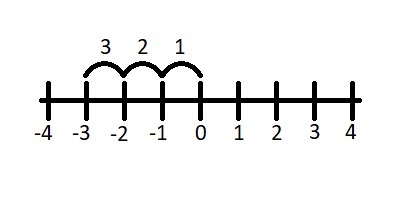
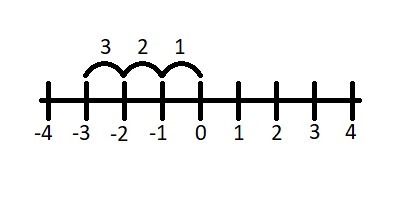
The price of a stock had a change of -3 dollars explain how you would use a number line to find the absolute value of -3.

Mathematics
2 answers:
sukhopar [10]2 years ago
5 0

Plot –3 on a number line. Find the distance the point is from 0. –3 is 3 units from zero. The absolute value is the distance from 0. The absolute value of –3 is 3.

stira [4]2 years ago
4 0

Starting at 0, count the number of whole numbers between 0 and -3. The amount counted is the abolsute value of -3. I've included an image showing ths process. From the number line shown, its clear the abolsute value is 3.

You might be interested in
Ruby has a DRF of 1.95 and a 6-month basic rate of $450. What is her annual
insens350 [35]
The answer on this question is D
6 0
2 years ago
Read 2 more answers
A study of immunizations among school‑age children in California found that some areas had rates of unvaccinated school‑age chil
Rom4ik [11]

Answer:

Probability that none of the 20 children in such a classroom would be unvaccinated is 0.055.

Step-by-step explanation:

We are given that a classroom of 20 children in one such area where 13.5% of children are unvaccinated.

If there are no siblings in the classroom, we are willing to consider the vaccination status of the 2020 unrelated children to be independent.

The above situation can be represented through binomial distribution;

P(X=r) = \binom{n}{r} \times p^{r} \times (1-p)^{n-r} ; x = 0,1,2,3,......

where, n = number of trials (samples) taken = 20 children

            r = number of success = none of the 20 children

            p = probability of success which in our case is probability that

                   children are unvaccinated, i.e; p = 13.5%

<u><em>Let X = Number of children that are unvaccinated</em></u>

So, X ~ Binom(n = 20, p = 0.135)

Now, Probability that none of the 20 children in such a classroom would be unvaccinated is given by = P(X = 0)

           P(X = 0)  =  \binom{20}{0} \times 0.135^{0} \times (1-0.135)^{20-0}

                          =  1\times 1 \times 0.865^{20}

                          =  0.055

<em>Hence, the probability that none of the 20 children in such a classroom would be unvaccinated is 0.055.</em>

8 0
2 years ago
tom was using wire of the following thicknesses .33mm , .275mm, .25mm, .3mm for some electrical work. order the wire from thicke
Lena [83]
Thickest to thinnest....
0.33m , 0.3mm, 0.275mm, 0.25mm
5 0
2 years ago
Daisy gave 1/2 of her lanzones to Nuel. Nuel gave 1/3 of the lanzones he received to Ronnie and Ronnie gave 1/4 of what he recei
enot [183]
Assuming all of them had the same amount at the start

3 0
2 years ago
A sled is being held at rest on a slope that makes an angle theta with the horizontal. After the sled is released, it slides a d
Alenkasestr [34]

Answer:

μ =  Sin θ * d₁ / (d₂ - Cos θ*d₁)

d₂ = (d₁*Sin θ) / μ

Step-by-step explanation:

a) We apply The work-energy theorem

W = ΔE

W = - Ff*d

Ff = μ*N = μ*m*g

<em>Distance 1:</em>

- Ff*d₁ = Ef - Ei

⇒  - (μ*m*g*Cos θ)*d₁ = (Kf+Uf) - (Ki+Ui) = (Kf+0) - (0+Ui) = Kf - Ui

Kf = 0.5*m*vf² = 0.5*m*v²

Ui = m*g*h = m*g*d₁*Sin θ

then

- (μ*m*g*Cos θ)*d₁ = 0.5*m*v² - m*g*d₁*Sin θ  

⇒   - μ*g*Cos θ*d₁ = 0.5*v² - g*d₁*Sin θ   <em>(I)</em>


<em>Distance 2:</em>

<em />

- Ff*d₂ = Ef - Ei

⇒  - (μ*m*g)*d₂ = (0+0) - (Ki+0) = - Ki

Ki = 0.5*m*vi² = 0.5*m*v²

then

- (μ*m*g)*d₂ = - 0.5*m*v²

⇒   μ*g*d₂ = 0.5*v²     <em>(II)</em>

<em />

<em>If we apply (I) + (II)</em>

- μ*g*Cos θ*d₁ = 0.5*v² - g*d₁*Sin θ

μ*g*d₂ = 0.5*v²

 ⇒ μ*g (d₂ - Cos θ*d₁) = v² - g*d₁*Sin θ   <em>  (III)</em>

Applying the equation (for the distance 1) we get v:

vf² = vi² + 2*a*d = 0² + 2*(g*Sin θ)*d₁   ⇒   vf² = 2*g*Sin θ*d₁ = v²

then (from the equation <em>III</em>) we get

μ*g (d₂ - Cos θ*d₁) = 2*g*Sin θ*d₁ - g*d₁*Sin θ

⇒  μ (d₂ - Cos θ*d₁) = Sin θ * d₁

⇒   μ =  Sin θ * d₁ / (d₂ - Cos θ*d₁)

b)

If μ is a known value

d₂ = ?

We apply The work-energy theorem again

W = ΔK   ⇒   - Ff*d₂ = Kf - Ki

Ff = μ*m*g

Kf = 0

Ki = 0.5*m*v² = 0.5*m*2*g*Sin θ*d₁ = m*g*Sin θ*d₁

Finally

- μ*m*g*d₂ = 0 - m*g*Sin θ*d₁   ⇒   d₂ = Sin θ*d₁ / μ

3 0
2 years ago
Other questions:
  • What is 706 × 76? cuz u suck at math
    9·2 answers
  • A high school student volunteers to present a report to the administration about the types of lunches students prefer. He survey
    6·2 answers
  • stephen buys x pencils and y notebook for his students each pencil costs $0.45 and each notebook costs $1.25 he buys a total of
    6·2 answers
  • Adam is ordering pizza for a company party that he needs to have catered. Company A charges $8 for each pizza and a delivery/set
    8·1 answer
  • Write a polynomial function, p(x) with degree 3 that has p(7)=0
    12·1 answer
  • There are five sales agents in a certain real estate office. One month Andy sold twice as many properties as Ellen, Bob sold 3 m
    13·1 answer
  • A study is planned to compare the proportion of men who dislike anchovies with the proportion of women who dislike anchovies. Th
    7·1 answer
  • In ΔSTU, the measure of ∠U=90°, TU = 6.6 feet, and US = 2.3 feet. Find the measure of ∠S to the nearest tenth of a degree.
    11·2 answers
  • Lauren bought 4 bags of popcorn for $3.00. What is the unit rate per bag of popcorn."?
    12·1 answer
  • A solid oblique pyramid has a regular hexagonal base with an area of 54StartRoot 3 EndRoot cm2 and an edge length of 6 cm. Angle
    12·1 answer
Add answer
Login
Not registered? Fast signup
Signup
Login Signup
Ask question!