answer.
Ask question
Login Signup
Ask question
All categories
  • English
  • Mathematics
  • Social Studies
  • Business
  • History
  • Health
  • Geography
  • Biology
  • Physics
  • Chemistry
  • Computers and Technology
  • Arts
  • World Languages
  • Spanish
  • French
  • German
  • Advanced Placement (AP)
  • SAT
  • Medicine
  • Law
  • Engineering
Ludmilka [50]
2 years ago
10

A pea plant purebred to produce round yellow peas is crossed with a plant purebred to produce wrinkled green peas. Round pea sha

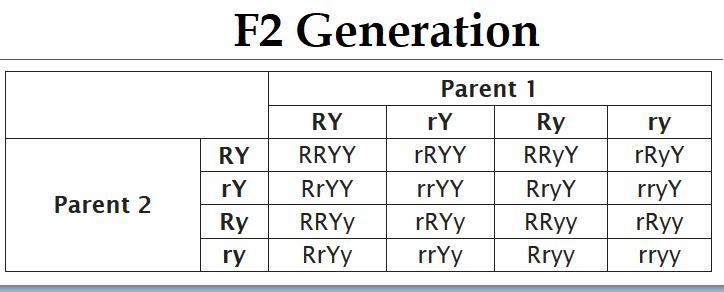
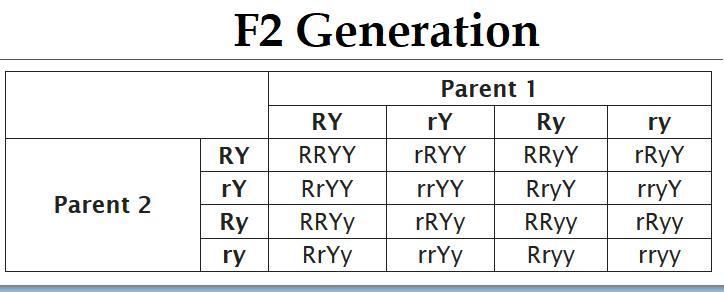
pe is dominant to wrinkled, and yellow pea color is dominant to green. Members of the resulting F1 generation are then crossed to produce an F2 generation, as shown in the figure. On average, what fraction of the F2 generation will display both recessive traits?      

Biology
1 answer:
krok68 [10]2 years ago
6 0

Answer:

1 out of 16 or 1/16

Explanation:

Let:

R = Round seed      r = wrinkled seed

Y = Yellow seed     y = green seed

Starting from the parent generation or the P generation, the genotype of the parents would be:

RRYY x rryy

This is because the cross is between a parents that are "purebred" for specific traits. This means that the parents are homozygous for the traits which in genotype form is represented by either two capital letters or two lower case letters.

Attached is the F1 generation results between a cross between the P generation.

As you can see the genotype of all the offsprings is RrYy.

Now also below is the cross between the F1 generation offsprings.

For recessive traits, it is only expressed when the dominant gene is not in the genotype, or in other words, the genotype is all in small letters. Since we are looking at two traits, you need to look for how many squares out of the total have all lowercase letters.

There is only 1 rryy out of the 16 predictions. So the answer would be 1/16.

You might be interested in
Japan is the leading producer of farm-raised shrimp, offering a lower price than Americans who farm or catch shrimp for a living
il63 [147K]
The most likely answer is
D)Decreased number of fish species who use the estuaries. 

The Japanese model for shrimp farming in estuaries basically involves converting estuary areas into shrimp farms, isolating these areas and dedicating them solely to the farming of shrimp. This excludes other fish species from areas that were previously the environment in which they lived.
7 0
2 years ago
21. Five darts strike near the center of the target. Whoever threw the darts is
shusha [124]
A
?
is most likely the answer
7 0
2 years ago
Nerve fibers from the olfactory bulb project directly to ________. nerve fibers from the olfactory bulb project directly to ____
ohaa [14]

The olfactory cortex (nucus) of the temporal lobe is where the nerve fibers of the olfactory bulb projects directly. This cortex is where you get the smell sensation before determining what the smell actually is. The olfactory cortex is located on the medial aspect of the temporal lobe, particularly in the uncus or the piriform lobe. It is also called the Rhinoencephalon or the nose brain.

6 0
2 years ago
Explain two ways in which the lens is structurally suited to perfrom its function
horsena [70]
The function of the lens is that it allows light rays to focus into the retina. They are composed of fluids that contains lots of nutrients for the lens to gain from it and cleanses dirt if it comes in contact the eye. Overtime, this lens, will slowly degrade as its fluid will start to lose.
5 0
2 years ago
A cell biologist carefully measured the quantity of DNA in grasshopper cells growing in cell culture. Cells examined during the
xz_007 [3.2K]

Answer:

100 units

Explanation:

The interphase of the cell cycle includes three stages: G1, S, and G2. During the S phase of interphase, the cell enters the process of DNA replication. DNA replication duplicates the existing DNA molecule and doubles the DNA content of the cell. The cell accommodates the newly formed DNA in two sister chromatids of chromosomes. If a cell of grasshopper contained 200 units of DNA in the G2 phase, the cell would have 100 units of DNA in the G1 phase. The S phase would have doubled the DNA content and the G2 phase had 200 units.  

7 0
2 years ago
Other questions:
  • A person starts to eat a hamburger. As she takes a bite and chews, an enzyme called salivary lipase helps to begin the process o
    8·2 answers
  • Which of these foods would give the highest positive biuret test chicken butter coconut potatoes cookies?
    12·1 answer
  • Westerlies blow at a curve between 10 and 60 degrees north and south of the equator. What prevents these winds from blowing in a
    5·2 answers
  • In a flowering plant, tall (T) is dominant to short (t), and blue flowers (B) is dominant to white flowers (b). A tall plant wit
    14·1 answer
  • Which of the following is an important exception to the central dogma of molecular biology? a) Proteins are responsible for most
    10·1 answer
  • DNA polymerases are capable of editing and error correction, whereas the capacity for error correction in RNA polymerases appear
    9·1 answer
  • In a certain prairie community, a dominant prairie grass species has recently been infected with a virus that disrupts one of th
    7·1 answer
  • While looking at bacteria under a microscope, you decide to take a break. When you return, the amount of bacteria has doubled in
    15·1 answer
  • Dr. Tanaka discovered a new virus. The virus has a single strand of a nucleic acid, but she does not know if it is DNA or RNA. A
    14·1 answer
  • Promoters and enhancers are DNA sequences both bound directly by ____________.
    8·2 answers
Add answer
Login
Not registered? Fast signup
Signup
Login Signup
Ask question!