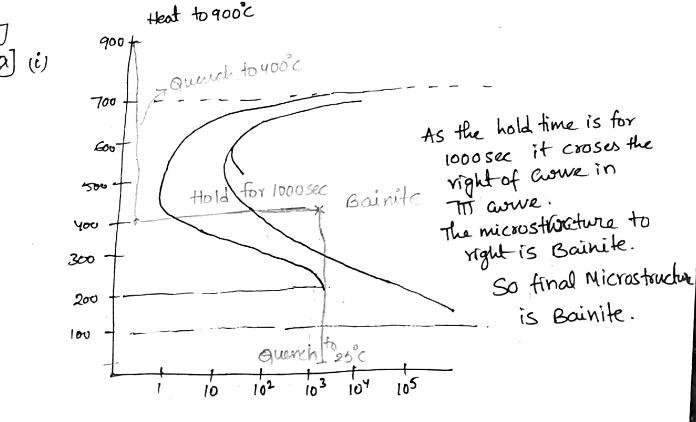
answer.
Ask question
Login Signup
Ask question
All categories
  • English
  • Mathematics
  • Social Studies
  • Business
  • History
  • Health
  • Geography
  • Biology
  • Physics
  • Chemistry
  • Computers and Technology
  • Arts
  • World Languages
  • Spanish
  • French
  • German
  • Advanced Placement (AP)
  • SAT
  • Medicine
  • Law
  • Engineering
Damm [24]
2 years ago
6

A 6cm OD, 2cm thick copper hollow sphere [k=386W/m.C] is uniformly heated at the inner surface at a rate of 150W/m2. The outside

surface is cooled with air at 20C with a heat transfer coefficient of 10W/m2.oC. Calculate the temperature of the outer surface
Engineering
1 answer:
Misha Larkins [42]2 years ago
6 0

Answer:

The outside surface temperature=21.66 C.

Explanation:

Given that

Outer diameter=6 cm

Inner diameter=2 cm

Heat\ flux\ at\ inner\ surface\q=150\frac{W}{m^2}

Outside temperature=20 C

Outside\ heat\ transfer\ coefficient=10\frac{W}{m^2-K}

To find the outside temperature

Heat out from sphere=Heat absorb by surrounding

q\times A_i=hA_o\Delta T

q\times d_i^2=hd_o^2(T_o-20)

Now by putting the values

150\times 2_i^2=10\times 6_o^2(T_o-20)

So\ T_o=21.66C

So the outside surface temperature=21.66 C.

You might be interested in
a. (24 points) Describe the microstructure present in a 10110 steel after each step in each of the following heat treatments (no
Mrac [35]

Answer:

Explanation:

Please check the below file for the attached file

6 0
2 years ago
three balls each have a mass m if a has a speed v just before a direct collision with B determine the speed of C after collision
ratelena [41]

Answer:

Vc2= V(l+e) ^2/4

Vg2= V(l-e^2)/4

Explanation:

Conservation momentum, when ball A strikes Ball B

Where,

M= Mass

V= Velocity

Ma(VA)1+ Mg(Vg)2= Ma(Va)2+ Ma(Vg)2

MV + 0= MVg2

Coefficient of restitution =

e= (Vg)2- (Va)2/(Va)1- (Vg)1

e= (Vg)2- (Va)2/ V-0

Solving equation 1 and 2 yield

(Va)2= V(l-e) /2

(Vg)2= V(l+e)/2

Conservative momentum when ball b strikes c

Mg(Vg)2+Mc(Vc)1 = Mg(Vg)3+Mc(Vc)2

=> M[V(l+e) /2] + 0 = M(Vg)3 + M(Vc) 2

Coefficient of Restitution,

e= (Vc)2 - (Vg)2/(Vg)2- (Vc)1

=> e= (Vc)2 - (Vg)2/V(l+e) /2

Solving equation 3 and 4,

Vc2= V(l+e) ^2/4

Vg2= V(l-e^2)/4

8 0
2 years ago
Read 2 more answers
A certain printer requires that all of the following conditions be satisfied before it will send a HIGH to la microprocessor ack
Elza [17]

Answer:

D) AND gate.

Explanation:

Given that:

A certain printer requires that all of the following conditions be satisfied before it will send a HIGH to la microprocessor acknowledging that it is ready to print

These conditions are:

1. The printer's electronic circuits must be energized.

2. Paper must be loaded and ready to advance.

3. The printer must be "on line" with the microprocessor.

Now; if these conditions are met  the logic gate produces a HIGH output indicating readiness to print.

The objective here is to determine the basic logic gate used in this circuit.

Now;

For NOR gate;

NOR gate gives HIGH only when all the inputs are low. but the question states it that "a HIGH is generated and applied to a 3-input logic gate". This already falsify NOR gate to be the right answer.

For NOT gate.

NOT gate operates with only one input and one output device but here; we are dealing with 3-input logic gate.

Similarly, OR gate gives output as a high if any one of the input signals is high but we need "a HIGH that is generated and applied to a 3-input logic gate".

Finally, AND gate output is HIGH only when all the input signal is HIGH and vice versa, i.e AND gate output is LOW only when all the input signal is LOW. So AND gate satisfies the given criteria that; all the three conditions must be true for the final signal to be HIGH.

3 0
2 years ago
The force exerted on a bridge pier in a river is to be tested in a 1:10 scale model using water as the working fluid. In the pro
Len [333]

Answer:

Force on the prototype is 5000 N

Solution:

As per the question:

Depth of water, x = 2.0 m

Flow velocity, v' = 1.5 m/s

Width of the river, w = 20 m

Force on the bridge pier model, F' = 5 N

Pressure, Ratio = Ratio of scale length

Scale = 1:10

Now,

\frac{P'}{P} = \frac{x}{w} = \frac{2.0}{20}

where

P' = pressure on model

P = pressure on prototype

\frac{\frac{F'}{A'}}{\frac{F}{A}} = \frac{1}{10}

where

F' = Force on model

F = Force on prototype

A' = Area of model

A = Area of prototype

Now:

\frac{F'}{F}.\frac{A}{A'} = \frac{1}{10}

\frac{5}{F}.\frac{1}{\frac{1}{10}}.\frac{1}{\frac{1}{10}} = \frac{1}{10}

F = 5000 N

3 0
2 years ago
A completely reversible heat pump produces heat at a rate of 300 kW to warm a house maintained at 24°C. The exterior air, which
Westkost [7]

Answer:

Entropy generation rate of the two reservoirs is approximately zero (\dot S_{gen} = 9.318 \times 10^{-4}\,\frac{kW}{K}) and system satisfies the Second Law of Thermodynamics.

Explanation:

Reversible heat pumps can be modelled by Inverse Carnot's Cycle, whose key indicator is the cooling Coefficient of Performance, which is the ratio of heat supplied to hot reservoir to input work to keep the system working. That is:

COP_{H} = \frac{\dot Q_{H}}{\dot W}

The following simplification can be used in the case of reversible heat pumps:

COP_{H,rev} = \frac{T_{H}}{T_{H} - T_{L}}

Where temperature must written at absolute scale, that is, Kelvin scale for SI Units:

COP_{H, rev} = \frac{297.15\,K}{297.15\,K-280.15\,K}

COP_{H, rev} = 17.479

Then, input power needed for the heat pump is:

\dot W = \frac{\dot Q}{COP_{H,rev}}

\dot W = \frac{300\,kW}{17.749}

\dot W = 16.902\,kW

By the First Law of Thermodynamics, heat pump works at steady state and likewise, the heat released from cold reservoir is now computed:

-\dot Q_{H} + \dot W + \dot Q_{L} = 0

\dot Q_{L} = \dot Q_{H} - \dot W

\dot Q_{L} = 300\,kW - 16.902\,kW

\dot Q_{L} = 283.098\,kW

According to the Second Law of Thermodynamics, a reversible heat pump should have an entropy generation rate equal to zero. The Second-Law model for the system is:

\dot S_{in} - \dot S_{out} - \dot S_{gen} = 0

\dot S_{gen} = \dot S_{in} - \dot S_{out}

\dot S_{gen} = \frac{\dot Q_{L}}{T_{L}} - \frac{\dot Q_{H}}{T_{H}}

\dot S_{gen} = \frac{283.098\,kW}{280.15\,K} - \frac{300\,kW}{297.15\,K}

\dot S_{gen} = 9.318 \times 10^{-4}\,\frac{kW}{K}

Albeit entropy generation rate is positive, it is also really insignificant and therefore means that such heat pump satisfies the Second Law of Thermodynamics. Furthermore, \dot S_{in} = \dot S_{out}.

5 0
2 years ago
Other questions:
  • Use Lagrange multiplier techniques to find the local extreme values of the given function subject to the stated constraint. If a
    15·1 answer
  • tech A says that a Hall-effect sensor can be used in an electronic ignition system. Tech B says that an optical-type sensor can
    6·1 answer
  • A 5-cm-diameter shaft rotates at 4500 rpm in a 15-cmlong, 8-cm-outer-diameter cast iron bearing (k = 70 W/m·K) with a uniform cl
    10·1 answer
  • thermal energy is being added to steam at 475.8 kPa and 75% quality. determine the amount of thermal energy to be added to creat
    15·1 answer
  • The device whose operation closely matches the way the clamp-on ammeter works is
    14·1 answer
  • A thin, flat plate that is 0.2 m × 0.2 m on a side is oriented parallel to an atmospheric airstream having a velocity of 40 m/s.
    5·2 answers
  • Benzene vapor at 480°C is cooled and converted to a liquid at 25°C in a continuous condenser. The condensate is drained into 1.7
    15·1 answer
  • An ideal Diesel cycle has a compression ratio of 18 and a cutoff ratio of 1.5. Determine the maximum air temperature and the rat
    9·1 answer
  • Toeboards are usually ___ inches high and used on landings and balconies.
    8·1 answer
  • A spring-loaded toy gun is used to shoot a ball of mass m = 1.50 kg straight up in the air. The spring has spring constant k = 6
    13·1 answer
Add answer
Login
Not registered? Fast signup
Signup
Login Signup
Ask question!