answer.
Ask question
Login Signup
Ask question
All categories
  • English
  • Mathematics
  • Social Studies
  • Business
  • History
  • Health
  • Geography
  • Biology
  • Physics
  • Chemistry
  • Computers and Technology
  • Arts
  • World Languages
  • Spanish
  • French
  • German
  • Advanced Placement (AP)
  • SAT
  • Medicine
  • Law
  • Engineering
Zigmanuir [339]
2 years ago
10

Another focus of effective communication, according to Stephen Covey, is ensuring that:

Engineering
2 answers:
svetoff [14.1K]2 years ago
4 0

Answer:

Stephen Covey believes this principle is the key to effective interpersonal communication. Seek first to understand, then to be understood. This habit is about communicating with others. It's about developing the habit of listening carefully and really understanding the other person BEFORE giving your thoughts.

Explanation:

Nana76 [90]2 years ago
4 0

Answer:

understanding others first before starting to explain your own point

Explanation:

Stephen covey believes the key to effective communication is understanding others first before starting to explain your own point. Communication is an important skill in life, in which one must have a good character in order to communicate effectively.

You might be interested in
A spring-loaded toy gun is used to shoot a ball of mass m = 1.50 kg straight up in the air. The spring has spring constant k = 6
adell [148]

Answer:

1) a) Mechanical energy is conserved because no dissipative forces perform work on the ball.

2) The muzzle velocity of the ball is approximately 5.272 meters per second.

3) The maximum height of the ball is 1.417 meters.

Explanation:

1) Which of the following statements are true?

a) Mechanical energy is conserved because no dissipative forces perform work on the ball.

True, statement indicates that there is no air resistence and no friction between ball and the inside of the gun because the first never touches the latter one.

b) The forces of gravity and the spring have potential energies associated with them.

False, force of gravity do work on the ball and spring receives a potential energy at being deformated by the ball.

c) No conservative forces act in this problem after the ball is released from the spring gun.

False, the absence of no conservative forces is guaranteed for the entire system according to the statement of the problem.

2) According to the statement, we understand that spring is deformed and once released and just after reaching its equilibrium position, the muzzle velocity is reached. As spring deformation is too small in comparison with height, we can neglect changes in gravitational potential energy. By Principle of Energy Conservation, we describe the motion of the ball by the following expression:

U_{k, 1}+K_{1}=U_{k,2}+K_{2} (Eq. 1)

Where:

U_{k,1}, U_{k,2} - Initial and final elastic potential energies of spring, measured in joules.

K_{1}, K_{2} - Initial and final translational kinetic energies of the ball, measured in joules.

After using definitions of elastic potential and translational kinetic energies, we expand the equation above as:

\frac{1}{2}\cdot m\cdot (v_{2}^{2}-v_{1}^{2}) = \frac{1}{2}\cdot k\cdot (x_{1}^{2}-x_{2}^{2})

And the final velocity is cleared:

m\cdot (v_{2}^{2}-v_{1}^{2}) = k\cdot (x_{1}^{2}-x_{2}^{2})

v_{2}^{2}-v_{1}^{2} =\frac{k}{m}\cdot (x_{1}^{2}-x_{2}^{2})

v_{2}^{2} =v_{1}^{2}+\frac{k}{m}\cdot (x_{1}^{2}-x_{2}^{2})

v_{2} = \sqrt{v_{1}^{2}+\frac{k}{m}\cdot (x_{1}^{2}-x_{2}^{2}) } (Eq. 2)

Where:

v_{1}, v_{2} - Initial and final velocities of the ball, measured in meters per second.

k - Spring constant, measured in newtons per meter.

m - Mass of the ball, measured in kilograms.

x_{1}, x_{2} - Initial and final position of spring, measured in meters.

If we know that v_{1} = 0\,\frac{m}{s}, k = 667\,\frac{N}{m}, m = 1.50\,kg, x_{1} = -0.25\,m and x_{2} = 0\,cm, the muzzle velocity of the ball is:

v_{2} =\sqrt{\left(0\,\frac{m}{s} \right)^{2}+\left(\frac{667\,\frac{N}{m} }{1.50\,kg} \right)\cdot [(-0.25\,m)^{2}-(0\,m)^{2}]}

v_{2}\approx 5.272\,\frac{m}{s}

The muzzle velocity of the ball is approximately 5.272 meters per second.

3) After leaving the toy gun, the ball is solely decelerated by gravity. We construct this model by Principle of Energy Conservation:

U_{g,2}+K_{2} = U_{g,3}+K_{3} (Eq. 3)

Where:

U_{g,2}, U_{g,3} - Initial and gravitational potential energies of the ball, measured in joules.

K_{2}, K_{3} - Initial and final translational kinetic energies of the ball, measured in joules.

After applying definitions of gravitational potential and translational kinetic energies, we expand the equation above and solve the resulting for the final height:

m\cdot g \cdot (h_{3}-h_{2}) = \frac{1}{2}\cdot m \cdot (v_{2}^{2}-v_{3}^{2})

h_{3}-h_{2}=\frac{v_{2}^{2}-v_{3}^{2}}{2\cdot g}

h_{3} = h_{2} +\frac{v_{2}^{2}-v_{3}^{2}}{2\cdot g} (Eq. 4)

h_{2}, h_{3} - Initial and final heights of the ball, measured in meters.

v_{2}, v_{3} - Initial and final velocities of the ball, measured in meters per second.

g - Gravitational acceleration, measured in meters per square second.

If we get that v_{2} = 5.272\,\frac{m}{s}, v_{3} = 0\,\frac{m}{s}, h_{2} = 0\,m and g = 9.807\,\frac{m}{s^{2}}, the maximum height of the ball is:

h_{3} = 0\,m+\frac{\left(5.272\,\frac{m}{s} \right)^{2}-\left(0\,\frac{m}{s} \right)^{2}}{2\cdot \left(9.807\,\frac{m}{s^{2}} \right)}

h_{3} = 1.417\,m

The maximum height of the ball is 1.417 meters.

5 0
2 years ago
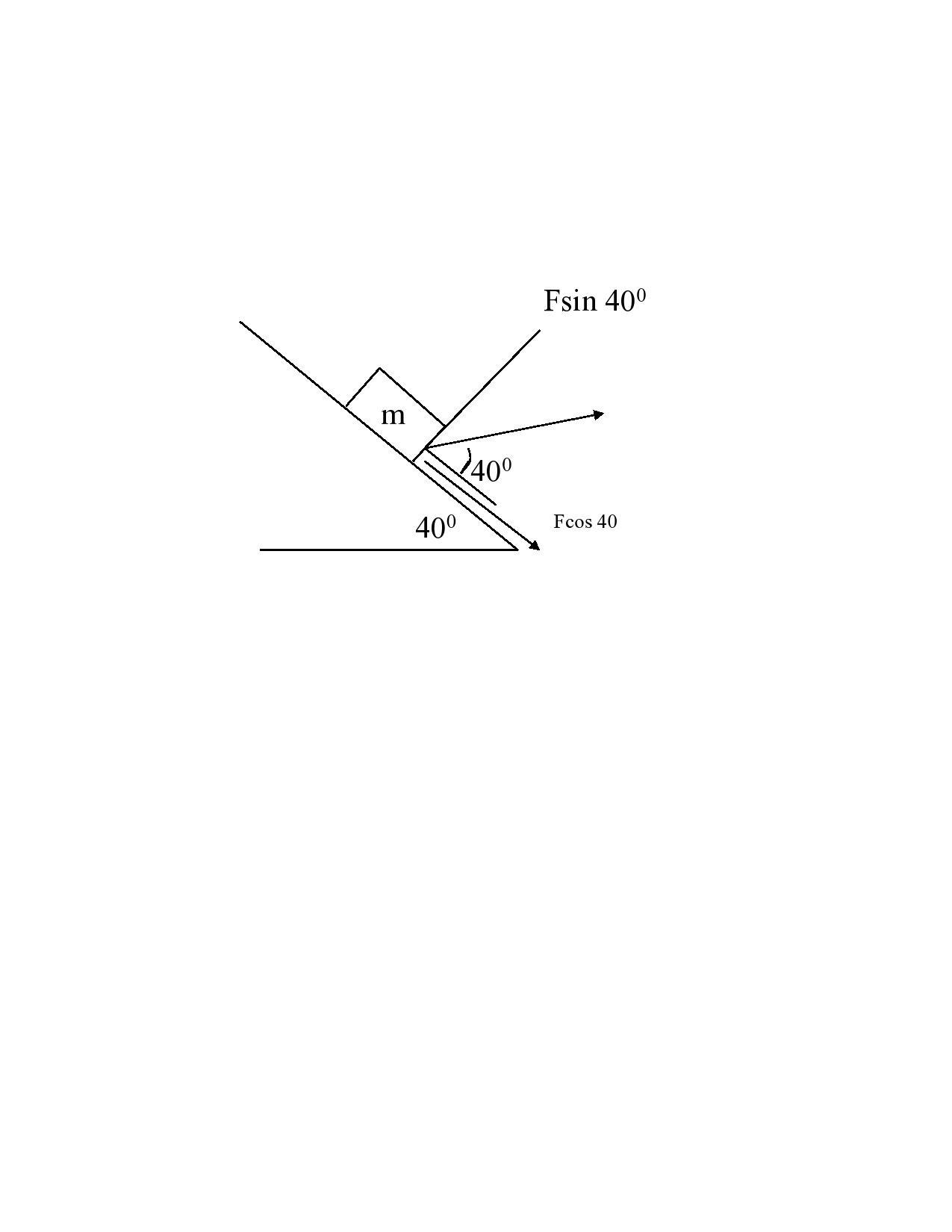
The 10-kg block slides down 2 m on the rough surface with kinetic friction coefficient μk = 0.2. What is the work done by the fr
Rashid [163]

Answer:

153.2 J

Explanation:

Let's first list our given parameters;

mass (m) of the block = 10 kg

which slides down ( i.e displacement) = 2 m

kinetic coefficient of friction (μk) = 0.2

In the diagram shown below;  if we take an integral look at the component of force in the direction of the displacement; we have

F_x= Fcos 40°

F_x= 100 (cos 40°)

F_x= 76.60 N

Workdone by the friction force can now be determined as:

W = F_x × displacement

W = 76.60 × 2

W = 153.2 J

∴  the work done by the friction force = 153.2 J

7 0
2 years ago
Two metallic terminals protrude from a device. The terminal on the left is the positive reference for a voltage called vx (the o
tresset_1 [31]

Answer:

Vx = 6.242 x 10raised to power 15

Vy = -6.242 x 10raised to power 15

Explanation:

from E = IVt

but V = IR from ohm's law and Q = It from faraday's first law

I = Q/t

E = Q/t x V x t = QV

hence, E =QV

V = E/Q

3 0
2 years ago
Read 2 more answers
what is the advantage of decreasing the field current of a separately excited dc motor below its nominal value
enyata [817]

Answer:

Ability to rotate at higher speeds

Explanation:

Constant K1 becomes greater than the other constant K2

This translates to that the motor being able to rotate at high speeds, without necessarily exceeding the nominal armature voltage.

The armature voltage is the voltage that is developed around the terminals of the armature winding of an Alternating Current, i.e AC or a Direct Current, i.e DC machine during the period in which it tries to generate power.

6 0
2 years ago
Write a method printShampooInstructions(), with int parameter numCycles, and void return type. If numCycles is less than 1, prin
kirill [66]

Answer:

// The method is defined with a void return type

// It takes a parameter of integer called numCycles

// It is declared static so that it can be called from a static method

public static void printShampooInstructions(int numCycles){

// if numCycles is less than 1, it display "Too few"

   if (numCycles < 1){

       System.out.println("Too few.");

   }

// else if numCycles is less than 1, it display "Too many"

    else if (numCycles > 4){

       System.out.println("Too many.");

   }

// else it uses for loop to print the number of times to display

// Lather and rinse

  else {

       for(int i = 1; i <= numCycles; i++){

           System.out.println(i + ": Lather and rinse.");

       }

       System.out.println("Done");


   }

}

Explanation:

The code snippet is written in Java. The method is declared static so that it can be called from another static method. It has a return type of void. It takes an integer as parameter.

It display "Too few" if the passed integer is less than 1. Or it display "Too much" if the passed integer is more than 4. Else it uses for loop to display "Lather and rinse" based on the passed integer.

8 0
2 years ago
Other questions:
  • The hot water needs of an office are met by heating tab water by a heat pump from 16 C to 50 C at an average rate of 0.2 kg/min.
    5·1 answer
  • Water has a density of 1.94 slug/ft^3. What is the density expressed in SI units? Express the answer to three significant figure
    8·1 answer
  • A woman approaches a room attendant with a letter. She requests that the attendant leave the letter in Room 1201. Which is the m
    9·1 answer
  • A 0.9% solution of NaCl is considered isotonic to mammalian cells. what molar concentration is this?
    10·1 answer
  • Consider a very long rectangular fin attached to a flat surface such that the temperature at the end of the fin is essentially t
    9·1 answer
  • Add a calculated field named AccountTime that calculates the number of days each client's accounts have been open. Assume today'
    6·1 answer
  • Steam at 40 bar and 500o C enters the first-stage turbine with a volumetric flow rate of 90 m3 /min. Steam exits the turbine at
    9·1 answer
  • if the mine winch drum diameter is 6 m, calculate how far the cage will drop for each single rotation of the drum
    9·1 answer
  • A rectangular channel 3.0 m wide has a flow rate of 5.0 m3/s with a normal depth of 0.50 m. The flow then encounters a dam that
    9·1 answer
  • Most fatal collisions in Florida happen during
    8·2 answers
Add answer
Login
Not registered? Fast signup
Signup
Login Signup
Ask question!