answer.
Ask question
Login Signup
Ask question
All categories
  • English
  • Mathematics
  • Social Studies
  • Business
  • History
  • Health
  • Geography
  • Biology
  • Physics
  • Chemistry
  • Computers and Technology
  • Arts
  • World Languages
  • Spanish
  • French
  • German
  • Advanced Placement (AP)
  • SAT
  • Medicine
  • Law
  • Engineering
JulijaS [17]
2 years ago
9

A Coca Cola can with diameter 62 mm and wall thickness 300 um has an internal pressure of 100 kPa. Calculate the principal stres

ses at a point on the cylindrical surface of the can far from its ends.
Engineering
1 answer:
GarryVolchara [31]2 years ago
4 0

Answer:

\sigma _1=10.33MPa

\sigma _2=5.16MPa

Explanation:

Given that

Diameter(d)=62 mm

Thickness(t)= 300 μm=0.3 mm

Internal pressure(P)=100 KPa

Actually there is no any shear stress so normal stress will become principle stress.This is the case of thin cylinder.The stress in thin cylinder are hoop stress and longitudinal stress .

The hoop stress

\sigma _h=\dfrac{Pd}{2t}

Longitudinal stress

\sigma _l=\dfrac{Pd}{4t}

Now by putting the values

\sigma _h=\dfrac{Pd}{2t}

\sigma _h=\dfrac{100\times 62}{2\times 0.3}

\sigma _h=10.33MPa

\sigma _l=5.16MPa

So the principle stress are

\sigma _1=10.33MPa

\sigma _2=5.16MPa

You might be interested in
A curve in a speed track has a radius of 1000 ft and a rated speed of 120 mi/h. (From Sample Prob. 12.7 is the definition of rat
forsale [732]

Answer:

tan \theta = \frac{(176ft/s)^2}{1000 ft 32.2 ft/s^2}= 0.962

\theta = tan^{-1} (0.962) = 43.89

Explanation:

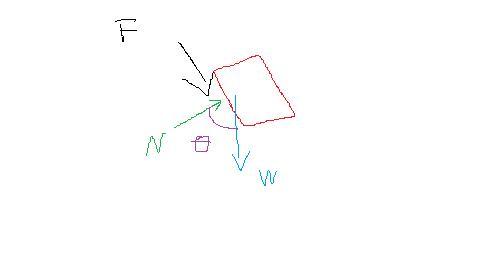
If the question is: Determine the banking angle θ

We have the forces involved on the figure attached.

For this case we know that the weight is given by:

W = mg

And for this case the centripetal acceleration would be given by:

a=\frac{v^2}{r}

If we analyze the sum of forces on x and y we have:

\sum F_x = m a_x

F + W sin \theta = ma cos theta

And if we solve for the force we got:

F = ma cos \theta - mg sin \theta = \frac{mv^2}{r} cos \theta - mg sin \theta

\sum F_y = m a_y

N - W cos \theta = ma sin \theta

If we solve for the normal force we got:

N =W cos \theta + ma sin \theta = \frac{mv^2}{r} sin \theta + mg cos \theta

In order to find the banking angle we use the fact that F =0

0 = \frac{mv^2}{r} cos \theta - mg sin \theta

tan \theta= \frac{v^2}{rg}

The velocity on this case is 120 mi/h if we convert this into ft/ s we got:

120 mi/h * \frac{5280 ft}{1mi} *\frac{1hr}{3600 s}= 176 ft/s

And then we have this:

tan \theta = \frac{(176ft/s)^2}{1000 ft 32.2 ft/s^2}= 0.962

\theta = tan^{-1} (0.962) = 43.89

5 0
2 years ago
An electrical utility delivers 6.25E10 kWh of power to its customers in a year. What is the average power required during the ye
Sindrei [870]

Answer:

The overall Utility delivered to customers in a year 'U' = 6.25 X 10¹⁰Kwh

However, the average power P, required for a year, t  = ? Kw

Expressing their relationship, we will have

             U = P x t

Given t = 1 year = 24 x 365 hours (assume a year operation is 365 days)

          t = 8760 hours

P = \frac{62500000000}{8760}

P = 7134.7Kw

Hence, the average power required during the year is 7,135Kw

Now to calculate the energy used by the power plant in a year (in quads)?

Recall, Efficiency, η = Power Output/Power Input (100)

so, we have

η = P₀/P₁, given

0.45 = \frac{7134.7Kw}{P₁}

P₁ = 15,855Kw

the total energy E₁ used in a year = 15,855x24x365 = 138.89MJoules

So to convert this to quads, Note;

1 quads of energy = 10¹⁵ Joules

The total energy used is 0.000000139 quads

Now to find the cubic feet of natural gas required to generate this power?

Note: 0.29Kwh of Power generated  = 1 cubic feet of natural gas used

Since, the power plant generated = 62500000000Kwh

The cubic feet of natural gas used = \frac{62500000000}{0.29}

Hence, 2.155x10²⁰cubic feet of N.gas was used to generate this much power.

8 0
2 years ago
In which of the following branches of engineering is the practice not restricted?
fgiga [73]

Answer:

a) civil engineering.

Explanation:

Civil engineering is a professional engineering program that deals with the construction, design, and maintenance of all the natural and man-made environments including dams, buildings, railways, and roads.

Civil engineering is the branch of engineering that is the practice not restricted because civil engineer is not restricted to academic profession but practice in designing and construction can make someone a professional civil engineer.

Hence, the correct answer is "a)."

6 0
2 years ago
Read 2 more answers
Write a method printShampooInstructions(), with int parameter numCycles, and void return type. If numCycles is less than 1, prin
kirill [66]

Answer:

// The method is defined with a void return type

// It takes a parameter of integer called numCycles

// It is declared static so that it can be called from a static method

public static void printShampooInstructions(int numCycles){

// if numCycles is less than 1, it display "Too few"

   if (numCycles < 1){

       System.out.println("Too few.");

   }

// else if numCycles is less than 1, it display "Too many"

    else if (numCycles > 4){

       System.out.println("Too many.");

   }

// else it uses for loop to print the number of times to display

// Lather and rinse

  else {

       for(int i = 1; i <= numCycles; i++){

           System.out.println(i + ": Lather and rinse.");

       }

       System.out.println("Done");


   }

}

Explanation:

The code snippet is written in Java. The method is declared static so that it can be called from another static method. It has a return type of void. It takes an integer as parameter.

It display "Too few" if the passed integer is less than 1. Or it display "Too much" if the passed integer is more than 4. Else it uses for loop to display "Lather and rinse" based on the passed integer.

8 0
2 years ago
. A piston-cylinder device whose piston is resting on top of a set of stops initially contains 0.5 kg of helium gas at 100 kPa a
Delvig [45]

Answer:

Qin = 1857 kJ

Explanation:

Given

m = 0.5 Kg

T₁ = 25°C = (25 + 273) K = 298 K

P₁ = 100 kPa

P₂ = 500 kPa

First, the temperature when the piston starts rising is determined from the ideal gas equations at the initial state and at that state:

T₂ = T₁*P₂/P₁

⇒  T₂ = 298 K*(500 kPa/100 kPa) = 1490 K

Until the piston starts rising no work is done so the heat transfer is the change in internal energy

Qin = ΔU = m*cv*(T₂-T₁)

⇒   Qin = 0.5*3.1156*(1490 - 298) kJ = 1857 kJ

8 0
2 years ago
Other questions:
  • Define a) Principal Plane b) Principal Stress c) anelasticity d) yield point e) ultimate tensile stress f) hardness g) toughness
    5·1 answer
  • Write a program that prompts the user to enter time in 12-hour notation. The program then outputs the time in 24-hour notation.
    6·1 answer
  • The in situ moist unit weight of a soil is 17.3 kN/m^3 and the moisture content is 16%. The specific gravity of soil solids is 2
    11·1 answer
  • Which statement concerning symbols used on plans is true?
    10·1 answer
  • Can crushers help us recycle in a space efficient way which is good for saving the earth and for giving you more room in your ap
    7·1 answer
  • A thin-walled tube with a diameter of 6 mm and length of 20 m is used to carry exhaust gas from a smoke stack to the laboratory
    7·1 answer
  • In this module you learned about searching, sorting and algorithms in C++ and how to implement these elements in your C++ progra
    6·1 answer
  • the ____ method is the safest turning technique to use as it does not expose your hands to the airbags deployment area
    15·1 answer
  • 11 Notează, în caiet, trăsăturile personajelor ce se pot
    13·1 answer
  • Mr. Ray deposited $200,000 in the Old and Third National Bank. If the bank pays 8% interest, how much will he have in the accoun
    10·2 answers
Add answer
Login
Not registered? Fast signup
Signup
Login Signup
Ask question!