answer.
Ask question
Login Signup
Ask question
All categories
  • English
  • Mathematics
  • Social Studies
  • Business
  • History
  • Health
  • Geography
  • Biology
  • Physics
  • Chemistry
  • Computers and Technology
  • Arts
  • World Languages
  • Spanish
  • French
  • German
  • Advanced Placement (AP)
  • SAT
  • Medicine
  • Law
  • Engineering
zavuch27 [327]
2 years ago
9

The following program includes fictional sets of the top 10 male and female baby names for the current year. Write a program tha

t creates: A set all_names that contains all of the top 10 male and all of the top 10 female names. A set neutral_names that contains only names found in both male_names and female_names. A set specific_names that contains only gender specific names. Sample output for all_names: {'Michael', 'Henry', 'Jayden', 'Bailey', 'Lucas', 'Chuck', 'Aiden', 'Khloe', 'Elizabeth', 'Maria', 'Veronica', 'Meghan', 'John', 'Samuel', 'Britney', 'Charlie', 'Kim'}

Engineering
2 answers:
yuradex [85]2 years ago
4 0

Answer:

Please see attachment

Explanation:

Please see attachment

otez555 [7]2 years ago
3 0

Answer:

Define Variables and Use List methods to do the following

Explanation:

#<em>Conjoins two lists together</em>

all_names = male_names.union(female_names)

#<em>Finds the names that appear in both lists, just returns those</em>

neutral_names = male_names.intersection(female_names)

#<em>Returns names that are NOT in both lists</em>

specific_names = male_names.symmetric_difference(female_names)

You might be interested in
What is the damped natural frequency (in rad/s) of a second order system whose undamped natural frequency is 25 rad/s and has a
TiliK225 [7]

Answer:

damped natural frequency = 23.84 rad/s

Explanation:

given data

damping ratio = 0.3

undamped natural frequency = 25 rad/s

to find out

damped natural frequency of a second order system

solution

we know that if damping ratio is = 0

then it is undamped system

and if damping ratio is > 1

then it is overdamped system

and  and if damping ratio is ≈ 1

then it is critical damped system

so damped natural frequency of a second order system formula is

damped natural frequency = wn × \sqrt{1-r^2}

here wn is undamped natural frequency and r is damping ratio

damped natural frequency = 25 × \sqrt{1-0.3^2}

damped natural frequency = 23.84 rad/s

3 0
2 years ago
The pressure drop across a valve through which air flows is expected to be 10 kPa. If this differential were applied to the two
ozzi

Answer:hit that soulja boy

Explanation:

6 0
2 years ago
The pump of a water distribution system is powered by a 6-kW electric motor whose efficiency is 95 percent. The water flow rate
Sonja [21]

Answer:

a) Mechanical efficiency (\varepsilon)=63.15%  b) Temperature rise= 0.028ºC

Explanation:

For the item a) you have to define the mechanical power introduced (Wmec) to the system and the power transferred to the water (Pw).

The power input (electric motor) is equal to the motor power multiplied by the efficiency. Thus, Wmec=0.95*6kW=5.7 kW.

Then, the power transferred (Pw) to the fluid is equal to the flow rate (Q) multiplied by the pressure jump \Delta P. So P_W = Q*\Delta P=0.018m^3/s * 200x10^3 Pa=3600W.

The efficiency is defined as the ratio between the output energy and the input energy. Then, the mechanical efficiency is \varepsilon=3.6kW/5.7kW=0.6315=63.15\%

For the b) item you have to consider that the inefficiency goes to the fluid as heat. So it is necessary to use the equation of the heat capacity but in a "flux" way. Calling <em>H</em> to the heat transfered to the fluid, the specif heat of the water and \rho the density of the water:

[tex]H=(5.7-3.6) kW=\rho*Q*c*\Delta T=1000kg/m^3*0.018m^3/s*4186J/(kg \ºC)*\Delta T[/tex]

Finally, the temperature rise is:

\Delta T=2100/75348 \ºC=0.028 \ºC

7 0
2 years ago
A 60-kg woman holds a 9-kg package as she stands within an elevator which briefly accelerates upward at a rate of g/4. Determine
Anuta_ua [19.1K]

Answer:

force R = 846.11 N

lifting force L = 110.36 N

if cable fail complete both R and L will be zero

Explanation:

given data

mass woman mw = 60 kg

mass package mp = 9 kg

accelerates rate a = g/4

to find out

force R and lifting force L and if cable fail than what values would R and L acquire

solution

we calculate here first reaction R force

we know elevator which accelerates upward

so now by direction of motion , balance the force that is express as

R - ( mw + mp ) × g = ( mw + mp ) × a

here put all these value and a = g/4 and use g = 9.81 m/s²

R - ( 60 + 9 ) × 9.81 = ( 60 + 9  ) × g/4

R = ( 69  ) × 9.81/4  + ( 69 ) 9.81

R = 69  ( 9.81 + 2.4525 )

force R = 846.11 N

and

lifting force is express as here

lifting force = mp ( g + a)

put here value

lifting force = 9 ( 9.81 + 9.81/4)

lifting force L = 110.36 N

and

we know if cable completely fail than body move free fall and experience no force

so both R and L will be zero

5 0
2 years ago
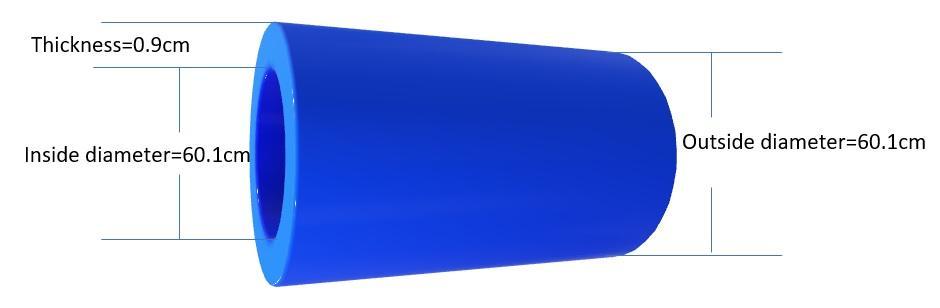
Water is flowing in a metal pipe. The pipe OD (outside diameter) is 61 cm. The pipe length is 120 m. The pipe wall thickness is
Yuki888 [10]

Answer:

1113kN

Explanation:

The ouside diameter OD of the pipe is 61cm and the thickness T is 0.9cm, so the inside diameter ID will be:

Inside Diameter = Outside Diameter - Thickness

Inside Diameter = 61cm - 0.9cm = 60.1cm

Converting this diameter to meters, we have:

60.1cm*\frac{1m}{100cm}=0.601m

This inside diameter is useful to calculate the volume V of water inside the pipe, that is the volume of a cylinder:

V_{water}=\pi  r^{2}h

V_{water}=\pi (\frac{0.601m}{2})^{2}*120m

V_{water}=113.28m^{3}

The problem gives you the water density d as 1.0kg/L, but we need to convert it to proper units, so:

d_{water}=1.0\frac{Kg}{L}*\frac{1L}{1000cm^{3}}*(\frac{100cm}{1m})^{3}

d_{water}=1000\frac{Kg}{m^{3}}

Now, water density is given by the equation d=\frac{m}{V}, where m is the water mass and V is the water volume. Solving the equation for water mass and replacing the values we have:

m_{water}=d_{water}.V_{water}

m_{water}=1000\frac{Kg}{mx^{3}}*113.28m^{3}

m_{water}=113280Kg

With the water mass we can find the weight of water:

w_{water}=m_{water} *g

w_{water}=113280kg*9.8\frac{m}{s^{2}}

w_{water}=1110144N

Finally we find the total weight add up the weight of the water and the weight of the pipe,so:

w_{total}=w_{water}+w_{pipe}

w_{total}=1110144N+2500N

w_{total}=1112644N

Converting this total weight to kN, we have:

1112644N*\frac{0.001kN}{1N}=1113kN

7 0
2 years ago
Other questions:
  • As shown, a load of mass 10 kg is situated on a piston of diameter D1 = 140 mm. The piston rides on a reservoir of oil of depth
    9·1 answer
  • 3. (20 points) Suppose we wish to search a linked list of length n, where each element contains a key k along with a hash value
    7·1 answer
  • A particle has an initial velocity of v0 = 14 ft/s to the right, at s0 = 0, and a = 2 ft/s2 to the left. determine its position
    5·1 answer
  • Let Deterministic Quicksort be the non-randomized Quicksort which takes the first element as a pivot, using the partition routin
    13·1 answer
  • Suggest how any sorting algorithm can be augmented in a way to make the best-case count of its key comparisons equal to just n−1
    6·1 answer
  • Argon contained in a closed, rigid tank, initially at 33.7°C, 2.1 bar, and a volume of 4.2 m3, is heated to a final pressure of
    12·1 answer
  • An ideal Diesel cycle has a compression ratio of 18 and a cutoff ratio of 1.5. Determine the maximum air temperature and the rat
    9·1 answer
  • According to the EWR specifications, ___ is responsible for picking up and disposing of debris or rubbish from
    15·1 answer
  • if the mine winch drum diameter is 6 m, calculate how far the cage will drop for each single rotation of the drum
    9·1 answer
  • A dryer is shaped like a long semi-cylindrical duct of diameter 1.5 m. The base of the dryer is occupied with water-soaked mater
    9·1 answer
Add answer
Login
Not registered? Fast signup
Signup
Login Signup
Ask question!