answer.
Ask question
Login Signup
Ask question
All categories
  • English
  • Mathematics
  • Social Studies
  • Business
  • History
  • Health
  • Geography
  • Biology
  • Physics
  • Chemistry
  • Computers and Technology
  • Arts
  • World Languages
  • Spanish
  • French
  • German
  • Advanced Placement (AP)
  • SAT
  • Medicine
  • Law
  • Engineering
ArbitrLikvidat [17]
2 years ago
11

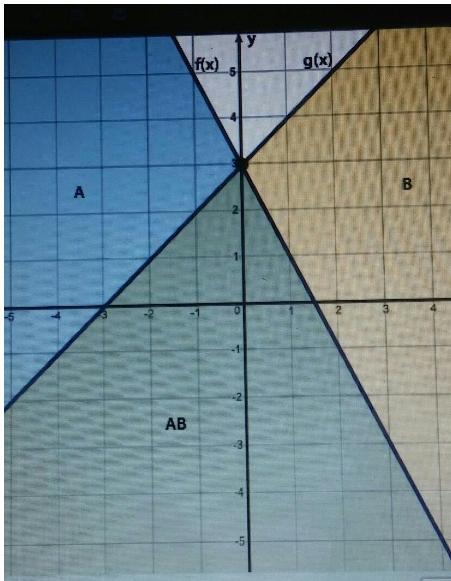
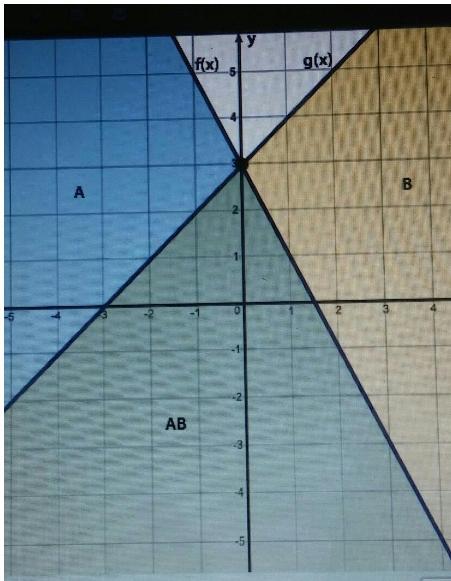
In the graph, the area below f(x) is shaded and labeled A, the area below g(x) is shaded and labeled B, and the area where f(x)

and g(x) have shading in common is labeled AB. Graph of two intersecting lines. One line g of x is solid and goes through the points negative 3, 0, negative 4, negative 1 and is shaded in below the line. The other line f of x is solid, and goes through the points 1, 1, 2, negative 1 and is shaded in below the line. The graph represents which system of inequalities? y ≤ −2x + 3 y ≤ x + 3 y ≥ −2x + 3 y ≥ x + 3 y ≤ −3x + 2 y ≤ −x + 2 y > −2x + 3 y > x + 3

Mathematics
2 answers:
mamaluj [8]2 years ago
6 0

Answer:

First option:  \left \{ {{y\leq -2x + 3} \atop {y \leq x + 3}} \right.

Step-by-step explanation:

The missing graph is attached.

The equation of the line in Slope-Intercept form is:

y=mx+b

Where "m" is the slope and  "b" is the y-intercept.

We can observe that:

1. Both lines have the same y-intercept:

b=3

2. The lines are solid, then the symbol of the inequality must be \leq or \geq.

3. Since both shaded regions are below the solid lines, the symbol is:

\leq

Based on this and looking at the options given, we can conclude that the graph represents the following system of inequalities:

\left \{ {{y\leq -2x + 3} \atop {y \leq x + 3}} \right.

Lubov Fominskaja [6]2 years ago
5 0

Answer:

y ≤ −2x + 3

y ≤ x + 3

Step-by-step explanation:

they both share the slope of 3.

line a has a slope of -2

line b has a slope of 1

the sign ≤ means that the inequalities have a solid line and there below the line.

You might be interested in
A low-strength children’s/adult chewable aspirin tablet contains 81 mg of aspirin per tablet. How many tablets may be prepared f
Svetlanka [38]

Answer:

12,345 tablets may be prepared from 1 kg of aspirin.

Step-by-step explanation:

The problem states that low-strength children’s/adult chewable aspirin tablets contains 81 mg of aspirin per tablet. And asks how many tablets may be prepared from 1 kg of aspirin.

Since the problem measures the weight of a tablet in kg, the first step is the conversion of 81mg to kg.

Each kg has 1,000,000mg. So

1kg - 1,000,000mg

xkg - 81mg.

1,000,000x = 81

x = \frac{81}{1,000,000}

x = 0.000081kg

Each tablet generally contains 0.000081kg of aspirin. How many such tablets may be prepared from 1 kg of aspirin?

1 tablet - 0.000081kg

x tablets - 1kg

0.000081x = 1

x = \frac{1}{0.000081}

x = 12,345 tablets

12,345 tablets may be prepared from 1 kg of aspirin.

4 0
2 years ago
NEED HELP ASAP!!
MArishka [77]
NEED HELP ASAP!!

Math Question: Your Team is given a bag containing a set of colored blocks or counters. The bag contains 5 yellow, 1 red, 6 green, and 8 blue blocks. If you were to reach into the bag and select one block without looking what is the probability of selecting a yellow block and the probability of selecting a green
3 0
2 years ago
The amount of bacteria in a Petri dish increases at a rate proportional to the amount present. At time t=0, the amount of bacter
Nostrana [21]
The answer is A. 70 grams
4 0
2 years ago
The porter family is moving from Baltimore, Maryland, to San Francisco, California. They would like to know what the difference
WARRIOR [948]

Answer:

78

Step-by-step explanation:

Wrong theories the passageway

7 0
2 years ago
Read 2 more answers
A country's population in 1993 was 94 million. in 1999 in was 99 million. estimate the population in 2005 using the exponential
Jet001 [13]
The initial population is
P₀ = 94 million in 1993

The growth formula is
P(t) = P_{0}e^{kt}
where P(t) is the population (in millions) after t years, measured from 1993.
k = constant.

Because P(5) = 99 million (in 1999), 
94e^{5k} = 99 \\e^{5k}=1.0532 \\ 5k = ln(1.0532) \\ k = 0.010367

In the year 2005, t = 12 years, and
P(12)=94e^{0.010367*12} = 106.45

Answer: 106 million (nearest million)
7 0
2 years ago
Other questions:
  • Lenovo uses the​ zx-81 chip in some of its laptop computers. the prices for the chip during the last 12 months were as​ follows:
    9·1 answer
  • Three interior angles of a quadrilateral measure 55, 117 and 120 degrees. What is the measure of the fourth interior angle?
    5·1 answer
  • Rita promises her daughter on her 12th birthday that she will give her $12,000 for college on her 18th birthday. How much does R
    12·2 answers
  • Describe the steps you used to solve the equation and find the amount of Carrie’s allowance. Linear equation:  1 4 a + 1 3 a + 8
    6·2 answers
  • Mr zuro finds the mean height of all 14 students in his class to be 69.0 inches. Just as Mr Zuro finishes explaining how to get
    7·1 answer
  • The extract of a plant native to Taiwan has been tested as a possible treatment for Leukemia. One of the chemical compounds prod
    5·1 answer
  • Solve for x. 3x−1=9x+2 Enter your answer in the box. x =
    7·2 answers
  • The histogram to the right represents the weights​ (in pounds) of members of a certain​ high-school programming team. What is th
    15·1 answer
  • Each side of a square field is 50m long. A barricade is to be placed along the diagonal of the field. Find the length of the bar
    12·2 answers
  • Katie draws 14 pictures in 24 minutes. At this rate, how many pictures can she draw in 312 minutes?
    9·2 answers
Add answer
Login
Not registered? Fast signup
Signup
Login Signup
Ask question!