answer.
Ask question
Login Signup
Ask question
All categories
  • English
  • Mathematics
  • Social Studies
  • Business
  • History
  • Health
  • Geography
  • Biology
  • Physics
  • Chemistry
  • Computers and Technology
  • Arts
  • World Languages
  • Spanish
  • French
  • German
  • Advanced Placement (AP)
  • SAT
  • Medicine
  • Law
  • Engineering
Sav [38]
2 years ago
3

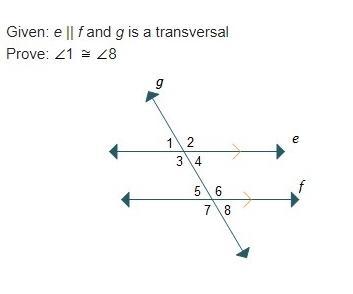
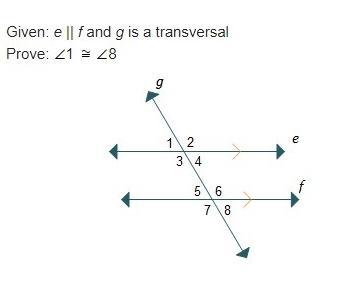
Given: e parallel f and g is a transversal Prove: Angle 1 Is-congruent-to Angle 8 Horizontal and parallel lines e and f are cut

by transversal g. On line e where it intersects line g, 4 angles are formed. Labeled clockwise, from uppercase left, the angles are: 1, 2, 4, 3. On line f where it intersects line g, 4 angles are formed. Labeled clockwise, from uppercase left, the angles are: 5, 6, 8, 7. Given that e parallel f and g is a transversal, we know that Angle 4 Is-congruent-to Angle 5 by the alternate interior angles theorem. We also know that Angle 1 Is-congruent-to Angle 4 and Angle 5 Is-congruent-to Angle 8 by the ________. Therefore, Angle 1 Is-congruent-to Angle 8 by the substitution property. corresponding angles theorem alternate interior angles theorem vertical angles theorem alternate exterior angles theorem

Mathematics
2 answers:
Oksana_A [137]2 years ago
7 0

Answer:

Fourth option: Vertical Angles Theorem.

Step-by-step explanation:

<h3> The missing picture is attached.</h3><h3 />

It is important to remember that when parallel lines are cut by another line (This line is called "Transversal"), several angles are formed. These angles can be made into pair of angles that have the same measure.

 Vertical angles are the opposite pair of angles that share the same vertex and they are congruent whether the lines are parallel or not.

Knowing this, we can identify in the picture that:

 \angle 1 and \angle 4 are opposite and share the same vertex; therefore they are Vertical angles.

 \angle 5 and \angle 8 are opposite and share the same vertex; therefore they are Vertical angles.

 Then:

\angle 1\cong\angle 4 and \angle 5\cong\angle 8  by the Vertical Angles Theorem.

Bess [88]2 years ago
6 0

Answer:

C

Step-by-step explanation:

i took the quiz on edg

You might be interested in
Ms stewart teaches three science classes her students are freshmen and sophomores. her student data are shown in the relative fr
viktelen [127]

Answer:

B) 25% of her students are in chemistry.

Step-by-step explanation:

There were 0.1, or 10%, of freshmen in chemistry.  There were 0.25, or 25%, of sophomores in chemistry.  This is a total of 0.1+0.25 = 0.35, or 35%.

This is not 25%.

4 0
2 years ago
Read 2 more answers
The blue segment below is a diameter of OO. What is the length of the radius of the circle? O A. 2.95 units O B. 11.8 units O c.
Archy [21]

Answer:

The length of the radius is <u><em>2.95 units </em></u>

6 0
1 year ago
If the expression (2ya)4 is equivalent to 16y8 , what is the value of A.
Alex Ar [27]
If you meant:

(2ya)^4=16y^8  raise the left side to the power of four

16y^4*a^4=16y^8  divide both sides by 16y^4

a^4=y^4  take the quartic root of both sides

a=±y  
7 0
2 years ago
What are the x- and y- coordinates of point E, which partitions the directed line segment from J to K into a ratio of 1:4? (–13,
Lana71 [14]

I added a screenshot of the complete question.

<u><em>Answer:</em></u>

(-7, -1)

<u><em>Explanation:</em></u>

<u>The formulas given to calculated the x and y coordinates are as follows:</u>

x = (\frac{m}{m+n})(x_{2}-x_{1}) + x_{1}\\\\y = (\frac{m}{m+n})(y_{2}-y_{1}) + y_{1}

<u>Let's define the variables used:</u>

(x₁ , y₁) are the coordinates of the first point while (x₂ , y₂) are the coordinates of the second point.

<u>We are given that the segment is directed from J to K, therefore:</u>

First point is J ..........> (x₁ , y₁) is (-15, -5)

Second point is K ....> (x₂ , y₂) is (25, 15)

m and n defined the portion of the partitioned segment (JE : EK). It is given that this ratio is 1:4. <u>Therefore:</u>

m = 1 and n = 4

<u>Finally, let's substitute with these variables in the equations as follows:</u>

x = (\frac{1}{1+4})(25-(-15)) + (-15) = -7\\\\y = (\frac{1}{1+4})(15-(-5)) + (-5) = -1

Based on the above, the coordinates of point E are (-7, -1)

Hope this helps :)
8 0
2 years ago
Read 2 more answers
Which expression is equivalent to b^-2/ab^-3 assume a=0 b=0
andrey2020 [161]
B^-2/ab^-3 = b^-2/b^-3 x 1/a = b^[-2-(-3)] x 1/a = b x 1/a = b/a
3 0
2 years ago
Read 2 more answers
Other questions:
  • The image shows a portion of a bridge supported by two vertical pillars built from the points B and C on the slope below. The le
    5·2 answers
  • Thurston wants to retire in Nevada when he is 80 years of age. Thurston, who is now 55, believes he'll need $400,000 to retire c
    6·1 answer
  • A college student needs 11 classes that are worth a total of 40 credits in order to complete her degree. The college offers both
    14·1 answer
  • A student received an 82% on an exam. If there were 50 questions on the exam, which ratio would show the number of questions ans
    6·2 answers
  • The function y=log(x) is translated 1 unit right and 2 units down. Which is the graph of the translated function?
    6·2 answers
  • The parent function f(x) = x3 is transformed to g(x) = (x – 1)3 + 4. Identify the graph of g(x).
    5·2 answers
  • S is the centroid of triangle XYZ. What is the length of SW? 5 units 11 units 22 units 28 units
    12·2 answers
  • When an apple is dropped from a tower 256 feet high, the function h(t) =-167 +256 models the height of the
    7·1 answer
  • Mindy and Daisy are making necklaces using beads. Mindy uses 4 red beads for every 5 white beads. Daisy uses 6 red beads for eve
    7·1 answer
  • All of the following expressions are equal to N except _____. |−N| −(−N) |N| −N
    11·2 answers
Add answer
Login
Not registered? Fast signup
Signup
Login Signup
Ask question!