answer.
Ask question
Login Signup
Ask question
All categories
  • English
  • Mathematics
  • Social Studies
  • Business
  • History
  • Health
  • Geography
  • Biology
  • Physics
  • Chemistry
  • Computers and Technology
  • Arts
  • World Languages
  • Spanish
  • French
  • German
  • Advanced Placement (AP)
  • SAT
  • Medicine
  • Law
  • Engineering
9966 [12]
2 years ago
12

If a worksite includes more than one set of management and workers, who should have access to the information, training, and con

trols needed to avoid workplace accidents?
Engineering
2 answers:
Elden [556K]2 years ago
4 0

Answer:

In a work site with more than one set of management and workers the Health and  safety officers in each set  should have access to the information, training and controls needed to avoid workplace accidents

Explanation:

The primary aim of a health and  safety officer in a workplace is to prevent accidents,injuries and work-related sickness from occurring in the work site by creating and implementing health and safety policies according to international standards and also ensure that these policies are implemented  by the sets of management and workers/staffs of the work site.  to achieve these they therefore should have access to the information,training and controls needed to avoid workplace accidents

Mashcka [7]2 years ago
4 0

Answer:every worker and manager

Explanation:

You might be interested in
A system consisting of 3 lb of water vapor in a piston–cylinder assembly, initially at 350°F and a volume of 71.7 ft3, is expand
Alla [95]

Answer:

isobaric expansion = 281.09 Btu

isothermal compression= 72 Btu

Explanation:

The first law of thermodynamics is:

Q_{AB}=W_{AB}+deltaU_{AB}

where:

Q=heat transferred

W= work

U=internal energy  

W_{AB}=P*(V_{B}-V_{A})

U_{AB}=n*C_{v}(T_{2}-T_{1})

P=pressure, V= volume, T= temperature, n =  moles, Cv= specific heat at constant volume.

In a isobaric process heat transferred is:

Q=P*(V_{B}-V_{A})+n*C_{v}(T_{2}-T_{1})

For an isothermal process (T2-T1 = 0) so

Q=P*(V_{B}-V_{A})= W_{AB}

From the data we know that the energy transferred to the system in the isothermal compression by work was 72 Btu that is the heat transferred to the system.

For the first process

Q=P*(V_{B}-V_{A})+n*C_{v}(T_{2}-T_{1})

we have to properties at the beginning of the process : temperature (350°F) and specific volume (V/mass)

specific-volume=\frac{71.7 ft^{3}}{3Lb}=23.9\frac{ft^{3}}{Lb}

we use this information in the appropriate unit to find the pressure in thermodynamic tables.

T1= 176°C

v1= 1.49 m^3/kg

P=1.37 bar

in the second state we have

P=1.37 bar =137000Pa

v_{2}=\frac{85.38ft^{3}}{3Lb}= 28.46\frac{ft^{3}}{Lb}

with thee properties we check in the thermodynamic tables

T2= 255°C

n=mass/Mw = 3Lb*\frac {1kg}{2.2Lb}*\frac{1000gr}{1kg}*\frac{1mol}{18gr}=75.75 mol

we usually find Cp on tables for water but from the Mayer relation we have:

C_{v}=C_{p}+R

Cp for water vapor is: 33.12 J/mol*K

R=8.314 J/mol*K

Cv= 41.434 J/mol*K

replacing in the equation for Q

Q=137000 Pa*(2.41m^{3}-2.030m^{3})+75.75mol*41.434\frac{ J}{mol*K}*(528.15-449.81 K)=296569J

296569J =281.09 Btu

5 0
2 years ago
A shaft consisting of a steel tube of 50-mm outer diameter is to transmit 100 kW of power while rotating at a frequency of 34 Hz
nikitadnepr [17]

Answer:

25 - \sqrt[4]{26.66*10^{-8} }  mm

Explanation:

Given data

steel tube : outer diameter = 50-mm

power transmitted = 100 KW

frequency(f) = 34 Hz

shearing stress ≤ 60 MPa

Determine tube thickness

firstly we calculate the ; power, angular velocity and torque of the tube

power = T(torque) * w (angular velocity)

angular velocity ( w ) = 2\pif = 2 * \pi * 34 = 213.71

Torque (T) = power / angular velocity = 100000 / 213.71 = 467.92 N.m/s

next we calculate the inner diameter  using the relation

  \frac{J}{c_{2}  } = \frac{T}{t_{max} }  = 467.92 / (60 * 10^6) =  7.8 * 10^-6 m^3

also

c2 = (50/2) = 25 mm

\frac{J}{c_{2} } = \frac{\pi }{2c_{2} } ( c^{4} _{2} - c^{4} _{1} ) =  \frac{\pi }{0.050} [ ( 0.025^{4} - c^{4} _{1}  ) ]

therefore; 0.025^4 - c^{4} _{1} = 0.050 / \pi (7.8 *10^-6)

c^{4} _{1} = 39.06 * 10 ^-8 - ( 1.59*10^-2 * 7.8*10^-6)

    39.06 * 10^-8 - 12.402 * 10^-8 =26.66 *10^-8

c_{1} = \sqrt[4]{26.66 * 10^{-8} }  =

THE TUBE THICKNESS

c_{2} - c_{1} = 25 - \sqrt[4]{26.66*10^{-8} }  mm

4 0
2 years ago
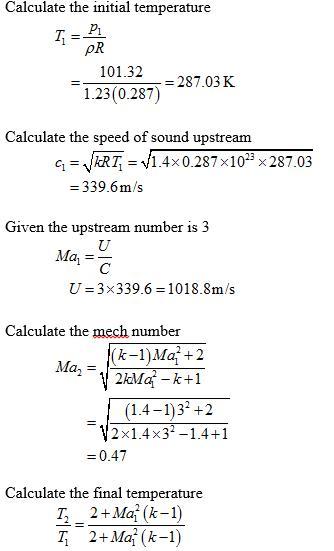
Consider a normal shock wave in air. The upstream conditions are given by M1=3, p1 = 1 atm, and r1 = 1.23 kg/m3. Calculate the d
mart [117]

Answer and Explanation:

The answer is attached below

7 0
2 years ago
(a) If 15 kW of power from a heat reservoir at 500 K is input into a heat engine with an efficiency of 37%, what is the power ou
julsineya [31]

Answer:

(A) Power output will be 5.55 KW (b) lower temperature will be 315 K

Explanation:

We have given efficiency of heat engine \eta =37% = 0.37

Input power = 15 KW

Temperature of heat reservoir T_H=500K

(A) We know that \eta =\frac{output}{input}

So  [text]0.37=\frac{output}{15}[text]

Output = 5.55 KW

(B) We also know that [text]\eta =1-\frac{T_L}{T_H}0.37=\frac{output}{15}[text], here T_L  is lower temperature and T_H is higher temperature

So 0.37=1-\frac{T_L}{T_H}

0.37=1-\frac{T_L}{500}

T_L=315K

5 0
2 years ago
The 8-mm-thick bottom of a 220-mm-diameter pan may be made from aluminum (k = 240 W/m ⋅ K) or copper (k = 390 W/m ⋅ K). When use
Artemon [7]

Answer:

For aluminum 110.53 C

For copper 110.32 C

Explanation:

Heat transmission through a plate (considering it as an infinite plate, as in omitting the effects at the borders) follows this equation:

q = \frac{k * A * (th - tc)}{d}

Where

q: heat transferred

k: conduction coeficient

A: surface area

th: hot temperature

tc: cold temperature

d: thickness of the plate

Rearranging the terms:

d * q = k * A * (th - tc)

\frac{d * q}{k * A} = th - tc

th = \frac{d * q}{k * A} + tc

The surface area is:

A = \frac{\pi * d^2}{4}

A = \frac{\pi * 0.22^2}{4} = 0.038 m^2

If the pan is aluminum:

th = \frac{0.008 * 600}{240 * 0.038} + 110 = 110.53 C

If the pan is copper:

th = \frac{0.008 * 600}{390 * 0.038} + 110 = 110.32 C

7 0
2 years ago
Other questions:
  • A thin metal disk of mass m=2.00 x 10^-3 kg and radius R=2.20cm is attached at its center to a long fiber. When the disk is turn
    11·1 answer
  • Write a program that prompts the user to enter time in 12-hour notation. The program then outputs the time in 24-hour notation.
    6·1 answer
  • A logic chip used in a computer dissipates 3 W of power in an environment at 120°F, and has a heat transfer surface area of 0.08
    11·1 answer
  • The 10-kg block slides down 2 m on the rough surface with kinetic friction coefficient μk = 0.2. What is the work done by the fr
    7·1 answer
  • tech A says that a Hall-effect sensor can be used in an electronic ignition system. Tech B says that an optical-type sensor can
    6·1 answer
  • Q5. A hypothetical metal alloy has a grain diameter of 2.4 x 10⁻² mm. After a heat treatment at 575°C for 500 min, the grain dia
    7·1 answer
  • Determine the design angle ϕ (0∘≤ϕ≤90 ∘) between struts AB and AC so that the 400 lb horizontal force has a component of 600 lb
    10·1 answer
  • Water at 70 kPa and 1008C is compressed isentropically in a closed system to 4 MPa. Determine the final temperature of the water
    6·1 answer
  • Why is data driven analytics of interest to companies?
    9·1 answer
  • It has been stated that crime rates are impacted by ecological conditions. Which of the following
    13·1 answer
Add answer
Login
Not registered? Fast signup
Signup
Login Signup
Ask question!