answer.
Ask question
Login Signup
Ask question
All categories
  • English
  • Mathematics
  • Social Studies
  • Business
  • History
  • Health
  • Geography
  • Biology
  • Physics
  • Chemistry
  • Computers and Technology
  • Arts
  • World Languages
  • Spanish
  • French
  • German
  • Advanced Placement (AP)
  • SAT
  • Medicine
  • Law
  • Engineering
Harlamova29_29 [7]
2 years ago
11

A thin metal disk of mass m=2.00 x 10^-3 kg and radius R=2.20cm is attached at its center to a long fiber. When the disk is turn

ed from the relaxed state through a small angle theta, the torque exerted by the fiber on the disk is proportional to theta. Find an expression for the torsional constant k in terms of the moment of inertia I of the disk and the angular frequency w of small, free oscillations. The disk, when twisted and released, oscillates with a period T of 1.00 s. Find the torsional constant k of the fiber.

Engineering
1 answer:
topjm [15]2 years ago
6 0

Answer:

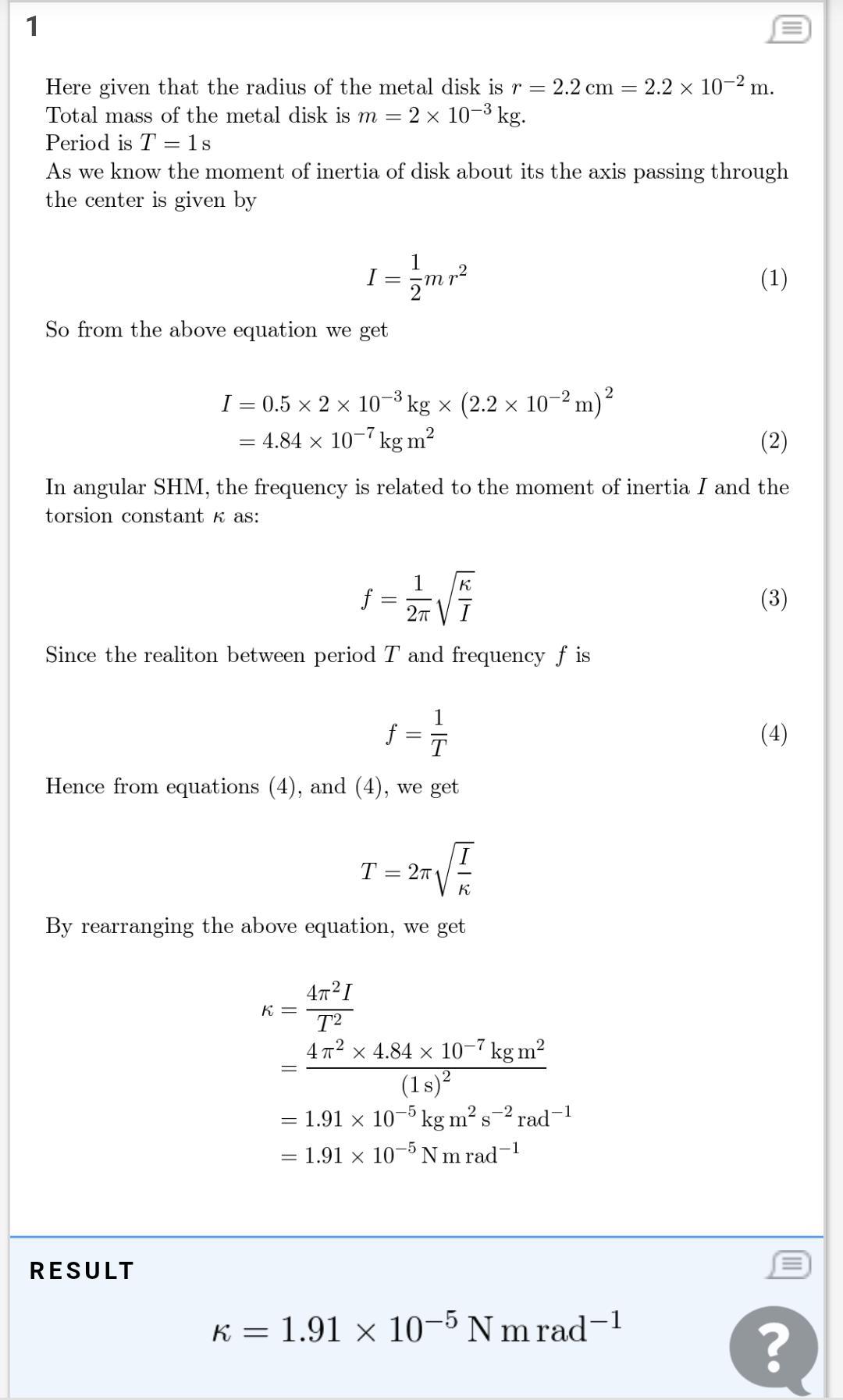
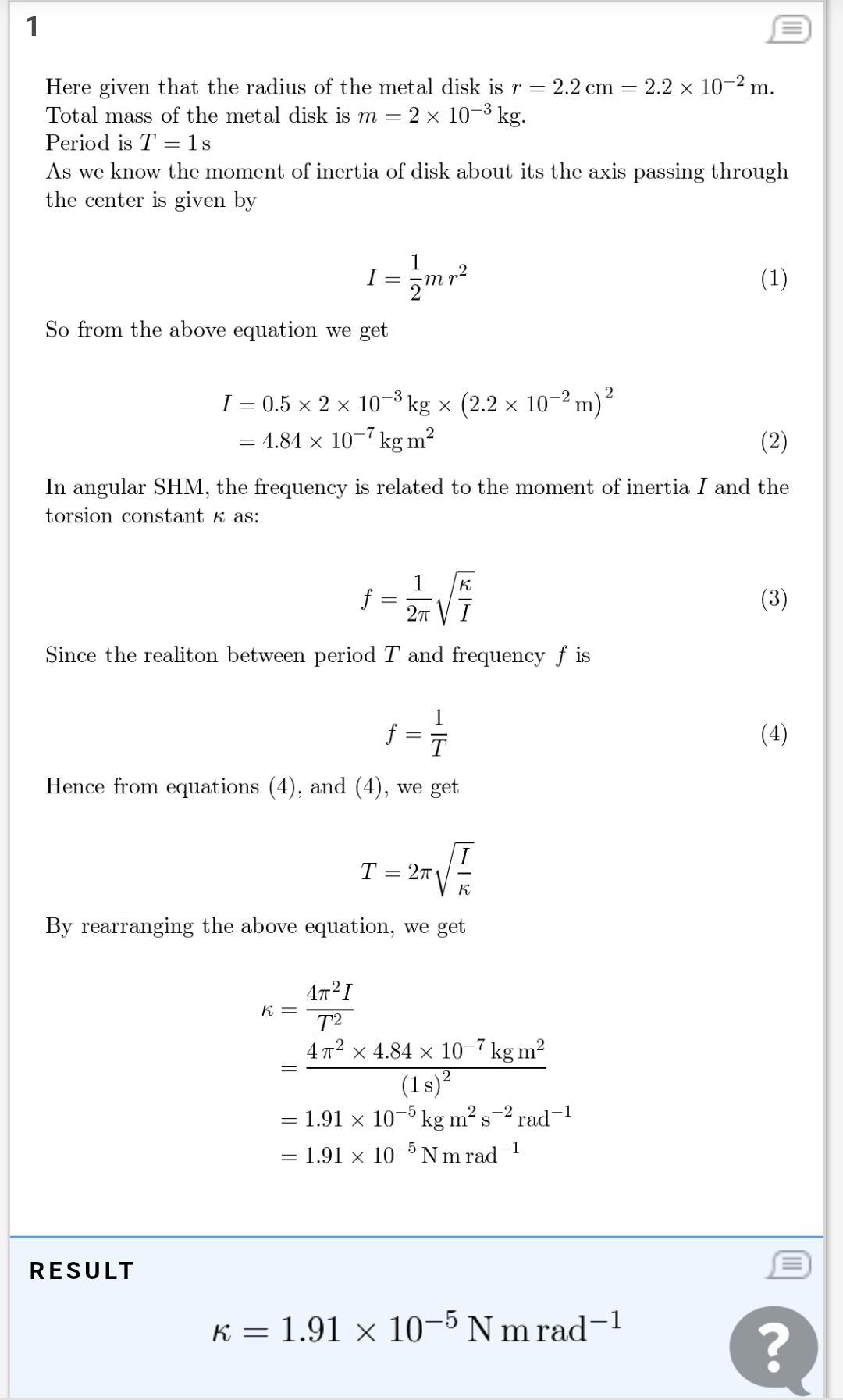
k = 1.91 × 10^-5 N m rad^-1

Workings and Solution to this question can be viewed in the screenshot below:

You might be interested in
Finally you will implement the full Pegasos algorithm. You will be given the same feature matrix and labels array as you were gi
Diano4ka-milaya [45]

Answer:

In[7] def pegasos(feature_matrix, labels, T, L):

   """

   .

   let learning rate = 1/sqrt(t),

   where t is a counter for the number of updates performed so far       (between 1   and nT inclusive).

Args:

       feature_matrix - A numpy matrix describing the given data. Each row

           represents a single data point.

       labels - A numpy array where the kth element of the array is the

           correct classification of the kth row of the feature matrix.

       T -  the maximum number of times that you should iterate through the feature matrix before terminating the algorithm.

       L - The lamba valueto update the pegasos

   Returns: Is defined as a  tuple in which the first element is the final value of θ and the second element is the value of θ0

   """

   (nsamples, nfeatures) = feature_matrix.shape

   theta = np.zeros(nfeatures)

   theta_0 = 0

   count = 0

   for t in range(T):

       for i in get_order(nsamples):

           count += 1

           eta = 1.0 / np.sqrt(count)

           (theta, theta_0) = pegasos_single_step_update(

               feature_matrix[i], labels[i], L, eta, theta, theta_0)

   return (theta, theta_0)

In[7] (np.array([1-1/np.sqrt(2), 1-1/np.sqrt(2)]), 1)

Out[7] (array([0.29289322, 0.29289322]), 1)

In[8] feature_matrix = np.array([[1, 1], [1, 1]])

   labels = np.array([1, 1])

   T = 1

   L = 1

   exp_res = (np.array([1-1/np.sqrt(2), 1-1/np.sqrt(2)]), 1)


   pegasos(feature_matrix, labels, T, L)

Out[8] (array([0.29289322, 0.29289322]), 1.0)
Explanation:

In[7] def pegasos(feature_matrix, labels, T, L):

   """

   .

   let learning rate = 1/sqrt(t),

   where t is a counter for the number of updates performed so far       (between 1   and nT inclusive).

Args:

       feature_matrix - A numpy matrix describing the given data. Each row

           represents a single data point.

       labels - A numpy array where the kth element of the array is the

           correct classification of the kth row of the feature matrix.

       T -  the maximum number of times that you should iterate through the feature matrix before terminating the algorithm.

       L - The lamba valueto update the pegasos

   Returns: Is defined as a  tuple in which the first element is the final value of θ and the second element is the value of θ0

   """

   (nsamples, nfeatures) = feature_matrix.shape

   theta = np.zeros(nfeatures)

   theta_0 = 0

   count = 0

   for t in range(T):

       for i in get_order(nsamples):

           count += 1

           eta = 1.0 / np.sqrt(count)

           (theta, theta_0) = pegasos_single_step_update(

               feature_matrix[i], labels[i], L, eta, theta, theta_0)

   return (theta, theta_0)

In[7] (np.array([1-1/np.sqrt(2), 1-1/np.sqrt(2)]), 1)

Out[7] (array([0.29289322, 0.29289322]), 1)

In[8] feature_matrix = np.array([[1, 1], [1, 1]])

   labels = np.array([1, 1])

   T = 1

   L = 1

   exp_res = (np.array([1-1/np.sqrt(2), 1-1/np.sqrt(2)]), 1)


   pegasos(feature_matrix, labels, T, L)

Out[8] (array([0.29289322, 0.29289322]), 1.0)
6 0
2 years ago
In a planetary geartrain with a form factor of 8, the sun gear rotates clockwise at 5 rad⁄s and the ring gear rotates clockwise
lina2011 [118]

Answer:

D. N= 11. 22 rad/s (CW)

Explanation:

Given that

Form factor R = 8

Speed of sun gear = 5 rad/s (CW)

Speed of ring gear = 12 rad/s (CW)

Lets take speed of carrier gear is N

From Algebraic method ,the relationship between speed and form factor given as follows

\dfrac{N_{sun}-N}{N_{ring}-N}=-R

here negative sign means that ring and sun gear rotates in opposite direction

Lets take CW as positive and ACW as negative.

Now by putting the values

\dfrac{N_{sun}-N}{N_{ring}-N}=-R

\dfrac{5-N}{12-N}=-8

N= 11. 22 rad/s (CW)

So the speed of carrier gear is 11.22 rad/s clockwise.

8 0
2 years ago
A completely reversible heat pump produces heat at a rate of 300 kW to warm a house maintained at 24°C. The exterior air, which
Westkost [7]

Answer:

Entropy generation rate of the two reservoirs is approximately zero (\dot S_{gen} = 9.318 \times 10^{-4}\,\frac{kW}{K}) and system satisfies the Second Law of Thermodynamics.

Explanation:

Reversible heat pumps can be modelled by Inverse Carnot's Cycle, whose key indicator is the cooling Coefficient of Performance, which is the ratio of heat supplied to hot reservoir to input work to keep the system working. That is:

COP_{H} = \frac{\dot Q_{H}}{\dot W}

The following simplification can be used in the case of reversible heat pumps:

COP_{H,rev} = \frac{T_{H}}{T_{H} - T_{L}}

Where temperature must written at absolute scale, that is, Kelvin scale for SI Units:

COP_{H, rev} = \frac{297.15\,K}{297.15\,K-280.15\,K}

COP_{H, rev} = 17.479

Then, input power needed for the heat pump is:

\dot W = \frac{\dot Q}{COP_{H,rev}}

\dot W = \frac{300\,kW}{17.749}

\dot W = 16.902\,kW

By the First Law of Thermodynamics, heat pump works at steady state and likewise, the heat released from cold reservoir is now computed:

-\dot Q_{H} + \dot W + \dot Q_{L} = 0

\dot Q_{L} = \dot Q_{H} - \dot W

\dot Q_{L} = 300\,kW - 16.902\,kW

\dot Q_{L} = 283.098\,kW

According to the Second Law of Thermodynamics, a reversible heat pump should have an entropy generation rate equal to zero. The Second-Law model for the system is:

\dot S_{in} - \dot S_{out} - \dot S_{gen} = 0

\dot S_{gen} = \dot S_{in} - \dot S_{out}

\dot S_{gen} = \frac{\dot Q_{L}}{T_{L}} - \frac{\dot Q_{H}}{T_{H}}

\dot S_{gen} = \frac{283.098\,kW}{280.15\,K} - \frac{300\,kW}{297.15\,K}

\dot S_{gen} = 9.318 \times 10^{-4}\,\frac{kW}{K}

Albeit entropy generation rate is positive, it is also really insignificant and therefore means that such heat pump satisfies the Second Law of Thermodynamics. Furthermore, \dot S_{in} = \dot S_{out}.

5 0
2 years ago
An inventor claims to have devised a cyclical engine for use in space vehicles that operates with a nuclear fuel generated energ
slava [35]

Answer:

Inventor claim is not valid.

Explanation:

Given that

Source temperature = 510 K

Sink temperature = 270 K

Power produce = 4.1 KW

Heat reject = 15,000 KJ/h

Heat reject =4.16 KW

As we know that

Heat addition = Heat rejection + Power produce

Heat addition = 4.16 + 4.1 KW

Heat addition = 8.16 KW

So efficiency of engine

\eta =\dfrac{Power\ produces}{heat\ added}

\eta =\dfrac{4.1}{8.16}

\eta =0.502

Now check the maximum efficiency can be possible by using Carnot heat engine

As we know that efficiency of Carnot heat engine given as

\eta =1-\dfrac{T_L}{T_H}

By putting the value

\eta =1-\dfrac{T_L}{T_H}

\eta =1-\dfrac{270}{510}

\eta =0.47

So the efficiency of Carnot cycle is less than the efficiency of above given engine.So this engine is not possible.It means that inventor claim is not valid.

6 0
2 years ago
You are considering building a residential wind power system to produce 6,000 kWh of electricity each year. The installed cost o
alisha [4.7K]

Answer:

leveled cost of electricity LCOE is 0.1159/kwh

Explanation:

given data:

installation cost of system = $1.50/winstalled

capacity factor = 22%

life = 10 year

rate of interest 8%

operation and maintenance cost = $0.04 / kwh generated

capcaitence recovery factorCRF = \frac{i(i+1)^n}{(i+1)^n -1}

i= rate of interest

n = annuity period

CRF = \frac{0.08(1+0.08)^10}}{(1+0.08)^{10} -1} = 0.14903

LCOE = \frac{cost\ of \installation \times CRF}{hours/ available \times capacity\ factor} + variable\ o&M\ cost

=  \frac{1.50\times 1000/kw \times 0.14903}{8760\times 0.22} + 0.04/kwh

          = 0.1159/kwh + 0.04 /kwh

          = 0.1559 /kwh

8 0
2 years ago
Other questions:
  • Six years ago, an 80-kW diesel electric set cost $160,000. The cost index for this class of equipment six years ago was 187 and
    8·1 answer
  • Small droplets of carbon tetrachloride at 68 °F are formed with a spray nozzle. If the average diameter of the droplets is 200 u
    10·1 answer
  • The basic barometer can be used to measure the height of a building. If the barometric readings at the top and the bottom of a b
    15·1 answer
  • An aircraft component is fabricated from an aluminum alloy that has a plane-strain fracture toughness of 40 MPa1m (36.4 ksi1in.)
    15·1 answer
  • Two physical properties that have a major influence on the cracking of workpieces, tools, or dies during thermal cycling are the
    13·1 answer
  • A 5-cm-diameter shaft rotates at 4500 rpm in a 15-cmlong, 8-cm-outer-diameter cast iron bearing (k = 70 W/m·K) with a uniform cl
    10·1 answer
  • Two resistors of values 7.0 and 15.0 Ω are connected in parallel. This combination in turn is hooked in series with a 3.8- Ω res
    7·1 answer
  • Hot combustion gases, modeled as air behaving as an ideal gas, enter a turbine at 10 bar, 1500 K and exit at 1.97 bar and 900 K.
    7·1 answer
  • what is the advantage of decreasing the field current of a separately excited dc motor below its nominal value
    7·1 answer
  • If you have power steering and you are able to __________, you should have your vehicle checked out by a qualified technician.
    7·1 answer
Add answer
Login
Not registered? Fast signup
Signup
Login Signup
Ask question!
