answer.
Ask question
Login Signup
Ask question
All categories
  • English
  • Mathematics
  • Social Studies
  • Business
  • History
  • Health
  • Geography
  • Biology
  • Physics
  • Chemistry
  • Computers and Technology
  • Arts
  • World Languages
  • Spanish
  • French
  • German
  • Advanced Placement (AP)
  • SAT
  • Medicine
  • Law
  • Engineering
charle [14.2K]
2 years ago
8

Suppose the weights of seventh graders at a certain school vary according to a Normal distribution, with a mean of 100 pounds an

d a standard deviation of 7.5 pounds. A researcher believes the average weight has decreased since the implementation of a new breakfast and lunch program at the school. She finds, in a random sample of 35 students, an average weight of 98 pounds.
What would the P?value tell the researcher in this situation?

a.) the probability that a random sample of students would have a mean of 100 pounds, if the true population mean is 98 pounds

b.) the probability that a random sample of students would have a mean of 98 pounds, if the true population mean is 100 pounds

c.)the probability that a random sample of students would have a mean less than or equal to 100 pounds, if the true population mean is 98 pounds

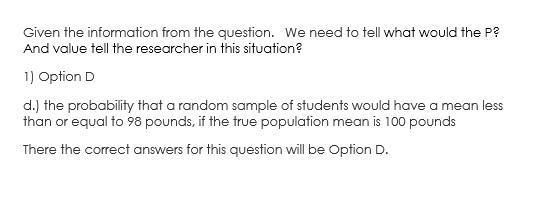
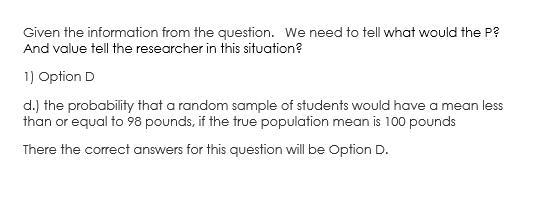
d.)the probability that a random sample of students would have a mean less than or equal to 98 pounds, if the true population mean is 100 pounds

Mathematics
1 answer:
vesna_86 [32]2 years ago
3 0

Answer:

Please see attachment

Step-by-step explanation:

Please see attachment

You might be interested in
Luis has saved $6. he doubles the amount he saves each week.does this represent an exponential function?complete:
Ilya [14]

Answer:

This 6(2)^{n-1} represent an exponential function, because his savings increase by a constant factor of 2.

Step-by-step explanation:

It is given that,

Luis has saved $6 and he doubles the amount each week.

So, the amount saved in the next week = 6×2 = 12

This gives the amount saved in the third week = 12×2 = 24

So, we get the sequence 6, 12, 24, 48,.....

It can be written as, 6×2⁰, 6×2¹, 6×2², 6×2³,.....

So, the sequence in the exponential form 6(2)^{n-1}, where 'n' is a natural number.

Also, 6, 12, 24, 48,.....

The numbers are increasing by the factor = \frac{12}{6}=\frac{24}{12}=....=2

Hence, we get,

This 6(2)^{n-1} represent an exponential function, because his savings increase by a constant factor of 2.

8 0
2 years ago
An insurance company collected data from a class of high school sophomores on whether or not they have a cell phone and whether
NeX [460]

Answer:

C. Those who have a car tend to have a cell phone.

Step-by-step explanation:

The relative frequency for a data set n is calculated by dividing each frequency x_i by n.

We have a table that relates the use of cars and cell phones.

First, we take from the table the population that has a car.

n = 18

Then, of the students who have a car, 12 have a cell phone and 6 do not have a cell phone.

Then we calculate the relative frequencies f_{x_i} for those who have a cell phone and those who do not.

______________________________________________

Relative frequency   Students with car  n = 18.

-------------------------------------------------- --------------------------------------

C<em>ell phone     No cell phone      Total n</em>

 12/18                    6/18                     18

_______________________________________________

_______________________________________________

Relative frequency   Students with car  n = 18.

-------------------------------------------------- --------------------------------------

C<em>ell phone     No cell phone      Total n</em>

  0.666              0.333                   18

________________________________________________

Most students who have a car also have a cell phone.

Now we calculate the relative frequency for students who do not have a car.

_______________________________________________

Relative frequency  Students without a car  n = 7

-------------------------------------------------- --------------------------------------

<em>Cell phone       No cell phone             Total  n</em>

 2/7                     5/7                          7

_______________________________________________  

_______________________________________________

Relative frequency  Students without a car  n = 7

-------------------------------------------------- --------------------------------------

<em>Cell phone</em>      <em>  No</em> <em>cell phone           Total  n</em>

 0.286                 0.714                              7

_______________________________________________

Most students who do not have a car do not have a cell phone either.

<em>Then these data suggest that. Those who have a car tend to have a cell phone.</em>

Option C
6 0
2 years ago
kyle has 105 baseball cards and must give 2/5 of his cards away. how many cards will kyle give away? what fraction of his cards
adelina 88 [10]
He has 3/5 of his cards left because he had 62/105 of his cards and that simplified is 3/5
6 0
2 years ago
Polygons QRST and Q’R’S’T’ are shown on the coordinate grid: A coordinate plane with two polygons is shown. Polygon QRST has ver
MAVERICK [17]
Thai. Is. Really. Counfusong. For me sorry idk.
3 0
2 years ago
In a box containing 25 cherries, 2 of them are rotten. Susan randomly picks cherries in the box. How many cherries should be pic
bezimeni [28]

Answer:

Susan should pick 6 cherries from box, so the probability of picking the 2 rotten cherries is 1/20

Step-by-step explanation:

assuming that each cherry is equally probable to be chosen , since each cherry is independent from the others and sampling is done without replacement , the random variable X= number of cherries that are rotten from the picked ones follows a hyper geometrical distribution , where

P(X=k)= C(M,k) * C(N-M, n-k) / C(N,n)

where

N= population size = 25

n= number of picks

M = total number of rotten cherries =2

k = number of rotten cherries picked =2

C( ) = combination

then

1/20=C(2,2)*C(25-2,n-2)/C(25,n) = 1 * (23!/(n-2)!*(25-n)! / (25!/(n!*(25-n)!

1/20 = n!/(n-2)!  * 1/(24*25)

24*25/20 = n*(n-1)

n²-n-30 =0

n= (1 +√(1+4*1*30))/2 = 12/2= 6

n=6

then Susan should pick 6 cherries from box, so the probability of picking the 2 rotten cherries is 1/20

7 0
2 years ago
Other questions:
  • Using the graph below, find values for the radius r, the angle theta (in both degrees and radians), and the coordinates for the
    11·1 answer
  • Write a program that prompts the user to read two integers and displays their sum . if anything but an integer is passed as inpu
    9·1 answer
  • A radar antenna, making one revolution every 5 seconds, is located on a ship that is 6 km from a straight shoreline. How fast is
    14·1 answer
  • A sphere has a radius of 7.5 centimeters. To the nearest cubic centimeter, what is the volume of the sphere?
    6·1 answer
  • Which equation is the inverse of y = 2x2 – 8?​
    12·1 answer
  • James has saved $24.60. Dillon saved 2/3 of
    12·2 answers
  • In 1970 the population of the United States was 203 million. Ten years later, in 1980, the population of the United States was 2
    5·1 answer
  • Find the values of a through e that make these two relations inverses of each other. a = b = c = d = e = An image shows 2 tables
    11·2 answers
  • On Tuesday morning, the temperature is -5º F. The temperature rises 3 4 degree each hour for 6 hours before dropping 1 4 degree
    14·1 answer
  • Joseph drove to Carly’s house for dinner. He was away from his house for 2 hours. He spent 50minutes at Carly’s house. Driving t
    5·1 answer
Add answer
Login
Not registered? Fast signup
Signup
Login Signup
Ask question!