answer.
Ask question
Login Signup
Ask question
All categories
  • English
  • Mathematics
  • Social Studies
  • Business
  • History
  • Health
  • Geography
  • Biology
  • Physics
  • Chemistry
  • Computers and Technology
  • Arts
  • World Languages
  • Spanish
  • French
  • German
  • Advanced Placement (AP)
  • SAT
  • Medicine
  • Law
  • Engineering
bija089 [108]
2 years ago
9

Front housings for cell phones are manufactured in an injection molding process. The time the part is allowed to cool in the mol

d before removal is thought to influence the occurrence of a particularly troublesome cosmetic defect, flow lines, in the finished housing. After manufacturing, the housings are inspected visually and assigned a score between 1 and 10 based on their appearance, with 10 corresponding to a perfect part and 1 corresponding to a completely defective part. An experiment was conducted using two cool-down times, 10 and 20 seconds, and 20 housings were evaluated at each level

Mathematics
1 answer:
vivado [14]2 years ago
4 0

Answer:

a) Null hypothesis: \mu_{10sec} \geq \mu_{20sec}

Alternative hypothesis: \mu_{10sec} < \mu_{20sec}  

The statistic calculated was t= -5.57 with a p value of p=0.000001353, a very low value so we have enough evidence to reject the null hypothesis on this case. So then we can conclude that more time cooling result in a lower number of defects

b) p_v = 0.000001353

c) \mu_{10sec} -\mu_{20sec} \leq -2.1949. And as we can see all the values are <0. We conclude that the two samples are different on the mean. And the group of 20 seconds seems better result.

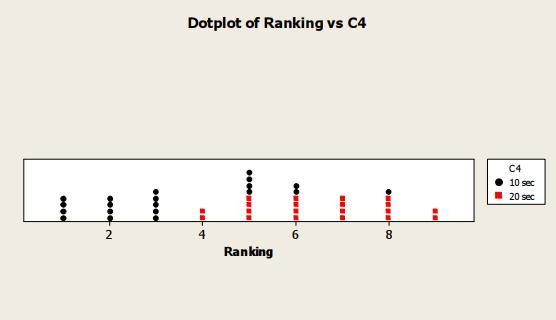
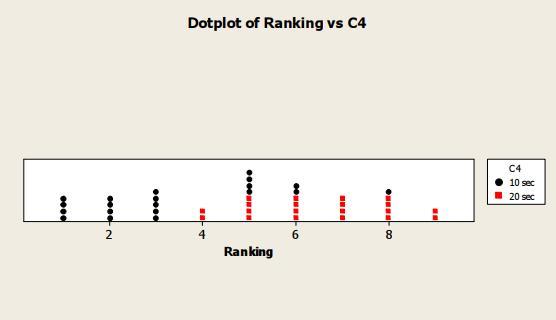
d) We can see this on the figure attached. And we see that the values for the group of 20 seconds are significantly higher than the values for the group of 10 seconds.

e) The results are on the figure attached. And as we can see the results are not significant different from the normal distribution since almost all the values for both graphs lies in the line adjusted.
Step-by-step explanation:

Assuming the following data:

Sample 1 (10 seconds) : 1,3,2,6,1,5,3,3,5,2,1,1,5,6,2,8,3,2,5,3

Sample 2(20 seconds): 7,6,8,9,5,5,9,7,5,4,8,6,6,8,4,5,6,8,7,7

Part a: Is there evidence to support the claim that the longer cool-down time results in fewer appearance  defects? Use α = 0.05.

Null hypothesis: \mu_{10sec} \geq \mu_{20sec}

Alternative hypothesis: \mu_{10sec} < \mu_{20sec}

For this case we can use the following R code:

> sample1<-c(1,3,2,6,1,5,3,3,5,2,1,1,5,6,2,8,3,2,5,3)

> sample2<-c(7,6,8,9,5,5,9,7,5,4,8,6,6,8,4,5,6,8,7,7)

> t.test(sample1,sample2,conf.level = 0.95,alternative = "less")

The results obtained are:

Welch Two Sample t-test

data:  sample1 and sample2

t = -5.5696, df = 35.601, p-value = 1.353e-06

alternative hypothesis: true difference in means is less than 0

95 percent confidence interval:

     -Inf -2.194869

sample estimates:

mean of x mean of y  

    3.35      6.50

And as we can see the statistic calculated was t= -5.57 with a p value of p=0.000001353, a very low value so we have enough evidence to reject the null hypothesis on this case. So then we can conclude that more time cooling result in a lower number of defects

Part b: What is the P-value for the test conducted in part (a)?

p_v = 0.000001353

Part c: Find a 95% confidence interval on the difference in means. Provide a practical interpretation of this  interval.

From the output given we see that the confidence interval obtained was:

\mu_{10sec} -\mu_{20sec} \leq -2.1949. And as we can see all the values are <0. We conclude that the two samples are different on the mean. And the group of 20 seconds seems better result.

Part d: Draw dot diagrams to assist in interpreting the results from this experiment

We can see this on the figure attached. And we see that the values for the group of 20 seconds are significantly higher than the values for the group of 10 seconds.

Part e :Check the assumption of normality for the data from this experiment.

We can use the following R code:

> qqnorm(sample1, pch = 1, frame = FALSE,main = "10 seconds")

> qqline(sample1, col = "steelblue", lwd = 2)

> qqnorm(sample2, pch = 1, frame = FALSE,main = "20 seconds")

> qqline(sample2, col = "steelblue", lwd = 2)

The results are on the figure attached. And as we can see the results are not significant different from the normal distribution since almost all the values for both graphs lies in the line adjusted.

You might be interested in
The endpoints of (line segment )AB are A(2, 2) and B(3, 8). (line segment ) AB is dilated by a scale factor of 3.5 with the orig
horrorfan [7]
The slope:
m = ( y2 - y1 ) / ( x2 - x1 ) = ( 8  2 ) / ( 3 - 2 ) = 6 / 1 
m = 6  ( we have the same slope for AB and A`B` )
AB = √[( 3 - 2 )² + ( 8 - 2 )²] = √37
A`B` = 3.5 √37 = 21.29 
5 0
2 years ago
Read 2 more answers
Pamela drove her car 99 kilometers and used 9 liters of fuel. She wants to know how many kilometers (k) she can drive with 12 li
masya89 [10]

Answer:

132 kilometers

Step-by-step explanation:

Given: Pamela drove her car 99 kilometers and used 9 liters of fuel.

To find: Number of kilometers Pamela drove in 12 liters of fuel.

Solution:

It is given that Pamela drove her car 99 kilometers and used 9 liters of fuel. Also the relationship between kilometers and fuel is proportional.

So, let us assume that she can travel x kilometers in 12 liters of fuel.

By proportionality we have,

99:9 :: x:12

\frac{99}{9} =\frac{x}{12}

11=\frac{x}{12}

x=12\times11

x=132

Hence, she can travel 132 kilometers in 12 liters of petrol.

7 0
2 years ago
Read 2 more answers
Find the average rate of change of the function defined by the following table. x y -2 -5 2 35 6 75 10 115
Pani-rosa [81]

By definition we have that the average rate of change of the function is:

 AVR =  \frac{f(x2) - f(x1)}{x2 - x1}

 Evaluating the function for the complete interval we have that the AVR is given by:

 AVR = \frac{115 - (-5)}{10 - (-2)}

 Rewriting we have:

 AVR = \frac{115+5}{10+2}

 Simplifying the expression we have:

 AVR = \frac{120}{12}

 AVR = 10

 Answer:

 the average rate of change of the function defined by the table is:

 AVR = 10

6 0
2 years ago
A coat at a store is originally priced at 54.99.The store marks the price down to 32.99.To the nearest percent ,what is the perc
AnnZ [28]
For this case what we can do is the following rule of three:
 54.99 ------> 100%
 32.99 ------> x
 We clear the value of
 x = (32.99 / 54.99) * (100)
 x = 59.99272595
 Therefore, the discount percentage is:
 100-59.99272595 = 40.00727405%
 To the nearest percent;
 40%
 Answer:
 
The percent markdown of the coat is:
 
40%
7 0
2 years ago
The distribution of average wait times in drive-through restaurant lines in one town was approximately normal with mean \mu = 18
Fynjy0 [20]

Answer:

193

Step-by-step explanation:

8 0
2 years ago
Other questions:
  • Hilda cuts a ribbon into2 equal pieces. Then she cuts 4 inches off one piece. That piece is now 5 inches long. What was the leng
    5·2 answers
  • M&amp;M plain candies come in various colors. According to the M&amp;M/Mars Department of Consumer Affairs, the distribution of
    7·1 answer
  • A company has an opportunity to bid on three contracts. Determine which would be the best investment given the information in th
    11·2 answers
  • what is the least possible value of the smallest of 99 consecutive positive integers whose sum is a perfect cube
    12·1 answer
  • What is the longest line segment that can be drawn in a right rectangular prism that is 14 cm long, 13 cm wide, and 12 cm tall?
    6·1 answer
  • charles meets with customers on a daily basis. he uses the function f(x)=5/x-8/+20 to calculate how many dollars he charges....f
    8·2 answers
  • An island population of 20,000, grows by 5% each year, compounded continuously. How many inhabitants will the island have in 5 y
    5·2 answers
  • The Polk Company reported that the average age of a car on U.S. roads in a recent year was 7.5 years. Suppose the distribution o
    15·2 answers
  • If you can buy 1/3 of a box of chocolates for 6 dollars, how much can you buy for 4 dollars?
    8·2 answers
  • Riya purchased a machine for Rs36000 and spent Rs2400 on its repair. She then sold it for Rs42000. Find the gain or loss percent
    11·2 answers
Add answer
Login
Not registered? Fast signup
Signup
Login Signup
Ask question!
