answer.
Ask question
Login Signup
Ask question
All categories
  • English
  • Mathematics
  • Social Studies
  • Business
  • History
  • Health
  • Geography
  • Biology
  • Physics
  • Chemistry
  • Computers and Technology
  • Arts
  • World Languages
  • Spanish
  • French
  • German
  • Advanced Placement (AP)
  • SAT
  • Medicine
  • Law
  • Engineering
Sladkaya [172]
2 years ago
11

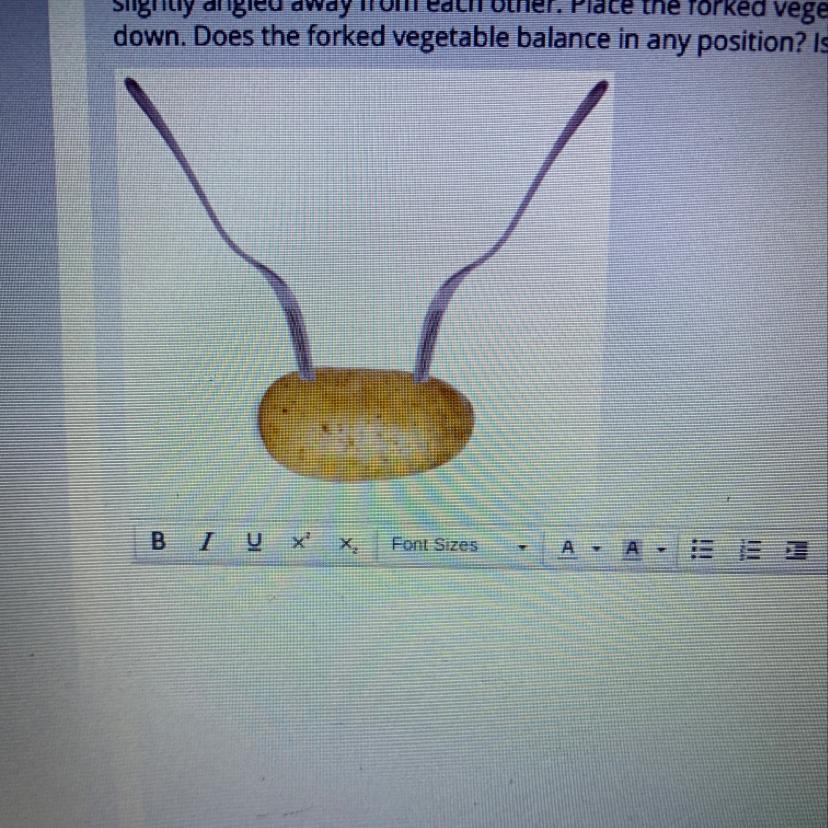
Stick a fork into each end of the root vegetable as shown. The forks should be on the same side of the vegetable, and

Physics
1 answer:
zhuklara [117]2 years ago
7 0

Answer:

Yes

Explanation:

There is a position that works better than this and that is switching the sides of the forks.

You might be interested in
Observe: Up until now, all the problems you have solved have involved converting only one unit. However, some conversion problem
ipn [44]

Answer:

t is appropriate to clarify that units such as time and angles the transformation is not in base ten, for example:

        60 s = 1 min

        60 min = 1 h

        24 h = 1 day

Therefore, for this transformation, you must be more careful

the length transformation is base 10

Explanation:

In many exercises the units used are transformed by equations into other units called derivatives, in general the transformation of derived units is the product of the transformation of the constituent units.

In the example of velocity, the derivative unit is m / s, which is why it works in the same way that you transform length and time if in the equation it is multiplying it is multiplied and if it is dividing it is divided.

It is appropriate to clarify that units such as time and angles the transformation is not in base ten, for example:

        60 s = 1 min

        60 min = 1 h

        24 h = 1 day

Therefore, for this transformation, you must be more careful

the length transformation is base 10

      1000 m = 1 km

7 0
2 years ago
Which of the following statements best describes the characteristic of the restoring force in the spring-mass system described i
Grace [21]

Answer : The restoring force is directly proportional to the displacement of the block.

Explanation :

Restoring force is defined as the force that is exerted by the spring due to its mass.

Mathematically, the restoring force can be written as :

F\propto-x

F = - k x

where,

k is the spring constant.

x is the displacement caused due to the mass.

Negative sign shows that the force is acting in opposite direction.

So, it is clear that the restoring force is directly proportional to the displacement of the block.

Hence, the correct option is (b) " The restoring force is directly proportional to the displacement of the block ".

5 0
2 years ago
Read 2 more answers
If a rock is thrown upward on the planet mars with a velocity of 14 m/s, its height (in meters) after t seconds is given by h =
crimeas [40]

<u>Answer:</u>

 Velocity of rock after 2 seconds = 6.56 m/s

<u>Explanation:</u>

 We have equation of motion , s= ut+\frac{1}{2} at^2, s is the displacement, u is the initial velocity, a is the acceleration and t is the time.

Here height of rock in meters, h = 14t-1.86t^2

Comparing both the equations

    We will get initial velocity = 14 m/s(already given) and \frac{1}{2} a = -1.86

     So,  Acceleration, a = -3.72 m/s^2

 Now we have equation of motion, v = u + at, where v is the final velocity, u is the initial velocity, a is the acceleration and t is the time taken.

 When time is 2 seconds we need to find final velocity.

     v = 14 - 3.72 * 2 = 6.56 m/s.

  So, Velocity of rock after 2 seconds = 6.56 m/s  

6 0
2 years ago
Now consider θc, the angle at which the blue refracted ray hits the bottom surface of the diamond. If θc is larger than the crit
Dennis_Churaev [7]

Complete Question:

A beam of white light is incident on the surface of a diamond at an angle \theta_{a},  since the index of refraction depends on the light's wavelength, the different colors that comprise white light will spread out as they pass through the diamond. For example, the indices of refraction in diamond are n_{red} = 2.410 for red light and n_{blue} = 2.450 for blue light. Thus, blue light and red light are refracted at different angles inside the diamond. The surrounding air has n_{air} = 1.000.

Now consider θc, the angle at which the blue refracted ray hits the bottom surface of the diamond. If θc is larger than the critical angle θcrit, the light will not be refracted out into the air, but instead it will be totally internally reflected back into the diamond. Find θcrit. Express your answer in degrees to four significant figures.

Answer:

\theta_{crit} = 24.09^{0}

Explanation:

Only the blue refracted ray is related to the critical angle in this question

n_{air} = 1.000

n_{blue} = 2.450

The relationship between the critical angle(\theta_{crit}), n_{air} and n_{blue} can be given as sin \theta_{crit} = \frac{n_{air} }{n_{blue} }

sin \theta_{crit} = \frac{1 }{2.450 }\\\theta_{crit} = sin^{-1} \frac{1 }{2.450 }\\\theta_{crit} = sin^{-1} 0.4082^{0}\\  \theta_{crit} = 24.09^{0}

6 0
2 years ago
Un tubo de acero de 40000 kilómetros forma un anillo que se ajusta bien a la circunferencia de la tierra. Imagine que las person
Darina [25.2K]

Answer:

82.76m

Explanation:

In order to find the distance of the steel ring to the ground, when its temperature has raised by 1°C, you first calculate the radius of the steel tube before its temperature increases.

You use the formula for the circumference of the steel ring:

C=2\pi r    (1)

C: circumference of the ring = 40000 km = 4*10^7m (you assume the circumference is the length of the steel tube)

you solve for r in the equation (1):

r=\frac{C}{2\pi}=\frac{4*10^7m}{2\pi}=6,366,197.724m

Next, you use the following formula to calculate the change in the length of the tube, when its temperature increases by 1°C:

L=Lo[1+\alpha \Delta T]         (2)

L: final length of the tube = ?

Lo: initial length of the tube = 4*10^7m

ΔT = change in the temperature of the steel tube = 1°C

α: thermal coefficient expansion of steel = 13*10^-6 /°C

You replace the values of the parameters in the equation (2):

L=(4*10^7m)(1+(13*10^{-6}/ \°C)(1\°C))=40,000,520m

With the new length of the tube, you can calculate the radius of a ring formed with the tube. You again solve the equation (1) for r:

r'=\frac{C}{2\pi}=\frac{40,000,520m}{2\pi}=6,366,280.484m

Finally, you compare both r and r' radius:

r' - r = 6,366,280.484m - 6,366,197.724m = 82.76m

Hence, the distance to the ring from the ground is 82.76m
4 0
2 years ago
Other questions:
  • You throw a baseball straight up into the air with a speed of 24.5 m/s. How long does it take the baseball to reach its highest
    13·2 answers
  • Describe the energy transformations that occur from the time a skydiver jumps out of a plane until landing on the ground.
    13·2 answers
  • A 150 g particle at x = 0 is moving at 8.00 m/s in the +x-direction. As it moves, it experiences a force given by Fx=(0.850N)sin
    11·1 answer
  • The frequency of a wave increases. If the speed of the wave remains constant, what happens to the distance between successive cr
    6·1 answer
  • A box is sliding with a speed of 4.50 m/s on a horizontal surface when, at point P, it encounters a rough section. The coefficie
    7·2 answers
  • Einstein and Lorentz, being avid tennis players, play a fast-paced game on a court where they stand 20.0 m from each other. Bein
    15·1 answer
  • One of the Lady Spartans was falling to the ground after
    15·1 answer
  • As light shines from air to another medium, i = 26.0 º. The light bends toward the normal and refracts at 32.0 º. What is the in
    9·1 answer
  • An iguana runs back and forth along the ground. The horizontal position of the iguana in meters over time is shown
    7·1 answer
  • A small object with mass m, charge q, and initial speed v0 = 5.00 * 103 m&gt;s is projected into a uniform electric field betwee
    13·1 answer
Add answer
Login
Not registered? Fast signup
Signup
Login Signup
Ask question!
