answer.
Ask question
Login Signup
Ask question
All categories
  • English
  • Mathematics
  • Social Studies
  • Business
  • History
  • Health
  • Geography
  • Biology
  • Physics
  • Chemistry
  • Computers and Technology
  • Arts
  • World Languages
  • Spanish
  • French
  • German
  • Advanced Placement (AP)
  • SAT
  • Medicine
  • Law
  • Engineering
VARVARA [1.3K]
2 years ago
13

Given the vector current density J = 10rho2zarho − 4rho cos2 φ aφ mA/m2:

Engineering
1 answer:
Xelga [282]2 years ago
4 0

Answer:

(a) Current density at P is J(P)=180.\textbf{a}_{\rho}-9.\textbf{a}_{\phi} \ (mA/m^2)\\.

(b) Total current I is 3.257 A

Explanation:

Because question includes symbols and formulas it can be misunderstood. In the question current density is given as below;

J=10\rho^2z.\textbf{a}_{\rho}-4\rho(\cos\phi)^2\textbf{a}_{\phi}\\

where \textbf{a}_{\rho} and \textbf{a}_{\phi} unit vectors.

(a) In order to find the current density at a specific point <em>(P)</em>, we can simply replace the coordinates in the current density equation.  Therefore

J(P(\rho=3, \phi=30^o,z=2))=10.3^2.2.\textbf{a}_{\rho}-4.3.(\cos(30^o)^2).\textbf{a}_{\phi}\\\\J(P)=180.\textbf{a}_{\rho}-9.\textbf{a}_{\phi} \ (mA/m^2)\\

(b) Total current flowing outward can be calculated by using the relation,

I=\int {\textbf{J} \, \textbf{ds}

where integral is calculated through the circular band given in the question. We can write the integral as below,

I=\int\{(10\rho^2z.\textbf{a}_{\rho}-4\rho(\cos\phi)^2\textbf{a}_{\phi}).(\rho.d\phi.dz.\textbf{a}_{\rho}})\}\\\\I=\int\{(10\rho^2z).(\rho.d\phi.dz)\}\\\\\\

due to unit vector multiplication. Then,

I=10\int\(\rho^3z.dz.d\phi

where \rho=3,\ 0. Therefore

I=10.3^3\int_2^{2.8}\(zdz.\int_0^{2\pi}d\phi\\I=270(\frac{2.8^2}{2}-\frac{2^2}{2} )(2\pi-0)=3257.2\ mA\\I=3.257\ A

You might be interested in
To unload a bound stack of plywood from a truck, the driver first tilts the bed of the truck and then accelerates from rest. Kno
azamat

Answer:

a) The truck must have an acceleration of at least 3.92 * cos(θ)^2 for the stack to start sliding.

b) a = 2.94 * cos(θ)^2 + 0.32 * L * cos(θ)

Explanation:

The stack of plywood has a certain mass. The weight will depend on that mass.

w = m * g

There will be a normal reaction between the stack and the bed of the truck, this will be:

nr = -m * g * cos(θ)

Being θ the tilt angle of the bed.

The static friction force will be:

ffs = - m * g * cos(θ) * fJK

The dynamic friction force will be:

ffd = - m * g * cos(θ) * fik

These forces would produce accelerations

affs = -g * cos(θ) * fJK

affd = -g * cos(θ) * fik

affs = -9.81 * cos(θ) * 0.4 = -3.92 * cos(θ)

affd = -9.81 * cos(θ) * 0.3 = -2.94 * cos(θ)

These accelerations oppose to movement and must be overcome by another acceleration to move the stack.

The acceleration of the truck is horizontal, the horizontal component of these friction forces is:

affs = -3.92 * cos(θ)^2

affd = -2.94 * cos(θ)^2

The truck must have an acceleration of at least 3.92 * cos(θ)^2 for the stack to start sliding.

Assuming the bed has a lenght L.

The horizontal movement will be over a distance cos(θ) * L because L is tilted.

Movement under constant acceleration:

X(t) = X0 + V0 * t + 1/2 * a * t^2

In this case X0 = 0, V0 = 0, and a will be the sum of the friction force minus the acceleration of the truck.

If we set the frame of reference with the origin on the initial position of the stack and the positive X axis pointing backwards, the acceleration of the truck will now be negative and the dynamic friction acceleration positive.

L * cos(θ) = 1/2 * (2.94 * cos(θ)^2 - a) * 0.4^2

2.94 * cos(θ)^2 - a = 2 * 0.16 * L * cos(θ)

a = 2.94 * cos(θ)^2 + 0.32 * L * cos(θ)

6 0
2 years ago
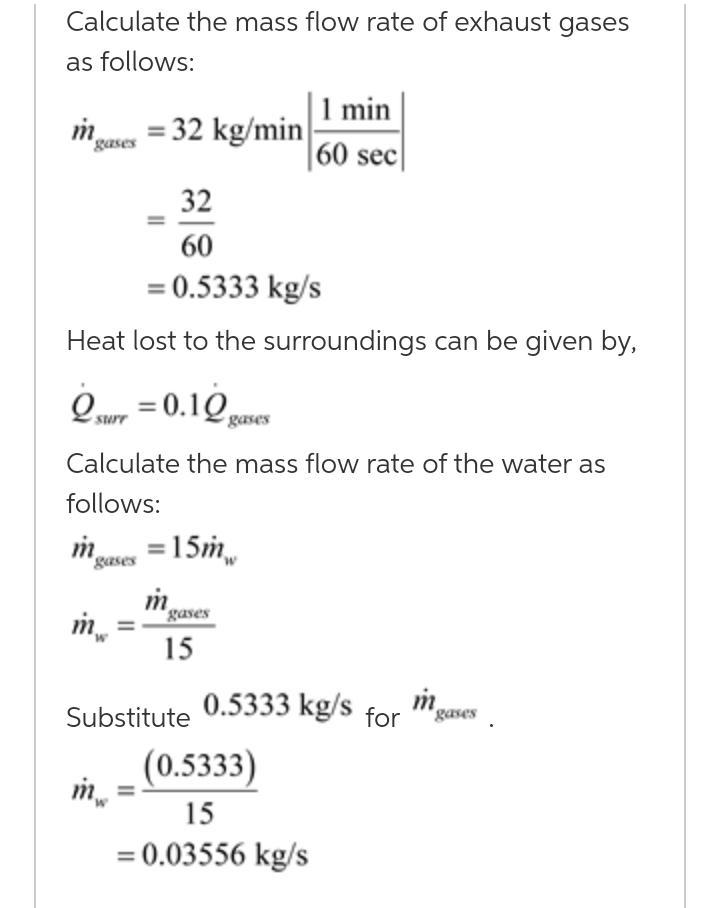
Hot exhaust gases of an internal combustion engine are to be used to produce saturated water vapor at 2 MPa pressure. The exhaus
Anastaziya [24]

Answer:

The flowrate of water is 0.03556kg/s

Explanation:

Exhaust gases inlet temperature T1=4000C

Water inlet temperature T3=150C Exit Pressure of water as saturated vapor P4=2MPa

Mass flow rate of exhaust gases Heat lost to the surroundings Qgases=32kg/min

Mass flow rate of exhaust gases is 15 times that of the water

Heat exchangers typically involve no work interactions (w = 0) and negligible...

7 0
2 years ago
Read 2 more answers
Twenty distinct cars park in the same parking lot every day. Ten of these cars are US-made, while the other ten are foreign-made
Zina [86]

Answer:

Total no. of ways to line up cars is 20! = 2.43 c 10^18

Probability that the cars alternate is 0.00001 or 0.001%

Explanation:

Since, the position of a car is random.Therefore, number ways in which cars can line up is given as:

<u>No. of ways = 20! = 2.43 x 10^18</u>

For the probability that cars alternate, two groups will be formed, one consisting of US-made 10 cars and other containing 10 foreign made. The number of favorable outcomes for this can be found out as the arrangements of 2! between these groups multiplied by the arrangements of 10! for each group, due to the arrangements among the groups themselves.

Favorable Outcomes = 2! x 10! x 10!

Thus the probability of event will be:

Probability = Favorable Outcomes/Total No. of Ways

Probability = (2! x 10! x 10!)/20!

<u>Probability = 0.00001 = 0.001%</u>

4 0
2 years ago
A certain working substance receives 100 Btu reversibly as heat at a temperature of 1000℉ from an energy source at 3600°R. Refer
Valentin [98]

Answer:

Explanation:

t1 = 1000 F = 1460 R

t0 = 80 F = 540 R

T2 = 3600 R

The working substance has an available energy in reference to the 80F source of:

B1 = Q1 * (1 - T0 / T1)

B1 = 100 * (1 - 540 / 1460) = 63 BTU

The available energy of the heat from the heat wource at 3600 R is

B2 = Q1 * (1 - T0 / T2)

B2 = 100 * (1 - 540 / 3600) = 85 BTU

The reduction of available energy between the source and the 1460 R temperature is:

B3 = B2 - B1 = 85 - 63 = 22 BTU

6 0
2 years ago
The slope distance and zenith angle between points A and B were measured with a total station instrument as 17685.20 ft and 93°
dimaraw [331]

True

Explanation:

three point bending is better than tensile for evaluating the strength of ceramics. it is got a positive benefit to tensile for evaluating the strength of ceramics.

4 0
2 years ago
Other questions:
  • A 0.2-m^3 rigid tank equipped with a pressure regulator contains steam at 2MPa and 320C. The steam in the tank is now heated. Th
    9·1 answer
  • A sign erected on uneven ground is guyed by cables EF and EG. If the force exerted by cable EF at E is 46 lb, determine the mome
    13·1 answer
  • Consider a very long rectangular fin attached to a flat surface such that the temperature at the end of the fin is essentially t
    9·1 answer
  • . Were you able to observe ???? = 0 in the circuit you constructed during lab? Why or why not? Hint: What value of resistance wo
    6·1 answer
  • 4-6. A vertical cylindrical storage vessel is 10 m high and 2 m in diameter. The vessel contains liquid cyclohexane currently at
    10·1 answer
  • thermal energy is being added to steam at 475.8 kPa and 75% quality. determine the amount of thermal energy to be added to creat
    15·1 answer
  • Consider water at 27°C in parallel flow over an isothermal, 1‐m‐long flat plate with a velocity of 2 m/s. a) Plot the variation
    15·1 answer
  • Explain why failure of this garden hose occurred near its end and why the tear occurred along its length. Use numerical values t
    12·1 answer
  • An ideal Diesel cycle has a compression ratio of 18 and a cutoff ratio of 1.5. Determine the maximum air temperature and the rat
    9·1 answer
  • A distância entre duas retas reversas é a medida de um segmento orientado que *?
    6·1 answer
Add answer
Login
Not registered? Fast signup
Signup
Login Signup
Ask question!