answer.
Ask question
Login Signup
Ask question
All categories
  • English
  • Mathematics
  • Social Studies
  • Business
  • History
  • Health
  • Geography
  • Biology
  • Physics
  • Chemistry
  • Computers and Technology
  • Arts
  • World Languages
  • Spanish
  • French
  • German
  • Advanced Placement (AP)
  • SAT
  • Medicine
  • Law
  • Engineering
Vikentia [17]
2 years ago
7

To unload a bound stack of plywood from a truck, the driver first tilts the bed of the truck and then accelerates from rest. Kno

wing that the coefficients of friction between the bottom sheet of plywood and the bed are fJK = 0.40 and fik = 0.30, determine (a) the smallest acceleration of the truck which will cause the stack of plywood to slide, (b) the acceleration of the truck which causes corner A of the stack of plywood to reach the end of the bed in 0.4 s.
Engineering
1 answer:
azamat2 years ago
6 0

Answer:

a) The truck must have an acceleration of at least 3.92 * cos(θ)^2 for the stack to start sliding.

b) a = 2.94 * cos(θ)^2 + 0.32 * L * cos(θ)

Explanation:

The stack of plywood has a certain mass. The weight will depend on that mass.

w = m * g

There will be a normal reaction between the stack and the bed of the truck, this will be:

nr = -m * g * cos(θ)

Being θ the tilt angle of the bed.

The static friction force will be:

ffs = - m * g * cos(θ) * fJK

The dynamic friction force will be:

ffd = - m * g * cos(θ) * fik

These forces would produce accelerations

affs = -g * cos(θ) * fJK

affd = -g * cos(θ) * fik

affs = -9.81 * cos(θ) * 0.4 = -3.92 * cos(θ)

affd = -9.81 * cos(θ) * 0.3 = -2.94 * cos(θ)

These accelerations oppose to movement and must be overcome by another acceleration to move the stack.

The acceleration of the truck is horizontal, the horizontal component of these friction forces is:

affs = -3.92 * cos(θ)^2

affd = -2.94 * cos(θ)^2

The truck must have an acceleration of at least 3.92 * cos(θ)^2 for the stack to start sliding.

Assuming the bed has a lenght L.

The horizontal movement will be over a distance cos(θ) * L because L is tilted.

Movement under constant acceleration:

X(t) = X0 + V0 * t + 1/2 * a * t^2

In this case X0 = 0, V0 = 0, and a will be the sum of the friction force minus the acceleration of the truck.

If we set the frame of reference with the origin on the initial position of the stack and the positive X axis pointing backwards, the acceleration of the truck will now be negative and the dynamic friction acceleration positive.

L * cos(θ) = 1/2 * (2.94 * cos(θ)^2 - a) * 0.4^2

2.94 * cos(θ)^2 - a = 2 * 0.16 * L * cos(θ)

a = 2.94 * cos(θ)^2 + 0.32 * L * cos(θ)

You might be interested in
A converging-diverging nozzle is designed to operate with an exit Mach number of 1.75 . The nozzle is supplied from an air reser
Flura [38]

Answer:

a. 4.279 MPa

b. 3.198 MPa to 4.279 MPa

c. 0.939 MPa

d. Below 3.198 MPa

Explanation:

From the given parameters

M_{exit} = 1.75 MPa  

M at 1.6 MPa gives A_{exit}/A* = 1.2502

M at 1.8 MPa gives  A_{exit}/A* = 1.4390

Therefore, by interpolation, we have M_{exit} = 1.75 MPa  gives A

However, we shall use M_{exit} = 1.75 MPa and A

Similarly,

P_{exit}/P₀ = 0.1878

a) Where the nozzle is choked at the throat there is subsonic flow in the following diverging part of the nozzle. From tables, we have

A_{exit}/A* = 1.387. by interpolation M

Therefore P_{exit} = P₀ × P

Which shows that the nozzle is choked for back pressures lower than 4.279 MPa

b) Where there is a normal shock at the exit of the nozzle, we have;

M₁ = 1.75 MPa, P₁ = 0.1878 × 5 = 0.939 MPa

Where the normal shock is at M₁ = 1.75 MPa, P₂/P₁ = 3.406

Where the normal shock occurs at the nozzle exit, we have

P_b = 3.406\times 0.939 = 3.198 MPa

Where the shock occurs t the section prior to the nozzle exit from the throat, the back pressure was derived as P_b = 4.279 MPa

Therefore the back pressure value ranges from 3.198 MPa to 4.279 MPa

c) At M_{exit} = 1.75 MPa  and P

d) Where the back pressure is less than 3.198 MPa according to isentropic flow relations supersonic flow will exist at the exit plane    

8 0
2 years ago
The pump of a water distribution system is powered by a 6-kW electric motor whose efficiency is 95 percent. The water flow rate
Sonja [21]

Answer:

a) Mechanical efficiency (\varepsilon)=63.15%  b) Temperature rise= 0.028ºC

Explanation:

For the item a) you have to define the mechanical power introduced (Wmec) to the system and the power transferred to the water (Pw).

The power input (electric motor) is equal to the motor power multiplied by the efficiency. Thus, Wmec=0.95*6kW=5.7 kW.

Then, the power transferred (Pw) to the fluid is equal to the flow rate (Q) multiplied by the pressure jump \Delta P. So P_W = Q*\Delta P=0.018m^3/s * 200x10^3 Pa=3600W.

The efficiency is defined as the ratio between the output energy and the input energy. Then, the mechanical efficiency is \varepsilon=3.6kW/5.7kW=0.6315=63.15\%

For the b) item you have to consider that the inefficiency goes to the fluid as heat. So it is necessary to use the equation of the heat capacity but in a "flux" way. Calling <em>H</em> to the heat transfered to the fluid, the specif heat of the water and \rho the density of the water:

[tex]H=(5.7-3.6) kW=\rho*Q*c*\Delta T=1000kg/m^3*0.018m^3/s*4186J/(kg \ºC)*\Delta T[/tex]

Finally, the temperature rise is:

\Delta T=2100/75348 \ºC=0.028 \ºC

7 0
2 years ago
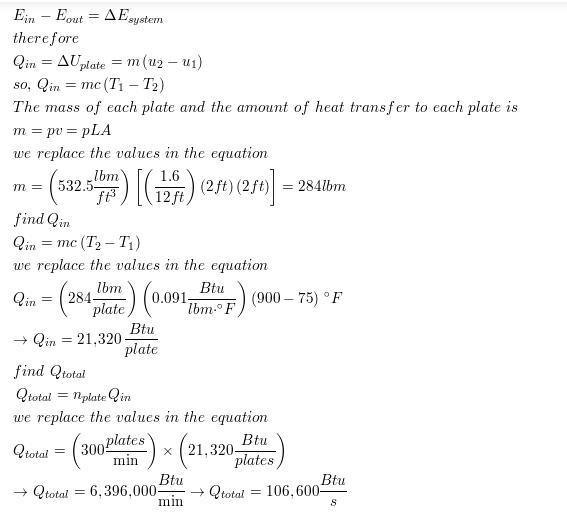
In a production facility, 1.6-in-thick 2-ft × 2-ft square brass plates (rho = 532.5 lbm/ft3 and cp = 0.091 Btu/lbm·°F) that are
Gnoma [55]

Answer:

106600 btu/s

<u>note: </u>

<u><em> solution is attached due to error in mathematical equation. please find the attachment</em></u>

8 0
2 years ago
2An oil pump is drawing 44 kW of electric power while pumping oil withrho=860kg/m3at a rate of 0.1m3/s.The inlet and outlet diam
Natasha2012 [34]

Answer:

\eta = 91.7%

Explanation:

Determine the initial velocity

v_1 = \frac{\dot v}{A_1}

    = \frac{0.1}{\pi}{4} 0.08^2

     = 19.89 m/s

final velocity

v_2 =\frac{\dot v}{A_2}

      = \frac{0.1}{\frac{\pi}{4} 0.12^2}

      =8.84 m/s

total mechanical energy is given as

E_{mech} = \dot m (P_2v_2 -P_1v_1) + \dot m \frac{v_2^2 - v_1^2}{2}

\dot v = \dot m v                       ( v =v_1 =v_2)

E_{mech} = \dot mv (P_2 -P_1) + \dot m \frac{v_2^2 - v_1^2}{2}

                = mv\Delta P + \dot m  \frac{v_2^2 -v_1^2}{2}

                 = \dot v \Delta P  + \dot v \rho \frac{v_2^2 -v_1^2}{2}

              = 0.1\times 500 + 0.1\times 860\frac{8.84^2 -19.89^2}{2}\times \frac{1}{1000}

E_{mech} = 36.34 W

Shaft power

W = \eta_[motar} W_{elec}

    =0.9\times 44 =39.6

mechanical efficiency

\eta{pump} =\frac{ E_{mech}}{W}

=\frac{36.34}{39.6} = 0.917  = 91.7%

8 0
2 years ago
Es una de las alternativas para obtener capital y como facilidad puede ayudarte a financiarte por más de 40 días, contando con e
andriy [413]

Answer:

Apalancamiento.

Explanation:

El apalancamiento es el uso de dinero prestado (deuda) para aumentar el rendimiento esperado del capital. El apalancamiento se mide como la relación entre la deuda que devenga intereses y los activos totales. Cuanto mayor sea la deuda que devenga intereses, mayor será el apalancamiento financiero o "aceleración". Esto puede tener un efecto positivo o negativo.

Los costos por intereses de este capital de préstamo suelen ser fijos y se deducen de los ingresos. Un préstamo permite que una organización genere más ingresos sin un aumento necesario en el capital. Como no es necesario recaudar ni mantener capital social adicional, no se requieren pagos de dividendos adicionales (que no se pueden deducir de las ganancias). Sin embargo, un alto apalancamiento puede ser beneficioso durante los tiempos de auge, pero puede conducir a serios problemas de flujo de efectivo durante una recesión, ya que es posible que no haya suficientes retornos para cubrir mayores costos de intereses y obligaciones de reembolso.

3 0
1 year ago
Other questions:
  • PDAs with two stacks are strictly more powerful than PDAs with one stack. Prove that 2-stack PDAs are not a valid model for CFLs
    12·1 answer
  • An electrical utility delivers 6.25E10 kWh of power to its customers in a year. What is the average power required during the ye
    15·1 answer
  • A charge of 2.0 × 10⁻¹⁰ C is to be stored on each plate of a parallel-plate capacitor having an area of 650 mm2 (1.0 in.2 ) and
    14·1 answer
  • An art collector is bidding on a statue that would complete a collection he is trying to assemble. The statue is being sold in a
    9·1 answer
  • An aircraft component is fabricated from an aluminum alloy that has a plane-strain fracture toughness of 40 MPa1m (36.4 ksi1in.)
    15·1 answer
  • A binary star system consists of two stars of masses m1m1m_1 and m2m2m_2. The stars, which gravitationally attract each other, r
    9·1 answer
  • Air whose density is 0.082 lbm/ft3 enters the duct of an air-conditioning system at a volume flow rate of 450 ft3/min. If the di
    8·2 answers
  • Which one of the following activities is not an example of incident coordination
    15·1 answer
  • The Hamming encoder/decoder in the lecture detected and corrected one error bit. By adding a thirteen bit which is the exclusive
    13·1 answer
  • A sample of normally consolidated clay was subjected to a CU triaxial compression test that was carried out until the specimen f
    6·1 answer
Add answer
Login
Not registered? Fast signup
Signup
Login Signup
Ask question!