answer.
Ask question
Login Signup
Ask question
All categories
  • English
  • Mathematics
  • Social Studies
  • Business
  • History
  • Health
  • Geography
  • Biology
  • Physics
  • Chemistry
  • Computers and Technology
  • Arts
  • World Languages
  • Spanish
  • French
  • German
  • Advanced Placement (AP)
  • SAT
  • Medicine
  • Law
  • Engineering
jasenka [17]
2 years ago
6

A sample of normally consolidated clay was subjected to a CU triaxial compression test that was carried out until the specimen f

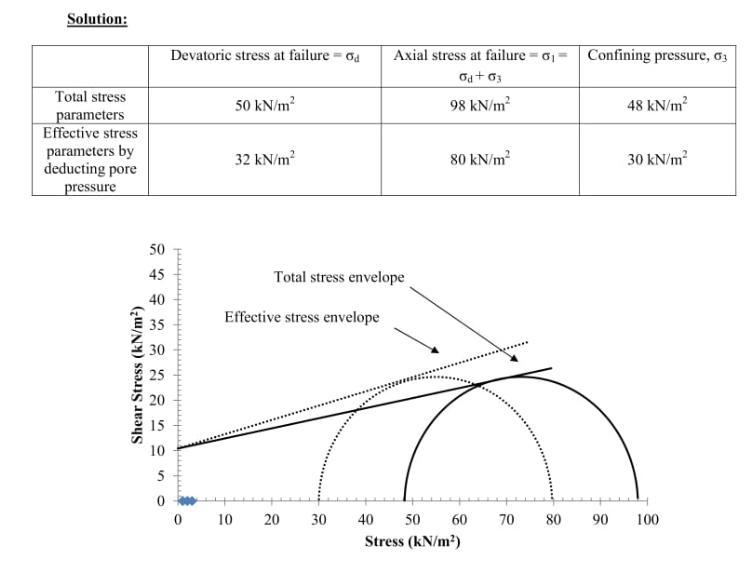
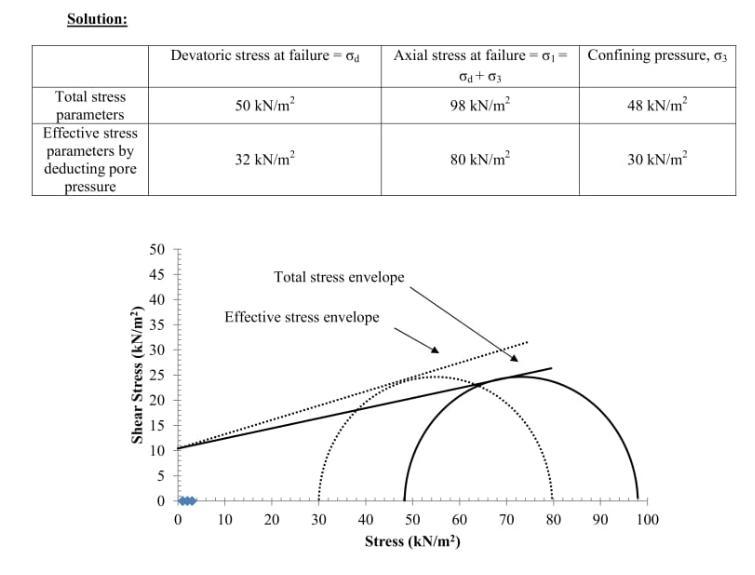
ailed at a deviator stress of 50 kN/m2. The pore water pressure at failure was recorded to be 18 kN/m2, and a confining pressure of 48 kN/m2 was used in the test. Using any software available at UGA, draw both the effective stress strength envelope and total stress strength envelope obtained form this CU test. Based on unconfined compression test using same clay, 20 kN/m2 of unconfined compressive stress was measured at the failure.

Engineering
1 answer:
QveST [7]2 years ago
7 0

Answer:

Check the explanation

Explanation:

Given

1) CU traixial compression test

2) Devatoric stress at failure  = бd = 50 kN/m^2

3) Confining pressure at failure  = бd = 48 kN/m^2

4) Pore pressure at failure  = u = 18 kN/m^2

5) Unconfined compression stress  = q = 20 kN/m^2

6) Undrained cohesion  = q/2 = 20 kN/m^2

To find:

1) Effective and total stress strength failure envelope

Kindly check the attached image below .

You might be interested in
Which of the following is correct regarding the principal stresses and maximum in-plane shear stresses? a. Principal stresses ca
ziro4ka [17]

Answer:

option B.

Explanation:

The correct answer is option B.

Principal stress is the maximum normal stress a body can have. In principal stress, there is purely normal stress. On principal plane shear stress is zero.

In-plane shear stress are the shear stress which is acting on the plane.

The statement which is correct regarding principle plane and shear stress is that The shear stress over principal stress planes is always zero.

4 0
2 years ago
A spherical tank for storing gas under pressure is 25 m in diameter and is made of steel 15 mm thick. The yield point of the mat
nalin [4]

Answer:

a) (option B) 230 kPa

b) (option A) 100 N/m

Explanation:

Given:

Diameter, d = 25 m

Thicknesses, t = 15 mm

Yield point = 240 MPa

Factor of safety = 2.5

a) To find the maximum internal pressure, let's use the formula:

\sigma l = \frac{\sigma y}{FOS} = \frac{PD}{4t}

\frac{\sigma y}{FOS} = \frac{PD}{4t}

Solving for P, we have:

P = \frac{\sigma y * 4t}{FOS * D}

P = \frac{240 * 4 * 15}{2.5 * 25}

P = 230.4 kPa

≈ 230 kPa

The maximum permissible internal pressure is nearly 230kPa

b) Given:

Thickness, t = 6.35 mm

L = 203 mm

Torque, T = 8 N m

Let's find the mean Area,

mA = (l - t)²

= (203 - 6.5)²

= 38671.22mm²

≈ 0.03867 m² (converted to meters)

To find the average shear flow, let's use the formula:

q = \frac{T}{2* mA}

= \frac{8}{2 * 0.03867}

q = 103.4 N/m approximately 100N/m

The average shear force flow is most nearly 100 N/m

4 0
2 years ago
Read 2 more answers
If a server takes precisely 15 seconds to serve a customer and customers arrive exactly every 20 seconds, what is the average wa
labwork [276]
The average waiting time is 10 seconds
7 0
2 years ago
A three-phase line has an impedance of 0.4 j2.7 ohms per phase. The line feeds two balanced three-phase loads that are connected
Viktor [21]

Answer:

a. The magnitude of the line source voltage is

Vs = 4160 V

b. Total real and reactive power loss in the line is

Ploss = 12 kW

Qloss = j81 kvar

Sloss = 12 + j81 kVA

c. Real power and reactive power supplied at the sending end of the line

Ss = 540.046 + j476.95 kVA

Ps = 540.046 kW

Qs = j476.95 kvar

Explanation:

a. The magnitude of the line voltage at the source end of the line.

The voltage at the source end of the line is given by

Vs = Vload + (Total current×Zline)

Complex power of first load:

S₁ = 560.1 < cos⁻¹(0.707)

S₁ = 560.1 < 45° kVA

Complex power of second load:

S₂ = P₂×1 (unity power factor)

S₂ = 132×1

S₂ = 132 kVA

S₂ = 132 < cos⁻¹(1)

S₂ = 132 < 0° kVA

Total Complex power of load is

S = S₁ + S₂

S = 560.1 < 45° + 132 < 0°

S = 660 < 36.87° kVA

Total current is

I = S*/(3×Vload)   ( * represents conjugate)

The phase voltage of load is

Vload = 3810.5/√3

Vload = 2200 V

I = 660 < -36.87°/(3×2200)

I = 100 < -36.87° A

The phase source voltage is

Vs = Vload + (Total current×Zline)

Vs = 2200 + (100 < -36.87°)×(0.4 + j2.7)

Vs = 2401.7 < 4.58° V

The magnitude of the line source voltage is

Vs = 2401.7×√3

Vs = 4160 V

b. Total real and reactive power loss in the line.

The 3-phase real power loss is given by

Ploss = 3×R×I²

Where R is the resistance of the line.

Ploss = 3×0.4×100²

Ploss = 12000 W

Ploss = 12 kW

The 3-phase reactive power loss is given by

Qloss = 3×X×I²

Where X is the reactance of the line.

Qloss = 3×j2.7×100²

Qloss = j81000 var

Qloss = j81 kvar

Sloss = Ploss + Qloss

Sloss = 12 + j81 kVA

c. Real power and reactive power supplied at the sending end of the line

The complex power at sending end of the line is

Ss = 3×Vs×I*

Ss = 3×(2401.7 < 4.58)×(100 < 36.87°)

Ss = 540.046 + j476.95 kVA

So the sending end real power is

Ps = 540.046 kW

So the sending end reactive power is

Qs = j476.95 kvar
7 0
2 years ago
At an impaired driver checkpoint, the time required to conduct the impairment test varies (according to an exponential distribut
professor190 [17]

Answer:

Option (d) 2 min/veh

Explanation:

Data provided in the question:

Average time required = 60 seconds

Therefore,

The maximum capacity that can be accommodated on the system, μ = 60 veh/hr

Average Arrival rate, λ = 30 vehicles per hour

Now,

The average time spent by the vehicle is given as

⇒ \frac{1}{\mu(1-\frac{\lambda}{\mu})}

thus,

on substituting the respective values, we get

Average time spent by the vehicle = \frac{1}{60(1-\frac{30}{60})}

or

Average time spent by the vehicle = \frac{1}{60(1-0.5)}

or

Average time spent by the vehicle = \frac{1}{60(0.5)}

or

Average time spent by the vehicle = \frac{1}{30} hr/veh

or

Average time spent by the vehicle = \frac{1}{30}\times60 min/veh

[ 1 hour = 60 minutes]

thus,

Average time spent by the vehicle = 2 min/veh

Hence,

Option (d) 2 min/veh

7 0
2 years ago
Other questions:
  • Water has a density of 1.94 slug/ft^3. What is the density expressed in SI units? Express the answer to three significant figure
    8·1 answer
  • An excavation is at risk for cave-in and water accumulation because of the excess soil that has accumulated. What type of excava
    12·1 answer
  • Pipe (2) is supported by a pin at bracket C and by tie rod (1). The structure supports a load P at pin B. Tie rod (1) has a diam
    15·1 answer
  • A mass of 12 kg saturated refrigerant-134a vapor is contained in a piston-cylinder device at 240 kPa. Now 300 kJ of heat is tran
    8·1 answer
  • The critical resolved shear stress for iron is 27 MPa (4000 psi). Determine the maximum possible yield strength for a single cry
    12·1 answer
  • 4-6. A vertical cylindrical storage vessel is 10 m high and 2 m in diameter. The vessel contains liquid cyclohexane currently at
    10·1 answer
  • Hot combustion gases, modeled as air behaving as an ideal gas, enter a turbine at 10 bar, 1500 K and exit at 1.97 bar and 900 K.
    7·1 answer
  • A dc shunt generator rated at 85 kW produces a voltage of 280 V. The brush voltage drop is 2.5 V, and the armature and field res
    6·1 answer
  • Water enters a circular tube whose walls are maintained at constant temperature at specified flow rate and temperature. For full
    8·1 answer
  • An airplane in level flight at an altitude h and a uniform speed v passes directly over a radar tracking station A. Calculate th
    5·1 answer
Add answer
Login
Not registered? Fast signup
Signup
Login Signup
Ask question!