answer.
Ask question
Login Signup
Ask question
All categories
  • English
  • Mathematics
  • Social Studies
  • Business
  • History
  • Health
  • Geography
  • Biology
  • Physics
  • Chemistry
  • Computers and Technology
  • Arts
  • World Languages
  • Spanish
  • French
  • German
  • Advanced Placement (AP)
  • SAT
  • Medicine
  • Law
  • Engineering
Anika [276]
2 years ago
6

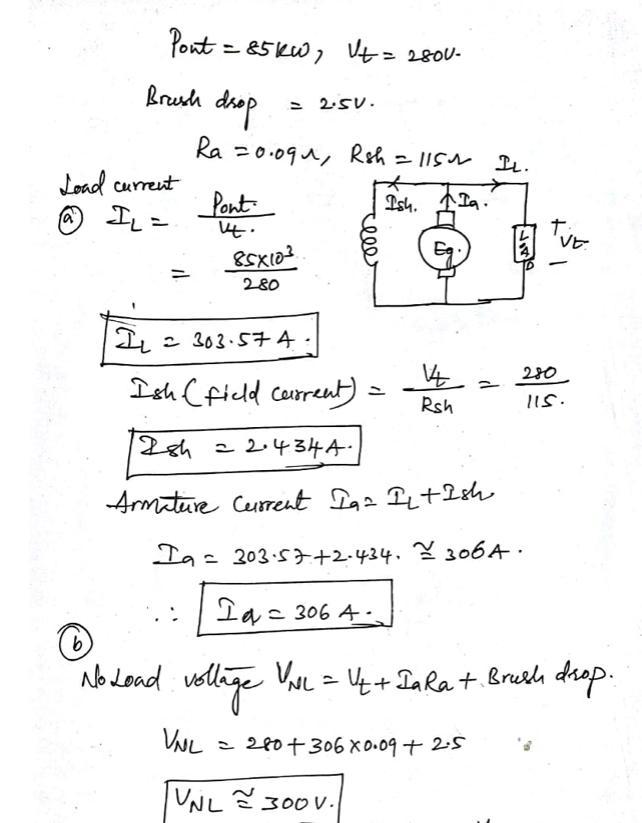
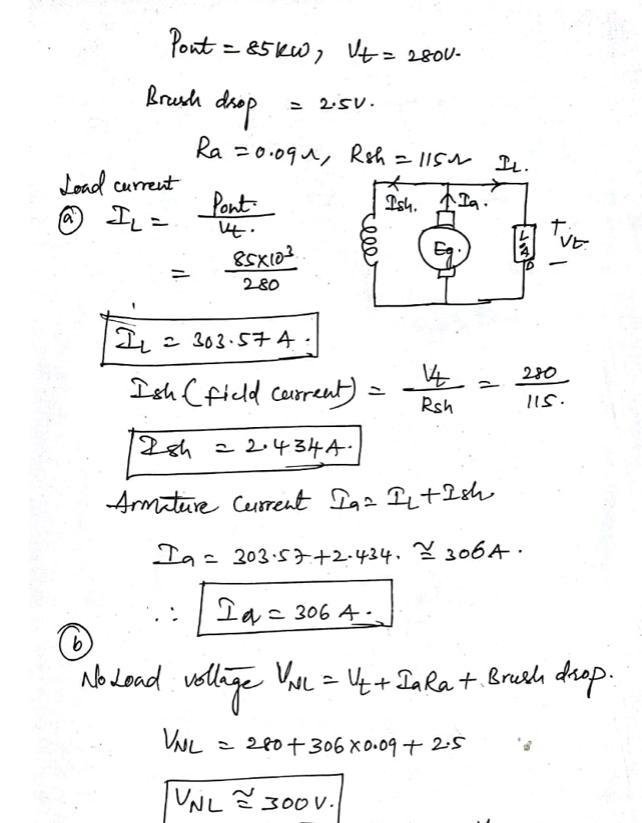
A dc shunt generator rated at 85 kW produces a voltage of 280 V. The brush voltage drop is 2.5 V, and the armature and field res

istances are 0.09 Ω and 115 Ω, respectively. The generator delivers rated current at rated speed and rated voltage. (a) Calculate the field, armature, and load currents versus load. Test the equations with the rated load. (b) Determine the terminal voltage at no-load and at rated load conditions. (c) Calculate the voltage regulation of the generator. Use the no-load voltage as the base value. (d) Plot the terminal voltage as a function of the load. Determine the load that corresponds to a 5% voltage drop using the no-load voltage as the base

Engineering
1 answer:
dalvyx [7]2 years ago
3 0

Answer:

(a) Calculate the field, armature, and load currents versus load = 306A

(b) Determine the terminal voltage at no-load and at rated load conditions = 300V

(c) Calculate the voltage regulation of the generator. Use the no-load voltage as the base value = 6.67%

(d) Plot the terminal voltage as a function of the load. Determine the load that corresponds to a 5% voltage drop using the no-load voltage as the base = 294.74V

Explanation:

CHECK THE ATTACHED FILES FOR DETAILED EXPLANATION.

You might be interested in
True or False:A retractable service pit cover can help other shop employees from falling into the pit while another technician i
coldgirl [10]

Answer:

f

Explanation:

7 0
2 years ago
Read 2 more answers
Methane and oxygen react in the presence of a catalyst to form formaldehyde. In a parallel reaction, methane is oxidized to carb
Nezavi [6.7K]

Answer:

y_{CH_4}^2=\frac{5mol/s}{100mol/s}=0.05\\y_{O_2}^2=\frac{3mol/s}{100mol/s}=0.03\\y_{H_2O}^2=\frac{47mol/s}{100mol/s}=0.47\\y_{HCHO}^2=\frac{43mol/s}{100mol/s}=0.43\\y_{CO_2}^2=\frac{2mol/s}{100mol/s}=0.02

Explanation:

Hello,

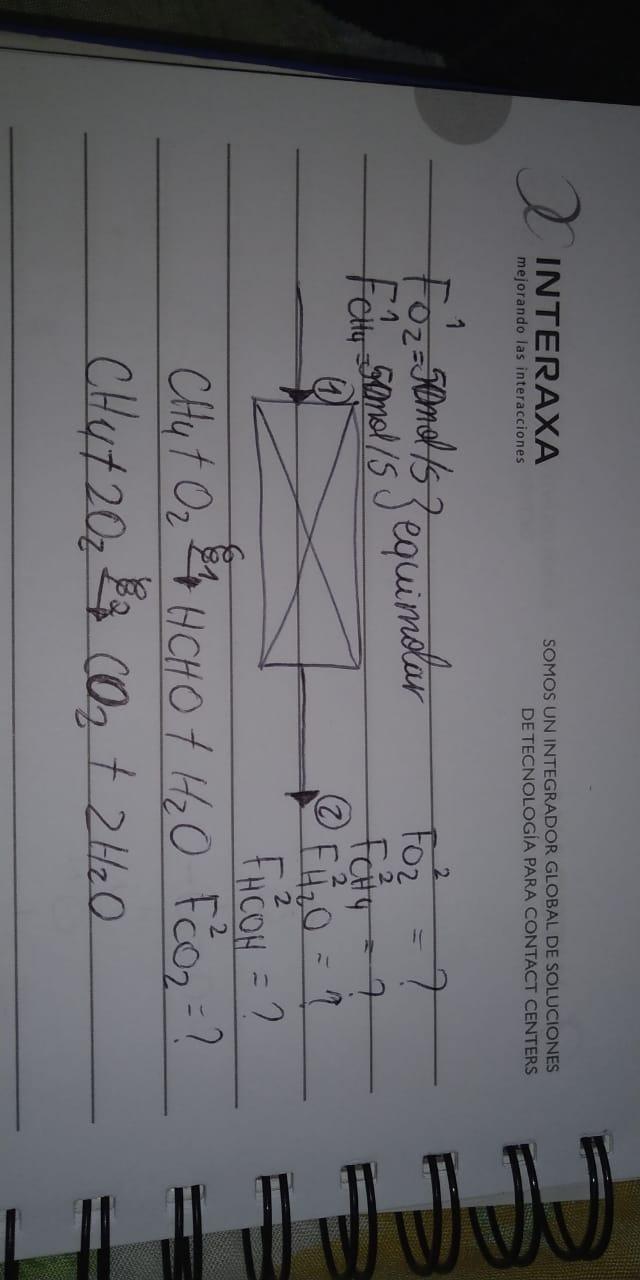
a. On the attached document, you can see a brief scheme of the process. Thus, to know the degrees of freedom, we state the following unknowns:

- \xi_1 and \xi_2: extent of the reactions (2).

- F_{O_2}^2, F_{CH_4}^2, F_{H_2O}^2, F_{HCHO}^2 and F_{CO_2}^2: Molar flows at the second stream (5).

On the other hand, we've got the following equations:

- F_{O_2}^2=50mol/s-\xi_1-2\xi_2: oxygen mole balance.

- F_{CH_4}^2=50mol/s-\xi_1-\xi_2: methane mole balance.

- F_{H_2O}^2=\xi_1+2\xi_2: water mole balance.

- F_{HCHO}^2=\xi_1: formaldehyde mole balance.

- F_{CO_2}^2=\xi_2: carbon dioxide mole balance.

Thus, the degrees of freedom are:

DF=7unknowns-5equations=2

It means that we need two additional equations or data to solve the problem.

b. Here, the two missing data are given. For the fractional conversion of methane, we define:

0.900=\frac{\xi_1+\xi_2}{50mol/s}

And for the fractional yield of formaldehyde we can set it in terms of methane as the reagents are equimolar:

0.860=\frac{F_{HCHO}^2}{50mol/s}

In such a way, one realizes that the output formaldehyde's molar flow is:

F_{HCHO}^2=0.860*50mol/s=43mol/s

Which is equal to the first reaction extent \xi_1, therefore, one computes the second one from the fractional conversion of methane as:

\xi_2=0.900*50mol/s-\xi_1\\\xi_2=0.900*50mol/s-43mol/s\\\xi_2=2mol/s

Now, one computes the rest of the output flows via:

- F_{O_2}^2=50mol/s-43mol/s-2*2mol/s=3mol/s

- F_{CH_4}^2=50mol/s-43mol/s-2mol/s=5mol/s

- F_{H_2O}^2=43mol/s+2*2mol/s=47mol/s

- F_{HCHO}^2=43mol/s

- F_{CO_2}^2=2mol/s

The total output molar flow is:

F_{O_2}+F_{CH_4}+F_{H_2O}+F_{HCHO}+F_{CO_2}=100mol/s

Therefore the output stream composition turns out into:

y_{CH_4}^2=\frac{5mol/s}{100mol/s}=0.05\\y_{O_2}^2=\frac{3mol/s}{100mol/s}=0.03\\y_{H_2O}^2=\frac{47mol/s}{100mol/s}=0.47\\y_{HCHO}^2=\frac{43mol/s}{100mol/s}=0.43\\y_{CO_2}^2=\frac{2mol/s}{100mol/s}=0.02

Best regards.

7 0
2 years ago
The wires each have a diameter of 12 mm, length of 0.6 m, and are made from 304 stainless steel. Determine the magnitude of forc
Sonbull [250]

Answer:

Magnitude of force P = 25715.1517 N

Explanation:

Given - The wires each have a diameter of 12 mm, length of 0.6 m, and are made from 304 stainless steel.

To find - Determine the magnitude of force P so that the rigid beam tilts 0.015∘.

Proof -

Given that,

Diameter = 12 mm = 0.012 m

Length = 0.6 m

\theta = 0.015°

Youngs modulus of elasticity of 34 stainless steel is 193 GPa

Now,

By applying the conditions of equilibrium, we have

∑fₓ = 0, ∑f_{y} = 0, ∑M = 0

If ∑M_{A} = 0

⇒F_{BC}×0.9 - P × 0.6 = 0

⇒F_{BC}×3 - P × 2 = 0

⇒F_{BC} = \frac{2P}{3}

If ∑M_{B} = 0

⇒F_{AD}×0.9 = P × 0.3

⇒F_{AD} ×3 = P

⇒F_{AD} = \frac{P}{3}

Now,

Area, A = \frac{\pi }{4} X (0.012)^{2} = 1.3097 × 10⁻⁴ m²

We know that,

Change in Length , \delta = \frac{P l}{A E}

Now,

\delta_{AD} = \frac{P(0.6)}{3(1.3097)(10^{-4}) (193)(10^{9}  } = 9.1626 × 10⁻⁹ P

\delta_{BC} = \frac{2P(0.6)}{3(1.3097)(10^{-4}) (193)(10^{9}  } = 1.83253 × 10⁻⁸ P

Given that,

\theta = 0.015°

⇒\theta = 2.618 × 10⁻⁴ rad

So,

\theta =  \frac{\delta_{BC} - \delta_{AD}}{0.9}

⇒2.618 × 10⁻⁴ = (  1.83253 × 10⁻⁸ P - 9.1626 × 10⁻⁹ P) / 0.9

⇒P = 25715.1517 N

∴ we get

Magnitude of force P = 25715.1517 N

6 0
2 years ago
A plane wall of thickness 2L = 60 mm and thermal conductivity k= 5W/m.K experiences uniform volumetric heat generation at a rate
aniked [119]

Answer:

Explanation:

A plane wall of thickness 2L=40 mm and thermal conductivity k=5W/m⋅Kk=5W/m⋅K experiences uniform volumetric heat generation at a rateq  

˙

q

q

˙

​  

, while convection heat transfer occurs at both of its surfaces (x=-L, +L), each of which is exposed to a fluid of temperature T∞=20∘CT  

∞

​  

=20  

∘

C. Under steady-state conditions, the temperature distribution in the wall is of the form T(x)=a+bx+cx2T(x)=a+bx+cx  

2

 where a=82.0∘C,b=−210∘C/m,c=−2×104C/m2a=82.0  

∘

C,b=−210  

∘

C/m,c=−2×10  

4

C/m  

2

, and x is in meters. The origin of the x-coordinate is at the midplane of the wall. (a) Sketch the temperature distribution and identify significant physical features. (b) What is the volumetric rate of heat generation q in the wall? (c) Determine the surface heat fluxes, q

′′

x

(−L)q  

x

′′

​  

(−L) and q

′′

x

(+L)q  

x

′′

​  

(+L). How are these fluxes related to the heat generation rate? (d) What are the convection coefficients for the surfaces at x=-L and x=+L? (e) Obtain an expression for the heat flux distribution q

′′

x

(x)q  

x

′′

​  

(x). Is the heat flux zero at any location? Explain any significant features of the distribution. (f) If the source of the heat generation is suddenly deactivated (q=0), what is the rate of change of energy stored in the wall at this instant? (g) What temperature will the wall eventually reach with q=0? How much energy must be removed by the fluid per unit area of the wall (J/m2)(J/m  

2

) to reach this state? The density and specific heat of the wall material are 2600kg/m32600kg/m  

3

 and 800J/kg⋅K800J/kg⋅K, respectively.

6 0
2 years ago
A 10-mm drill rod was heat-treated and ground. The measured hardness He was found to be 300 Brinell. Estimate the endurance stre
lesya [120]

Answer:

The endurance strength for the rod is 434.6 MPa

Explanation:

Since the rod is used in rotating bending, we need to use Marin equation given by

S=k_ak_bS'_e

Here S stands for the endurance strength for rotating  bending, S'_e is the endurance strength, and k_a \text{ and } k_b are the parameters for Marin surface modification factor.

Endurance strength.

We can start finding the endurance strength, from the directions we know that the hardness H_e was found to be 300 Brinell, thus for such value we can find the ultimate tensile strength using

S_{ut}=3.41H_e

Replacing the hardness we get

S_{ut}=3.41(300) MPa \\ S_{ut}=1023 MPa

Now since the ultimate tensile strength has a value less than 1400 MPa, we can find the endurance strength using

S'_e =0.5S_{ut}

Replacing the tensile strength we get

S'_e=0.5(1023) MPa \\ S'_e = 511.5 MPa

Parameters for Marin surface modification factor.

From the directions we know that the drill rod has a ground surface finish, so then from tables we get

a=1.58 \text{ and } b = -0.085

Thus the surface factor will be

k_a=a(S_{ut})^b

Replacing values and the ultimate tensile strength

k_a=(1.58)1023^{-0.085}\\k_a=0.8766

Then we can find the rotating shaft factor, for a diameter of 10 mm, we can use the equation

k_b=1.24d^{-0.107}

Replacing the diameter we get

k_b=1.24(10)^{-0.107}\\k_b=0.9692

Estimating endurance strength for rotating shaft.

We can replace now all values we have found in Marin equation.

S=k_ak_bS'_e

S=(0.8766)(0.9692)(511.5) MPa

S=434.6 MPa

Thus the endurance strength for the rod is 434.6 MPa

3 0
2 years ago
Other questions:
  • Water is flowing in a metal pipe. The pipe OD (outside diameter) is 61 cm. The pipe length is 120 m. The pipe wall thickness is
    9·1 answer
  • Why is it important that ironworkers wait to begin work until after cement masons are finished with their job?
    13·1 answer
  • Gina is about to use a fire extinguisher on a small fire. What factor determines the type of extinguisher she should use
    9·2 answers
  • The 2-Mg concrete pipe has a center of mass at point G. If it is suspended from cables AB and AC, determine the diameter of cabl
    12·1 answer
  • A logic chip used in a computer dissipates 3 W of power in an environment at 120°F, and has a heat transfer surface area of 0.08
    11·1 answer
  • An aircraft component is fabricated from an aluminum alloy that has a plane-strain fracture toughness of 40 MPa1m (36.4 ksi1in.)
    15·1 answer
  • A piston-cylinder assembly contains 2 lb of air at a temperature of 540 °R and a pressure of 1 atm. The air compressed to a stat
    5·1 answer
  • A rectification column is fed 100 kg mol/h of a mixture of 50 mol % benzene and 50 mol % toluene at 101.32 kPa abs pressure. The
    5·1 answer
  • Anytime scaffolds are assembled or __________, a competent person must oversee the operation.
    15·2 answers
  • The rate of flow through an ideal clarifier is 8000m3 /d, the detention time is 1h and the depth is 3m. If a full-length movable
    5·1 answer
Add answer
Login
Not registered? Fast signup
Signup
Login Signup
Ask question!