answer.
Ask question
Login Signup
Ask question
All categories
  • English
  • Mathematics
  • Social Studies
  • Business
  • History
  • Health
  • Geography
  • Biology
  • Physics
  • Chemistry
  • Computers and Technology
  • Arts
  • World Languages
  • Spanish
  • French
  • German
  • Advanced Placement (AP)
  • SAT
  • Medicine
  • Law
  • Engineering
maria [59]
2 years ago
7

A heat pump cycle operating at steady state receives energy by heat transfer from well water at 10oC and discharges energy by he

at transfer to a building at the rate of 1.4x10⁵ kJ/h. Over a period of 14 days, an electric meter records that 1620 kW·h of electricity is provided to the heat pump. These are the only energy transfers involved. Determine the total amount of energy transfer by work into the heat pump over the 14-day period, in GJ. Determine the amount of energy that the heat pump receives by heat transfer from the well water over the 14-day period, in GJ. Determine the heat pump’s coefficient of performance.
Engineering
1 answer:
Marta_Voda [28]2 years ago
8 0

Answer: the total amount of energy transferred by work into the heat pump over the 14-day period is 5.8GJ

Explanation: since the meter reading for the 14 days period is 1620kW.h

Electrical power Ep is

Ep = 1620*10^3W.h

In 14 days there are 14*24 hrs = 336hrs

Ep = (1620*10^3)/336 = 4821.42W

This means 4821.42J of work is done per sec. Therefore for 14 days we have,

3600*24*14*4821.42J of enegy

= 5831989632J = 5.8GJ

Answer 2 = the amount of energy that the heat pump receives by heat transfer from the well water over the 14-day period is 41.2GJ

Explanation: rate of energy transfer as heat to building is 1.4*10^5 kJ/hr

That is 1.4*10^8 J/hr

In 14 days it becomes

24*14*1.4*10^8 = 47GJ

Energy received from well by heat pump =

Energy transfered - energy received

= 47 - 5.8 =41.2GJ

Answer 3. the heat pump’s coefficient of performance is 0.12

Explanation: COP = energy obtained/ work done

COP = 5.8/47 = 0.12

You might be interested in
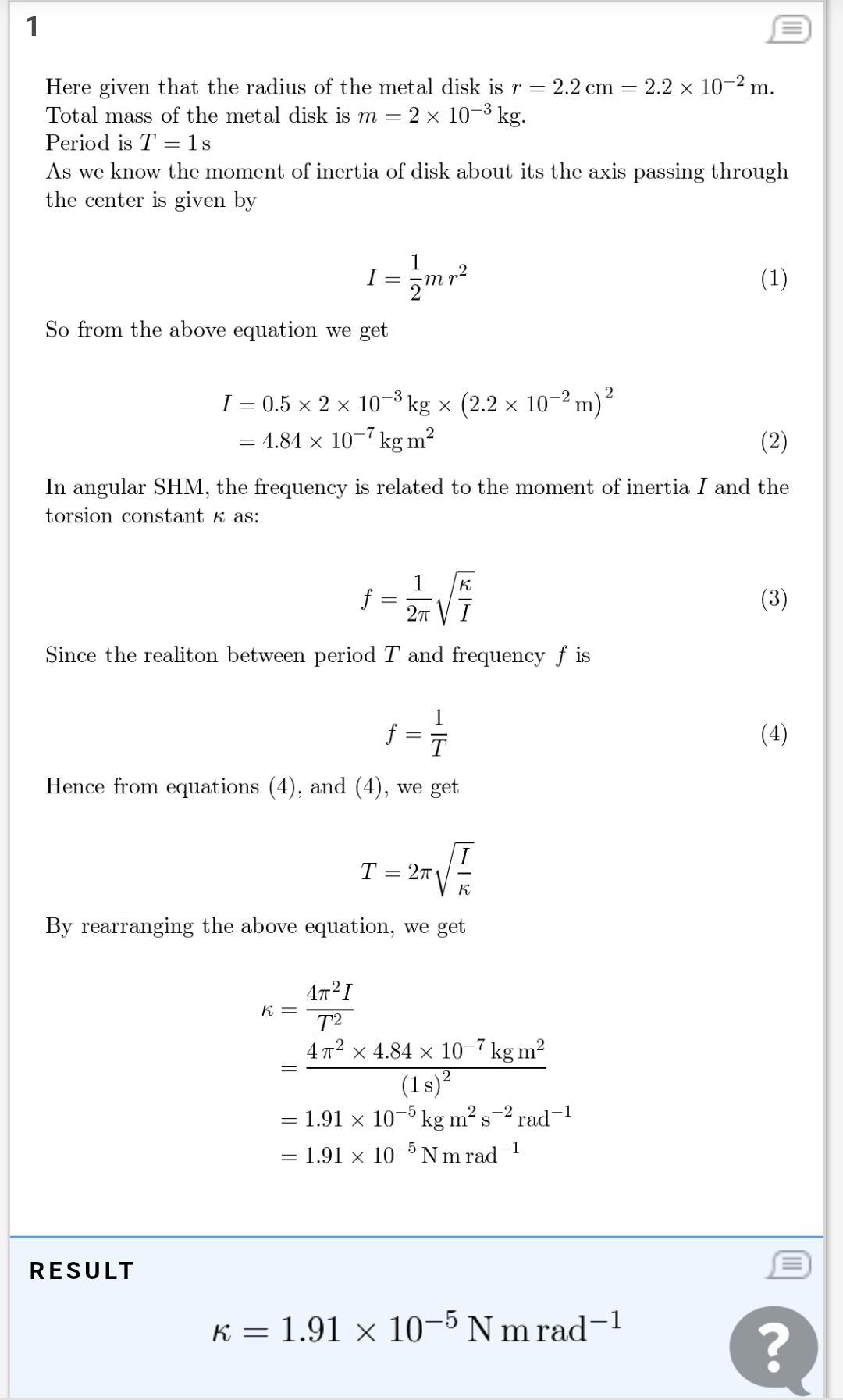
A thin metal disk of mass m=2.00 x 10^-3 kg and radius R=2.20cm is attached at its center to a long fiber. When the disk is turn
topjm [15]

Answer:

k = 1.91 × 10^-5 N m rad^-1

Workings and Solution to this question can be viewed in the screenshot below:

6 0
2 years ago
Write multiple if statements: If carYear is before 1967, print "Probably has few safety features." (without quotes). If after 19
Free_Kalibri [48]

Answer:

The solution code is written in Python 3.

  1. carYear = 1995
  2. if(carYear < 1967):
  3.    print("Probably has few safety features.\n")
  4. if(carYear > 1970):
  5.    print("Probably has head rests. \n")
  6. if(carYear > 1991):
  7.    print("Probably has electronic stability control.\n")
  8. if(carYear > 2002):
  9.    print("Probably has airbags. \n")

Explanation:

Firstly, create a variable, <em>carYear</em> to hold the value of year of the car make. (Line 1)

Next, create multiple if statements as required by the question (Line 3-13). The operator "<" denotes "smaller" and therefore <em>carYear < 1967</em> means any year before 1967. On another hand, the operator ">" denotes "bigger" and therefore <em>carYear > 1970 </em>means any year after 1970.

The print statement in each of the if statements is done using the Python built-in function <em>print()</em>. The "\n" is an escape sequence that create a new line at the end of each printed phrase.

5 0
2 years ago
The emissivity of galvanized steel sheet, a common roofing material, is ε = 0.13 at temperatures around 300 K, while its absorpt
Step2247 [10]

Answer:

759.99W/m²

Explanation:

Question: If the temperature of the sheet is 77C,what is the incident solar radiation on aday with Tinf= Tsurr= 16°C?

Given

Energy Equation of the Gas

αs * Gs * A + h * A * (T inf - Tg) + εσA (Tsurr⁴- Tg⁴) = 0

Where σ= 5.67 *10^-8 W/m²K⁴ (Stefan-Boltzmann constant)

ε = 0.13 (Emisivity)

αs = 0.65 (Absorptivity for solar radiation)

h = 7W/m²K⁴

Tg = 77 + 273.15K = 350.15K

T inf = 16 + 273.15 = 288.15K

T surr= T inf = 288.15

Substitute the above values in the Gas Equation, we have

0.65 * Gs * A + 7 * A * (288.15 - 350.15) + 0.13 * 5.67 * 10^-8 * A * (288.15⁴ - 350.15⁴) = 0

0.65 * Gs * A = - 7 * A * (288.15 - 350.15) - 0.13 * 5.67 * 10^-8 * A * (288.15⁴ - 350.15⁴)

A cancels out, so we are left with

0.65 * Gs = - 7 * (288.15 - 350.15) - 0.13 * 5.67 * 10^-8 * (288.15⁴ - 350.15⁴)

0.65Gs = 434 - 0.7372 * 10^-8(−8,137,940,481.697)

0.65Gs = 434 + 0.7372 * 81.37940481697

0.65Gs = 493.992897231070284

Gs = 493.992897231070284/0.65

Gs = 759.9890726631850

Gs = 759.99W/m² ------- Approximated

3 0
2 years ago
The ingredient weights for making 1 yd (cyd) of concrete by assuming aggregates in SSD state are given below. The volume of air
Pachacha [2.7K]

Answer:

Explanation:

Ans) Given batch weight of each component :

Cement = 700 lb

Water = 315 lb

Coarse aggregate = 1575 lb

Fine aggregate = 1100 lb

Part 1) Amount of water = 328.5 lb

Amount of water is needed to be increased if the aggregates has absorption capacity, To maintain constant water cement ratio, the mixing water is increased because some of the water is absorbed by aggregates.

Amount of water absorbed = 328.5 lb - 315 lb = 13.5 lb

Total amount of aggregates = 1575 + 1100 = 2675 lb

=> % Absorption capacity = 13.5 x 100 / 2675 = 0.5 %

Hence, new amount of Coarse aggregate = (1 - 0.005) x 1575 lb = 1567.125 lb

New amount of fine aggregate = (1 - 0.005) x 1100 = 1094.5 lb

Since, water cement ratio is maintained constant , amount of cement remains unchanged

=> Volume of water = 328.5 / 62.4 = 5.26 ft3

=> Volume of cement = 700 / (3.15 x 62.4) = 3.56 ft3

=> Volume of coarse aggregate = 1567.125 / (2.4 x 62.4) = 10.46 ft3

=> Volume of fine aggregate = 1100 / (2.4 x 62.4) = 7.34 ft3

Volume of air = 2% = 0.02 x 27 = 0.54 ft3

Total concrete volume = 5.26 + 3.56 + 10.46 + 7.34 + 0.54 \approx 27 ft3 = 1 yd3

Hence, calculated amount of each component is correct

Part 2) We know, minus sign indicated that the aggregate will absorb some moisture from concrete, hence mixing water amount needed to be corrected .

=> Amount of water absorbed by coarse aggregate = 0.01 x 1567.125 lb = 15.67 lb

=> Amount of water absorbed by fine aggregate = 0.02 x 1094.50 lb = 21.89 lb

Total amount of water absorbed = 15.67 + 21.89 = 37.56 lb

To maintain same water cement ratio, amount of mixing water is needed to be increased

=> Corrected amount of mixing water = 328.5 lb + 37.56 lb = 366 lb

=> Corrected amount of coarse aggregate = (1 - 0.01) x 1567.125 = 1551.45 lb

=> Corrected amount of fine aggregate = (1 - 0.02) x 1094.5 = 1072.6 lb

Part 3) We know,

Unit weight = Sum of weight of each material / Total volume

=> Sum of weight = 366 + 700 + 1551.45 + 1072.6 = 3690.05 lb

Total volume = 1 yd3 or 27 ft3

=> Expected Unit Weight = 3690.05 lb / 27 ft3 = 136.67 lb/ft3

Also, Concrete Yield = Weight of all components / Unit weight of concrete

=> Yield = 3690.05 / 136.67 = 27 ft3 or 1 yd3

4 0
2 years ago
Derive the probability that a receptor is occupied by a ligand using a model that treats the L ligands in solution as distinguis
love history [14]

that is the same thing as you are not going through this week or something

7 0
2 years ago
Other questions:
  • a. Replacing standard incandescent lightbulbs with energy-efficient compact fluorescent lightbulbs can save a lot of energy. Cal
    9·1 answer
  • Water at 400 kPa with a quality of 75% has its pressure raised 200 kPa (to 600 kPa) in a constant volume process. What is the ne
    15·1 answer
  • Air at 40°C flows over a long, 25-mm-diameter cylinder with an embedded electrical heater. In a series of tests, measurements we
    11·1 answer
  • Steam flows at steady state through a converging, insulated nozzle, 25 cm long and with an inlet diameter of 5 cm. At the nozzle
    11·1 answer
  • Choose the correct sequence of the following events leading to the sensory processing of a stimulus. 1. transmission 2. transduc
    13·1 answer
  • A mass of 12 kg saturated refrigerant-134a vapor is contained in a piston-cylinder device at 240 kPa. Now 300 kJ of heat is tran
    8·1 answer
  • A thin-walled tube with a diameter of 12 mm and length of 25 m is used to carry exhaust gas from a smoke stack to the laboratory
    7·1 answer
  • A spherical tank for storing gas under pressure is 25 m in diameter and is made of steel 15 mm thick. The yield point of the mat
    5·2 answers
  • A glycerin pump is powered by a 5-kW electric motor. The pressure differential between the outlet and the inlet of the pump at f
    13·1 answer
  • Draw an ERD for each of the following situations. (If you believe that you need to make additional assumptions, clearly state th
    15·1 answer
Add answer
Login
Not registered? Fast signup
Signup
Login Signup
Ask question!