answer.
Ask question
Login Signup
Ask question
All categories
  • English
  • Mathematics
  • Social Studies
  • Business
  • History
  • Health
  • Geography
  • Biology
  • Physics
  • Chemistry
  • Computers and Technology
  • Arts
  • World Languages
  • Spanish
  • French
  • German
  • Advanced Placement (AP)
  • SAT
  • Medicine
  • Law
  • Engineering
sukhopar [10]
2 years ago
8

The working substance of a certain Carnot engine is 1.20 mol of an ideal monatomic gas. During the isothermal expansion portion

of this engine's cycle, the volume of the gas doubles, while during the adiabatic expansion the volume increases by a factor of 5.7. The work output of the engine is 960 J in each cycle.Compute the temperatures of the two reservoirs between which this engine operates.
Engineering
1 answer:
ruslelena [56]2 years ago
3 0

Answer:

The engine operates between 86.44K and 278.84K

Explanation:

Given:

Dung the isothermal expansion portion of this engine's cycle, the volume of the gas doubles, so

V2 = 2V1 and

V3 = 2V4. (V1 to V4 represent volumes)

W,out = 960J

∆V = Increment of Volume = 5.7

n = Number of Moles of Working Substance = 1.20mol

Let Th represents hot temperature

Let Tc represents cold temperature

For a Carnot engine:

V3/V4 = V2/V1 and

Work Done in the Cycle = nR((Th)ln(V2/V1) - (Tc)ln(V3/V4)) where R = 8.31 J/mol K Gas Constant

Substitute in the values

960 = 1.2 * R [Th * ln(2V1/V1) - Tc * ln(2V4/V4)]

960 = 1.2R[Th * ln(2) - Tc * ln(2)]

960 = 1.2R ln(2) (Th - Tc) ---- Divide through by 1.2 ln(2)

960/(1.2 ln(2)) = R(Th - Tc)

1154.16 = R(Th - Tc)

Th - Tc = 1154.16/8.31

Th - Tc = 192.3593387851951

Th - Tc = 192.40K ------ (1)

For the reversible adiabatic expansion:

T2 = T1*(V1/V2)^(R/Cv).

Where V2/V1 = 5.7 ----- Given

For a monatomic ideal gas, Cv = 3/2R. Tc = T2 and Th = T1

So,

Tc = Th*(1/5.7)^(R/3/2R)

Tc = Th * (1/5.7)^⅔

Tc = Th * 0.313388769773343

Tc = Th * 0.31

Tc = 0.31Th

Substitute 0.31Th for Tc in (1)

Th - 0.31Th = 192.40

0.69Th = 192.4 ---- Divide through by 0.69

Th = 192.4/0.69

Th = 278.8405797101449

Th = 278.84K ---- Approximated

Tc = 0.31 * 278.8405797101449

Tc = 86.440579710144919

Tc = 86.44K ------ Approximated

You might be interested in
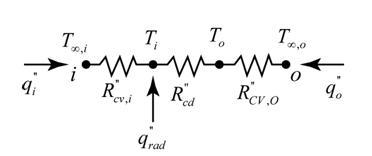
The wall of drying oven is constructed by sandwiching insulation material of thermal conductivity k = 0.05 W/m°K between thin me
masha68 [24]

Answer:

86 mm

Explanation:

From the attached thermal circuit diagram, equation for i-nodes will be

\frac {T_ \infty, i-T_{i}}{ R^{"}_{cv, i}} + \frac {T_{o}-T_{i}}{ R^{"}_{cd}} + q_{rad} = 0 Equation 1

Similarly, the equation for outer node “o” will be

\frac {T_{ i}-T_{o}}{ R^{"}_{cd}} + \frac {T_{\infty, o} -T_{o}}{ R^{"}_{cv, o}} = 0 Equation 2

The conventive thermal resistance in i-node will be

R^{"}_{cv, i}= \frac {1}{h_{i}}= \frac {1}{30}= 0.033 m^{2}K/w Equation 3

The conventive hermal resistance per unit area is

R^{"}_{cv, o}= \frac {1}{h_{o}}= \frac {1}{10}= 0.100 m^{2}K/w Equation 4

The conductive thermal resistance per unit area is

R^{"}_{cd}= \frac {L}{K}= \frac {L}{0.05} m^{2}K/w Equation 5

Since q_{rad}  is given as 100, T_{o}  is 40 T_ \infty  is 300 T_{\infty, o}  is 25  

Substituting the values in equations 3,4 and 5 into equations 1 and 2 we obtain

\frac {300-T_{i}}{0.033} +\frac {40-T_{i}}{L/0.05} +100=0  Equation 6

\frac {T_{ i}-40}{L/0.05}+ \frac {25-40}{0.100}=0

T_{i}-40= \frac {L}{0.05}*150

T_{i}-40=3000L

T_{i}=3000L+40 Equation 7

From equation 6 we can substitute wherever there’s T_{i} with 3000L+40 as seen in equation 7 hence we obtain

\frac {300- (3000L+40)}{0.033} + \frac {40- (3000L+40)}{L/0.05}+100=0

The above can be simplified to be

\frac {260-3000L}{0.033}+ \frac {(-3000L)}{L/0.05}+100=0

\frac {260-3000L}{0.033}=50

-3000L=1.665-260

L= \frac {-258.33}{-3000}=0.086*10^{-3}m= 86mm

Therefore, insulation thickness is 86mm

8 0
2 years ago
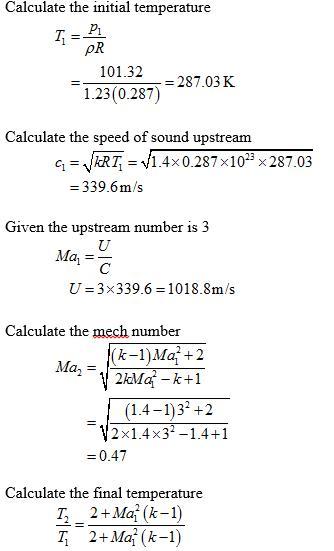
Consider a normal shock wave in air. The upstream conditions are given by M1=3, p1 = 1 atm, and r1 = 1.23 kg/m3. Calculate the d
mart [117]

Answer and Explanation:

The answer is attached below

7 0
2 years ago
A 10-m long steel linkage is to be designed so that it can transmit 2 kN of force without stretching more than 5 mm nor having a
Fed [463]

Answer:

<em>minimum required diameter of the steel linkage is 3.57 mm</em>

<em></em>

Explanation:

original length of linkage l = 10 m

force to be transmitted  f = 2 kN = 2000 N

extension e = 5 mm= 0.005 m

maximum stress σ = 200 N/mm^2 = 2*10^{8}  N/m^{2}

maximum stress allowed on material σ = force/area

imputing values,

200 = 2000/area

area = 2000/(2*10^{8}) = 10^{-5} m^2

recall that area = \pi d^{2} /4

10^{-5} = \frac{3.142*d^{2} }{4} = 0.7855d^{2}

d^{2} = \frac{10^{-5} }{0.7855} = 1.273*10^{-5}

d = \sqrt{1.273*10^{-5}  } = 3.57*10^{-3} m = 3.57 mm

<em>maximum diameter of  the steel linkage d = 3.57 mm</em>

4 0
2 years ago
A three-point bending test was performed on an aluminum oxide specimen having a circular cross section of radius 3.5 mm (0.14 in
RideAnS [48]

To resolve this problem we have,

R=3.5mm\\F_f1=950N\\L_1=50mm\\b=12mm\\L_2=40mm

F_{f2} is unknown.

With these dates we can calculate the Flexural strenght of the specimen,

\sigma{fs}=\frac{F_{f1}L}{\pi R^3}\\\sigma{fs}=\frac{(950)(50*10^{-3})}{\pi 3.5*10^{-3}}\\\sigma{fs}=352.65Mpa

After that, we can calculate the flexural strenght for the square cross section using the previously value.

\sigma{fs}=\frac{F_{f2}L}{\pi R^3}\\(352.65*10^6)=\frac{3Ff(40*10^{-3})}{2(12*10^{-10})}\\F_{f2}=\frac{352.65*10^6}{34722.22}\\F_{f2}=10156.32N\\F_{f2}=10.2kN

6 0
2 years ago
A cylindrical specimen of a brass alloy having a length of 60 mm (2.36 in.) must elongate only 10.8 mm (0.425 in.) when a tensil
Gemiola [76]

The radius of the specimen is 60 mm

<u>Explanation:</u>

Given-

Length, L = 60 mm

Elongated length, l = 10.8 mm

Load, F = 50,000 N

radius, r = ?

We are supposed to calculate the radius of a cylindrical brass specimen in order to produce an elongation of 10.8 mm when a load of 50,000 N is applied. It is necessary to compute the strain corresponding to this

elongation using Equation:

ε = Δl / l₀

ε = 10.8 / 60

ε = 0.18

We know,

σ = F / A

Where A = πr²

According to the stress-strain curve of brass alloy,

σ = 440 MPa

Thus,

sigma = 50,000 / \pi  (r)^2\\\\440 X 10^6 = \frac{50,000}{3.14 X (r)^2}\\\\r = 0.06m\\r = 60mm\\\\\\

Therefore, the radius of the specimen is 60 mm

3 0
2 years ago
Other questions:
  • Mary is interested in developing new machines that would increase the productivity of small scale farmers. After high school, wh
    8·1 answer
  • A rod is 2m long at temperature of 10oC. Find the expansion of the rod, when the temperature is raised to 80oC. If this expansio
    7·1 answer
  • Consider the following class definitions: class smart class superSmart: public smart { { public: public: void print() const; voi
    6·1 answer
  • The function below takes a single string parameter: input_string. If the input contains the lowercase letter z, return the strin
    15·1 answer
  • Show that a chirped Gaussian pulse is compressed initially inside a single-mode fiber when ftC &lt; 0. Derive expressions for th
    12·1 answer
  • A vineyard owner is planting several new rows of grapevines, and needs to know how many grapevines to plant in each row. She has
    8·1 answer
  • 4.9 Given that I 4 amps when Vs 40 volts and Is 4 amps and I 1 amp when Vs 20 volts and Is 0, use superposition and linearity to
    5·1 answer
  • A flexural member is fabricated from two flange plates 7-1/2 x ½ and a web plate 17 x 3/8. The yield stress of steel is 50 ksi.
    8·1 answer
  • Water enters a circular tube whose walls are maintained at constant temperature at specified flow rate and temperature. For full
    8·1 answer
  • 11 Notează, în caiet, trăsăturile personajelor ce se pot
    13·1 answer
Add answer
Login
Not registered? Fast signup
Signup
Login Signup
Ask question!