answer.
Ask question
Login Signup
Ask question
All categories
  • English
  • Mathematics
  • Social Studies
  • Business
  • History
  • Health
  • Geography
  • Biology
  • Physics
  • Chemistry
  • Computers and Technology
  • Arts
  • World Languages
  • Spanish
  • French
  • German
  • Advanced Placement (AP)
  • SAT
  • Medicine
  • Law
  • Engineering
NARA [144]
2 years ago
6

Consider the following class definitions: class smart class superSmart: public smart { { public: public: void print() const; voi

d print() const; void set(int, int); void set(int, int, int); int sum(); int manipulate(); smart(); superSmart(); smart(int, int); superSmart(int, int, int); private: private: int x; int z; int y; int secret(); }; }; Which private members, if any, of smart are public members of superSmart
Engineering
1 answer:
arsen [322]2 years ago
5 0

Answer:

a) There is no any private member of smart which are public members of superSmart.

Explanation:

You might be interested in
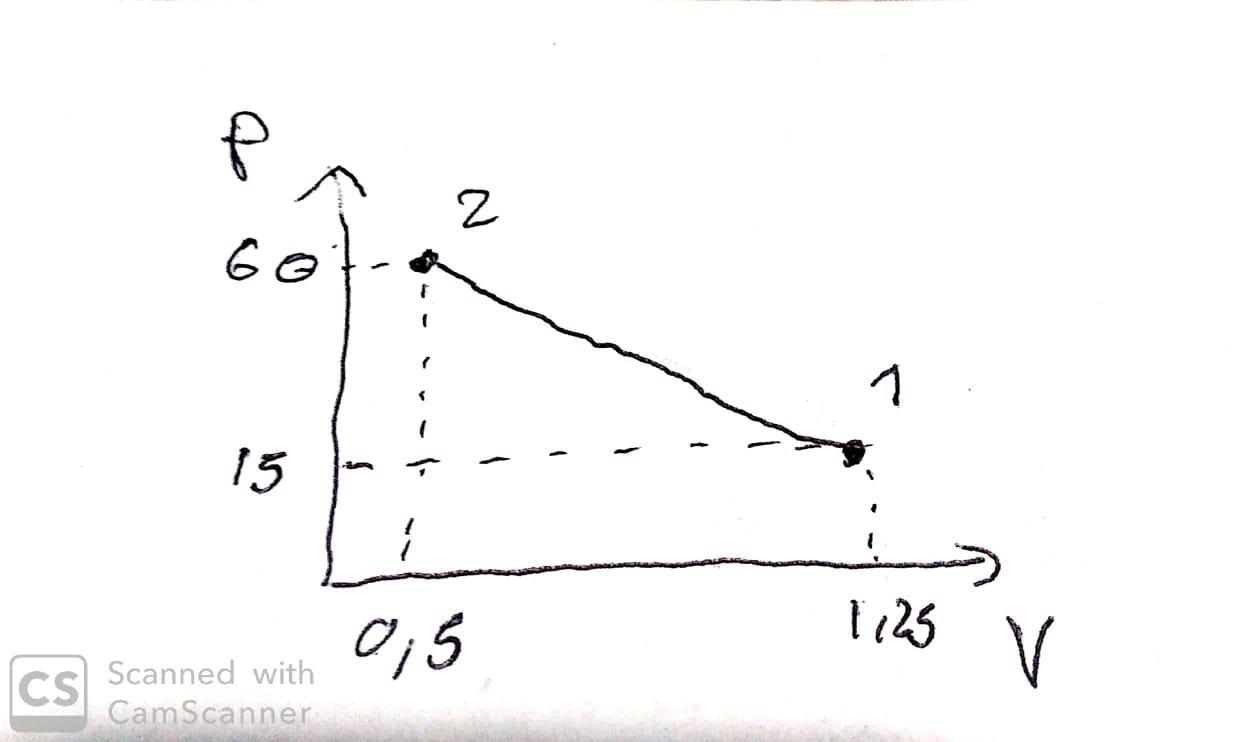
A closed system consisting of 4 lb of a gas undergoes a process during which the relation between pressure and volume is pVn 5 c
gayaneshka [121]

Answer:

V1=5<u>ft3</u>

<u>V2=2ft3</u>

n=1.377

Explanation:

PART A:

the volume of each state is obtained by multiplying the mass by the specific volume in each state

V=volume

v=especific volume

m=mass

V=mv

state 1

V1=m.v1

V1=4lb*1.25ft3/lb=5<u>ft3</u>

state 2

V2=m.v2

V2=4lb*0.5ft3/lb=  <u> 2ft3</u>

PART B:

since the PV ^ n is constant we can equal the equations of state 1 and state 2

P1V1^n=P2V2^n

P1/P2=(V2/V1)^n

ln(P1/P2)=n . ln (V2/V1)

n=ln(P1/P2)/ ln (V2/V1)

n=ln(15/53)/ ln (2/5)

n=1.377

3 0
2 years ago
A spring-loaded toy gun is used to shoot a ball of mass m = 1.50 kg straight up in the air. The spring has spring constant k = 6
adell [148]

Answer:

1) a) Mechanical energy is conserved because no dissipative forces perform work on the ball.

2) The muzzle velocity of the ball is approximately 5.272 meters per second.

3) The maximum height of the ball is 1.417 meters.

Explanation:

1) Which of the following statements are true?

a) Mechanical energy is conserved because no dissipative forces perform work on the ball.

True, statement indicates that there is no air resistence and no friction between ball and the inside of the gun because the first never touches the latter one.

b) The forces of gravity and the spring have potential energies associated with them.

False, force of gravity do work on the ball and spring receives a potential energy at being deformated by the ball.

c) No conservative forces act in this problem after the ball is released from the spring gun.

False, the absence of no conservative forces is guaranteed for the entire system according to the statement of the problem.

2) According to the statement, we understand that spring is deformed and once released and just after reaching its equilibrium position, the muzzle velocity is reached. As spring deformation is too small in comparison with height, we can neglect changes in gravitational potential energy. By Principle of Energy Conservation, we describe the motion of the ball by the following expression:

U_{k, 1}+K_{1}=U_{k,2}+K_{2} (Eq. 1)

Where:

U_{k,1}, U_{k,2} - Initial and final elastic potential energies of spring, measured in joules.

K_{1}, K_{2} - Initial and final translational kinetic energies of the ball, measured in joules.

After using definitions of elastic potential and translational kinetic energies, we expand the equation above as:

\frac{1}{2}\cdot m\cdot (v_{2}^{2}-v_{1}^{2}) = \frac{1}{2}\cdot k\cdot (x_{1}^{2}-x_{2}^{2})

And the final velocity is cleared:

m\cdot (v_{2}^{2}-v_{1}^{2}) = k\cdot (x_{1}^{2}-x_{2}^{2})

v_{2}^{2}-v_{1}^{2} =\frac{k}{m}\cdot (x_{1}^{2}-x_{2}^{2})

v_{2}^{2} =v_{1}^{2}+\frac{k}{m}\cdot (x_{1}^{2}-x_{2}^{2})

v_{2} = \sqrt{v_{1}^{2}+\frac{k}{m}\cdot (x_{1}^{2}-x_{2}^{2}) } (Eq. 2)

Where:

v_{1}, v_{2} - Initial and final velocities of the ball, measured in meters per second.

k - Spring constant, measured in newtons per meter.

m - Mass of the ball, measured in kilograms.

x_{1}, x_{2} - Initial and final position of spring, measured in meters.

If we know that v_{1} = 0\,\frac{m}{s}, k = 667\,\frac{N}{m}, m = 1.50\,kg, x_{1} = -0.25\,m and x_{2} = 0\,cm, the muzzle velocity of the ball is:

v_{2} =\sqrt{\left(0\,\frac{m}{s} \right)^{2}+\left(\frac{667\,\frac{N}{m} }{1.50\,kg} \right)\cdot [(-0.25\,m)^{2}-(0\,m)^{2}]}

v_{2}\approx 5.272\,\frac{m}{s}

The muzzle velocity of the ball is approximately 5.272 meters per second.

3) After leaving the toy gun, the ball is solely decelerated by gravity. We construct this model by Principle of Energy Conservation:

U_{g,2}+K_{2} = U_{g,3}+K_{3} (Eq. 3)

Where:

U_{g,2}, U_{g,3} - Initial and gravitational potential energies of the ball, measured in joules.

K_{2}, K_{3} - Initial and final translational kinetic energies of the ball, measured in joules.

After applying definitions of gravitational potential and translational kinetic energies, we expand the equation above and solve the resulting for the final height:

m\cdot g \cdot (h_{3}-h_{2}) = \frac{1}{2}\cdot m \cdot (v_{2}^{2}-v_{3}^{2})

h_{3}-h_{2}=\frac{v_{2}^{2}-v_{3}^{2}}{2\cdot g}

h_{3} = h_{2} +\frac{v_{2}^{2}-v_{3}^{2}}{2\cdot g} (Eq. 4)

h_{2}, h_{3} - Initial and final heights of the ball, measured in meters.

v_{2}, v_{3} - Initial and final velocities of the ball, measured in meters per second.

g - Gravitational acceleration, measured in meters per square second.

If we get that v_{2} = 5.272\,\frac{m}{s}, v_{3} = 0\,\frac{m}{s}, h_{2} = 0\,m and g = 9.807\,\frac{m}{s^{2}}, the maximum height of the ball is:

h_{3} = 0\,m+\frac{\left(5.272\,\frac{m}{s} \right)^{2}-\left(0\,\frac{m}{s} \right)^{2}}{2\cdot \left(9.807\,\frac{m}{s^{2}} \right)}

h_{3} = 1.417\,m

The maximum height of the ball is 1.417 meters.

5 0
2 years ago
1. A glass window of width W = 1 m and height H = 2 m is 5 mm thick and has a thermal conductivity of kg = 1.4 W/m*K. If the inn
emmasim [6.3K]

Answer:

1. \dot Q=19600\ W

2. \dot Q=120\ W

Explanation:

1.

Given:

  • height of the window pane, h=2\ m
  • width of the window pane, w=1\ m
  • thickness of the pane, t=5\ mm= 0.005\ m
  • thermal conductivity of the glass pane, k_g=1.4\ W.m^{-1}.K^{-1}
  • temperature of the inner surface, T_i=15^{\circ}C
  • temperature of the outer surface, T_o=-20^{\circ}C

<u>According to the Fourier's law the rate of heat transfer is given as:</u>

\dot Q=k_g.A.\frac{dT}{dx}

here:

A = area through which the heat transfer occurs = 2\times 1=2\ m^2

dT = temperature difference across the thickness of the surface = 35^{\circ}C

dx = t = thickness normal to the surface = 0.005\ m

\dot Q=1.4\times 2\times \frac{35}{0.005}

\dot Q=19600\ W

2.

  • air spacing between two glass panes, dx=0.01\ m
  • area of each glass pane, A=2\times 1=2\ m^2
  • thermal conductivity of air, k_a=0.024\ W.m^{-1}.K^{-1}
  • temperature difference between the surfaces, dT=25^{\circ}C

<u>Assuming layered transfer of heat through the air and the air between the glasses is always still:</u>

\dot Q=k_a.A.\frac{dT}{dx}

\dot Q=0.024\times 2\times \frac{25}{0.01}

\dot Q=120\ W

5 0
2 years ago
An annealed copper strip of 228 mm wide and 25 mm thick being rolled to a thickness of 20 mm, in one pass. The roll radius is 30
sdas [7]

Answer:

The roll force is 1.59 MN

The power required in this operation is 644.96 kW

Explanation:

Given;

width of the annealed copper, w = 228 m

thickness of the copper, h₀ = 25 mm

final thickness, hf = 20 mm

roll radius, R = 300 mm

The roll force is given by;

F = LwY_{avg}

where;

w is the width of the annealed copper

Y_{avg} is average true stress of the strip in the roll gap

L is length of arc in contact, and for frictionless situation it is given as;

L = \sqrt{R(h_o-h_f)} \\\\L = \sqrt{300(25-20)}\\\\L = 38.73 \ mm

Now, determine the average true stress, Y_{avg}, for the annealed copper;

The absolute value of the true strain, ε = ln(25/20)

ε = 0.223

from true stress vs true strain graph; at true strain of 0.223, the true stress is 280 MPa.

Then, the average true stress = ¹/₂(280 MPa.) = 180 MPa

Finally determine the roll force;

F = LwY_{avg}

F = (\frac{38.73 }{1000})(\frac{228}{1000})*180 \ MPa\\\\F =   1.59 \ MN

The power required in this operation is given by;

P = \frac{2\pi FLN}{60}\\\\P =  \frac{2\pi (1.59*10^6)(0.03873)(100)}{60}\\\\P = 644955.2 \ W\\\\P = 644.96 \ kW

5 0
2 years ago
______process in sheet metal is used for producing fluid tight joints. A - Hemming B- Seaming C-Beading D-Roll forming
SOVA2 [1]

Answer:

option B

Explanation:

The correct answer is option B

Seaming is an operation in which the edges are folded over another part to achieve the tight fit.

Seaming is generally used to join other parts together.

So, seaming is generally used for producing fluid-tight joints.

This process is used in the food industry on canned goods, metal roofing, and in the automotive industry.  

5 0
2 years ago
Other questions:
  • What can your employer do to protect you from overhead power lines?
    8·1 answer
  • The four-wheel-drive all-terrain vehicle has a mass of 320 kg with center of mass G2. The driver has a mass of 82 kg with center
    15·1 answer
  • When a man returns to his well-sealed house on a summer day, he finds that the house is at 35°C. He turns on the air conditioner
    13·1 answer
  • The driving force for fluid flow is the pressure difference, and a pump operates by raising the pressure of a fluid (by converti
    13·1 answer
  • The components of an electronic system dissipating 90 W are located in a 1-m-long circular horizontal duct of 15-cm diameter. Th
    11·1 answer
  • 4-6. A vertical cylindrical storage vessel is 10 m high and 2 m in diameter. The vessel contains liquid cyclohexane currently at
    10·1 answer
  • Can crushers help us recycle in a space efficient way which is good for saving the earth and for giving you more room in your ap
    7·1 answer
  • Technician A says that the most efficient method of EVAP system leak detection is introducing smoke under low pressure from a ma
    7·1 answer
  • Define initial set and final set. Briefly discuss one method used to determine them. The following laboratory tests are performe
    12·1 answer
  • Who can work on a fixed ladder that extends more than 24 feet?
    11·1 answer
Add answer
Login
Not registered? Fast signup
Signup
Login Signup
Ask question!