answer.
Ask question
Login Signup
Ask question
All categories
  • English
  • Mathematics
  • Social Studies
  • Business
  • History
  • Health
  • Geography
  • Biology
  • Physics
  • Chemistry
  • Computers and Technology
  • Arts
  • World Languages
  • Spanish
  • French
  • German
  • Advanced Placement (AP)
  • SAT
  • Medicine
  • Law
  • Engineering
nexus9112 [7]
2 years ago
13

When a man returns to his well-sealed house on a summer day, he finds that the house is at 35°C. He turns on the air conditioner

, which cools the entire house to 20°C in 30 min. If the COP of the air-conditioning system is 2.8, determine the power drawn by the air conditioner. Assume the entire mass within the house is equivalent to 800 kg of air for which cv = 0.72 kJ/kg·°C and cp = 1.0 kJ/kg·°C.
Engineering
1 answer:
ipn [44]2 years ago
3 0

Answer:

\dot W = 1.667\, kW

Explanation:

A well-sealed house means that there is no mass interaction between air indoors and outdoors. Hence, cooling process is isochoric. The heat removed by the air conditioner is:

\dot Q_{L} = \frac{m_{air}}{\Delta t} \cdot c_{v, air} \cdot (T_{o}-T_{f})\\\dot Q_{L} = \frac{800\, kg}{(30\, min)\cdot (\frac{60\, s}{1 \, min} )}\cdot (0.7 \frac{kJ}{kg \cdot K}) \cdot (15\, K)\\\dot Q_{L} = 4.667\, kW

The power drawn by the air conditioner is:

\dot W = \frac{\dot Q_{L}}{COP_{R}} \\\dot W = \frac {4.667\, kW}{2.8}\\\dot W = 1.667\, kW

You might be interested in
Two kilograms of oxygen fills the cylinder of a piston-cylinder assembly. The initial volume and pressure are 2 m3 and 1 bar, re
valentinak56 [21]

Answer: Heat transfer (Q) is 521 kJ.

Explanation: In the piston-cilinder assembly, we can suppose that the oxygen act as an ideal gas, so, it can be used the General Gas Equation:

PV=\frac{m}{M}RT, where:

P is pressure;

V is volume;

m is mass;

M is molar mass;

R is a constant: R = 8.314.10^{-5} m³bar.K⁻¹.mol⁻¹;

T is temperature;

Using this equation, find the intial temperature:

PV = \frac{m}{M}RT

1.2 = \frac{2}{16}.8.314.10^{-5}.T

T = 1.924.10^{5} K

To determine the final temperature, use Combined Gas Law:

\frac{P_{i} . V_{i} }{T_{i} } = \frac{P.V }{T}, in which, the left side of the equality is related to the initial values and the right side, to the final values.

As pressure is constant:

\frac{V_{i} }{T_{i} } =\frac{V}{T}

T = \frac{V.T_{i} }{V_{i} }

T = \frac{4.1.924.10^{-5} }{2}

T = 3.85.10^{5} K

With the temperatures, calculate the heat transfer of the process:

Q = m.k.ΔT, where:

k is heat constant

ΔT = T - T_{i}

Q = m.k.ΔT

Q = 2.1.35.(3.85 - 1.92).10^{5}

Q = 521 kJ

The heat transfer in the process is 521 kJ.

6 0
2 years ago
Read 2 more answers
A system consisting of 3 lb of water vapor in a piston–cylinder assembly, initially at 350°F and a volume of 71.7 ft3, is expand
Alla [95]

Answer:

isobaric expansion = 281.09 Btu

isothermal compression= 72 Btu

Explanation:

The first law of thermodynamics is:

Q_{AB}=W_{AB}+deltaU_{AB}

where:

Q=heat transferred

W= work

U=internal energy  

W_{AB}=P*(V_{B}-V_{A})

U_{AB}=n*C_{v}(T_{2}-T_{1})

P=pressure, V= volume, T= temperature, n =  moles, Cv= specific heat at constant volume.

In a isobaric process heat transferred is:

Q=P*(V_{B}-V_{A})+n*C_{v}(T_{2}-T_{1})

For an isothermal process (T2-T1 = 0) so

Q=P*(V_{B}-V_{A})= W_{AB}

From the data we know that the energy transferred to the system in the isothermal compression by work was 72 Btu that is the heat transferred to the system.

For the first process

Q=P*(V_{B}-V_{A})+n*C_{v}(T_{2}-T_{1})

we have to properties at the beginning of the process : temperature (350°F) and specific volume (V/mass)

specific-volume=\frac{71.7 ft^{3}}{3Lb}=23.9\frac{ft^{3}}{Lb}

we use this information in the appropriate unit to find the pressure in thermodynamic tables.

T1= 176°C

v1= 1.49 m^3/kg

P=1.37 bar

in the second state we have

P=1.37 bar =137000Pa

v_{2}=\frac{85.38ft^{3}}{3Lb}= 28.46\frac{ft^{3}}{Lb}

with thee properties we check in the thermodynamic tables

T2= 255°C

n=mass/Mw = 3Lb*\frac {1kg}{2.2Lb}*\frac{1000gr}{1kg}*\frac{1mol}{18gr}=75.75 mol

we usually find Cp on tables for water but from the Mayer relation we have:

C_{v}=C_{p}+R

Cp for water vapor is: 33.12 J/mol*K

R=8.314 J/mol*K

Cv= 41.434 J/mol*K

replacing in the equation for Q

Q=137000 Pa*(2.41m^{3}-2.030m^{3})+75.75mol*41.434\frac{ J}{mol*K}*(528.15-449.81 K)=296569J

296569J =281.09 Btu

5 0
2 years ago
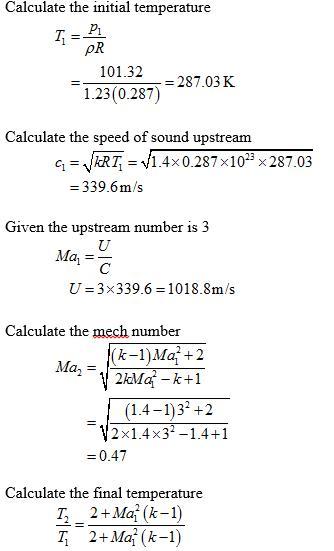
Consider a normal shock wave in air. The upstream conditions are given by M1=3, p1 = 1 atm, and r1 = 1.23 kg/m3. Calculate the d
mart [117]

Answer and Explanation:

The answer is attached below

7 0
2 years ago
A converging-diverging nozzle is designed to operate with an exit Mach number of 1.75 . The nozzle is supplied from an air reser
Flura [38]

Answer:

a. 4.279 MPa

b. 3.198 MPa to 4.279 MPa

c. 0.939 MPa

d. Below 3.198 MPa

Explanation:

From the given parameters

M_{exit} = 1.75 MPa  

M at 1.6 MPa gives A_{exit}/A* = 1.2502

M at 1.8 MPa gives  A_{exit}/A* = 1.4390

Therefore, by interpolation, we have M_{exit} = 1.75 MPa  gives A

However, we shall use M_{exit} = 1.75 MPa and A

Similarly,

P_{exit}/P₀ = 0.1878

a) Where the nozzle is choked at the throat there is subsonic flow in the following diverging part of the nozzle. From tables, we have

A_{exit}/A* = 1.387. by interpolation M

Therefore P_{exit} = P₀ × P

Which shows that the nozzle is choked for back pressures lower than 4.279 MPa

b) Where there is a normal shock at the exit of the nozzle, we have;

M₁ = 1.75 MPa, P₁ = 0.1878 × 5 = 0.939 MPa

Where the normal shock is at M₁ = 1.75 MPa, P₂/P₁ = 3.406

Where the normal shock occurs at the nozzle exit, we have

P_b = 3.406\times 0.939 = 3.198 MPa

Where the shock occurs t the section prior to the nozzle exit from the throat, the back pressure was derived as P_b = 4.279 MPa

Therefore the back pressure value ranges from 3.198 MPa to 4.279 MPa

c) At M_{exit} = 1.75 MPa  and P

d) Where the back pressure is less than 3.198 MPa according to isentropic flow relations supersonic flow will exist at the exit plane    

8 0
2 years ago
Tech A says that as moisture levels increase in brake fluid, the boiling point of the brake fluid decreases. Tech B says that fi
dezoksy [38]

Answer: Both Technician A and B are correct.

Explanation:

Technicians A and B are both right about their diagnosis. The Society of Automotive Engineers performed extensive research on vehicle brake fluids and found that there is typically a 2% moisture content in the brake fluid after a year of operating a vehicle. And as the moisture content of the brake fluid rises, the boiling point of the brake fluid decreases as well.

4 0
2 years ago
Other questions:
  • A 1020 CD steel shaft is to transmit 15 kW while rotating at 1750 rpm. Determine the minimum diameter for the shaft to provide a
    10·1 answer
  • a. Replacing standard incandescent lightbulbs with energy-efficient compact fluorescent lightbulbs can save a lot of energy. Cal
    9·1 answer
  • As shown, a load of mass 10 kg is situated on a piston of diameter D1 = 140 mm. The piston rides on a reservoir of oil of depth
    9·1 answer
  • Water is the working fluid in an ideal Rankine cycle. The condenser pressure is 8 kPa, and saturated vapor enters the turbine at
    10·1 answer
  • An uninsulated, thin-walled pipe of 100-mm diameter is used to transport water to equipment that operates outdoors and uses the
    9·1 answer
  • A piece of corroded metal alloy plate was found in a submerged ocean vessel. It was estimated that the original area of the plat
    6·1 answer
  • 4-6. A vertical cylindrical storage vessel is 10 m high and 2 m in diameter. The vessel contains liquid cyclohexane currently at
    10·1 answer
  • Benzene vapor at 480°C is cooled and converted to a liquid at 25°C in a continuous condenser. The condensate is drained into 1.7
    15·1 answer
  • What ratio between differential gain and common-mode gain is called​
    9·1 answer
  • Use the drop -down menus to select the appropriate question type. Picking between two possible alternatives: Showing an understa
    7·1 answer
Add answer
Login
Not registered? Fast signup
Signup
Login Signup
Ask question!