answer.
Ask question
Login Signup
Ask question
All categories
  • English
  • Mathematics
  • Social Studies
  • Business
  • History
  • Health
  • Geography
  • Biology
  • Physics
  • Chemistry
  • Computers and Technology
  • Arts
  • World Languages
  • Spanish
  • French
  • German
  • Advanced Placement (AP)
  • SAT
  • Medicine
  • Law
  • Engineering
kati45 [8]
2 years ago
5

When Sebastian wrote the contract with BP for over two billion dollars, he included targets for performance that had to be met b

efore a payment would be released. Sebastian was trying to avoid ________bias.
Business
1 answer:
Lynna [10]2 years ago
6 0

Answer:

The question is incomplete, The complete question with options should be;

When Sebastian wrote the contract with BP for over two billion dollars, he included targets for performance that had to be met before a payment would be released. Sebastian was trying to avoid ________bias.

A. overconfidence

B. escalation of commitment

C. sunk-cost

D. framing

E. hindsight

The answer is

B. Escalation of commitment

Explanation:

Escalation of commitment is a human behavior pattern in which an individual or group facing increasingly negative outcomes from a decision, action, or investment regardless continues the behavior instead of changing the course.

It simply means the irrational behaviour of investing additional resources to a project that is failing.

These resources could be time, energy and money that an individual continue to invest into a falling and sinking venture or business

So, in this situation, before releasing the payment, Sebastian ensures that the targets should be met for the performance. He is avoiding the situation of escalation of commitment bias of him continuing to release or invest money into an already failing contract.

You might be interested in
Your uncle holds just one stock, East Coast Bank (ECB). You agree that this stock is relatively safe, but you want to demonstrat
g100num [7]

Complete question:

Assume that your uncle holds just one stock, East Coast Bank (ECB), which he thinks has very little risk.  You agree that the stock is relatively safe, but you want to demonstrate that his risk would be even lower if he were more diversified.  You obtain the following returns data for West Coast Bank (WCB).  Both banks have had less variability than most other stocks over the past 5 years.  

                   Year               ECB                WCB  

               2004             40.00%            40.00%

               2005            -10.00%            15.00%

               2006             35.00%            -5.00%

               2007             -5.00%           -10.00%

               2008             15.00%            35.00%

a. What is the expected return and risk of each stock?

b. Measured by the standard deviation of returns, by how much would your uncle's risk have been reduced if he had held a portfolio consisting of 60% in ECB and the remainder in WCB?  In other words, what is the difference between portfolio's standard deviation and weighted average of components' standard deviations? (Hint: check the example on page 11-12 on my note).

Solution:

The estimated return of the stock is the average profit.

So the average of ECB is (40-10+35-5+15)/5

=  \frac{75 percent}{5}

= 15% expected return

WCB expected return = 40+15-5-10+35  

= \frac{75 percent}{5}

= 15%

They've had the same planned return.

This is generally defined in the Greek letter Mu, (U) A weighted average may also be used to calculate portfolio volatility.

Standard deviation of ECB is \sqrt{{ sum [(x-U)^2]/5}}

so for ECB:

(40-15)^2= 25^2 =6.25%

(-10-15)^2= -35^2 = 0.1225

(35-15)^2= 20^2 = 0.04

(-5-15)^2= -20^2 = 0.04

(15-15)^2=0

now 0.0625+0.1225+0.04+0.04+0=0.265

stdev= \sqrt{(0.265/5)} = 0.23

So WCB is the same except in a different order to make things quick I'm only going to add the median again WCB=0.23

Then the 60/40 portfolio will be the "weighted average" of the returns.

portfolio returns

2004: (60%*40%)+(40%*40%) = 40%

2005: (60%*-10%)+(40%*15%) = 0%

2006: (60%*35%)+(40%*-5%) = 19%

2007: (60%*-5%)+(40%*-10%) = -7%

2008:(60%*15%)+(40%*35%) = 23%

we have an average return of (40+19-7+23)/5 = 75/5 =15%  

The estimated return of all combined stocks is a better way to do so.

we knew they both had expected returns of 15% so we can say  

(60%*15%)+(40%*15%)=15%  so the portfolio has an expected return of 15%

Now we do the standard deviation for the whole portfolio and get

(40-15)^2= 25^2 =6.25%

(0-15)^2 = - 25^2 =6.25%

(19-15)^2= 4^2 = 0.16%

(-7-15)^2 = -22^2 = -4.84%

(23-15)^2= 8^2 = 0.64%

now add them up and get 9.78%

\sqrt{(9.78%/5)} = 13.98%

Therefore, the normal portfolio variance is 13.98 per cent and the predicted portfolio return is 15 per cent.

Every stock has a standard deviation of 23 per cent and an average return of 15 per cent, meaning that the fund has the same estimated return but with less standard deviation. This ensures that the same gain is less costly. It's stronger than any of these products.


5 0
2 years ago
Beck Kubiak wishes to purchase new appliances for her home. The total cost for the appliances is $2,900. To finance the purchase
Flura [38]

Answer:

total finance charge = $203.08

her monthly payment = $105.13

Explanation:

The Loan amount = Cost of Appliance - Down Payment

                              = $2,900 - ($2,900 × 20%)

                              = $2,320

Change the APR to nominal compounding,

Using a Financial Calculator, this will be :

8.50 % Shift EFF%

12 Shift P/YR

Shift NOM % = 8.19%

Then calculate the <em>monthly payment</em> as follows :

Pv = $2,320

n = 24

p/yr = 12

r = 8.19%

Fv = $0

PMT = ?

Using a Financial Calculator, monthly payment, PMT is $105.13

Total Finance Charge will then be obtained from the amortization schedule from the First Period to the 24th Period and this will be : $203.08.

5 0
2 years ago
Starling Company purchased machinery at the beginning of Year 1 at a cost of $86,100. The machinery has an estimated life of fiv
Alja [10]

Answer:  $10,906

Explanation:

Given that,

Purchased machinery at the beginning of Year 1 = $86,100

machinery has an estimated life of five years,

Estimated residual value = $4,305

Accumulated depreciation = $49,077 at the end of Year 2

Year 3 Depreciation expense:

= \frac{Cost\ of\ machinery - Estimated\ residual\ value - Accumulated\ depreciation}{3}

= \frac{86,100 - 4,305 - 49,077}{3}

= $10,906

5 0
2 years ago
A trader creates a long butterfly spread from options with strike prices $60, $65, and $70 by trading a total of 400 options. Th
malfutka [58]

Answer:

$400

Explanation:

From the question, there is a butterfly spread when a trader buys 100 options with strike prices $60 and $70 and sells 200 options with strike price $65.

The maximum gain is the point where both the stock price and the middle strike price are equal, i.e. equal to $65. At that point, the options payoffs are respectively $500, 0, and 0. By implication, the total payoff is $500.

The set up cost of the butterfly spread can be calculated as follows:

Setup cost = ($11×100) + ($18×100) – ($14×200)

                  = 1,100 + 1,800 – 2,800

Setup cost = $100

Net gain = Options payoffs – Setup cost = $500 - $100 = $400

Therefore, the maximum net gain (after the cost of the options is taken into account) is $400.

3 0
2 years ago
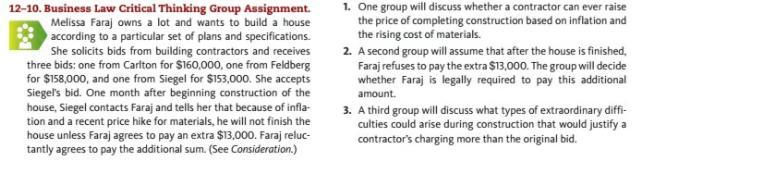
Is Faraj legally required to pay this additional amount in this case? Melissa Faraj owns a lot and wants to build a house accord
lubasha [3.4K]

Answer:

The issues that arises between the Faraj and Siegel can be discussed by three different groups in resolving the contract agreement.

Note: Kindly find an attached copy of the complete question below.

Explanation:

Solution

In this case between Faraj and Siege'ls building contractors the following issue are discussed by three groups as follows:

(1) The contractor can increase the price of finishing construction based on inflation and the cost of raising materials during inflation prices for the materials increases or goes up and this will affect the customer gradually.

(2) Faraj will not pay the additional amount requested by Siegel because according to the contract the amount she has to pay is $153,000

(3) Issues or problems that might come up during construction is listed below:

  • Poor communication
  • Not feasible or impractical forecasting
  • The unavailability of structure

3 0
2 years ago
Other questions:
  • What is the first step that a smart new-car buyer should take before talking to salespersons and putting a deposit on a car? A.
    15·1 answer
  • An economy is employing 2 units of capital, 5 units of raw materials, and 8 units of labour to produce its total output of 640 u
    11·1 answer
  • Luther Inc., has 1,000 shares of 8%, $50 par value, cumulative preferred stock and 50,000 shares of $1 par value common stock ou
    12·1 answer
  • Susan was conducting a group discussion in her organization. She found that the sales people and the production team had differe
    14·1 answer
  • Whitney Corporation granted stock options that permit certain executives to buy 10,000 common shares at an exercise price of $10
    11·1 answer
  • 44. CEO compensation The total compensation of the chief executive officers (CEOs) of the 800 largest U.S. companies (the Fortun
    14·1 answer
  • Assume that Brazil and Mexico have floating exchange rates. Other things unchanged, if the price level is stable in Mexico but B
    15·1 answer
  • Ervin Company uses the allowance method to account for uncollectible accounts receivable. Bad debt expense is established as a p
    5·1 answer
  • Seller Wanda told her broker Chad that she wants to clear $75,000.00 when she sells her home. Chad took the listing and sold the
    13·1 answer
  • 1. In this chapter, business was defined as the organized effort of individuals to produce and sell, for a profit, the goods and
    12·1 answer
Add answer
Login
Not registered? Fast signup
Signup
Login Signup
Ask question!