answer.
Ask question
Login Signup
Ask question
All categories
  • English
  • Mathematics
  • Social Studies
  • Business
  • History
  • Health
  • Geography
  • Biology
  • Physics
  • Chemistry
  • Computers and Technology
  • Arts
  • World Languages
  • Spanish
  • French
  • German
  • Advanced Placement (AP)
  • SAT
  • Medicine
  • Law
  • Engineering
kap26 [50]
2 years ago
4

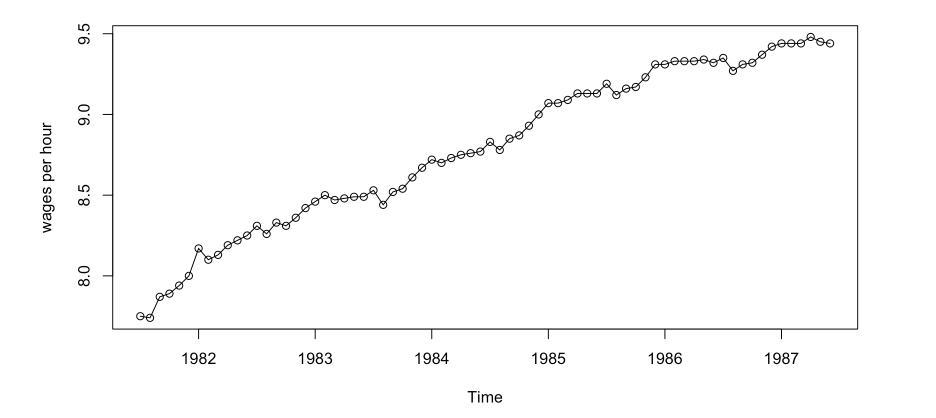
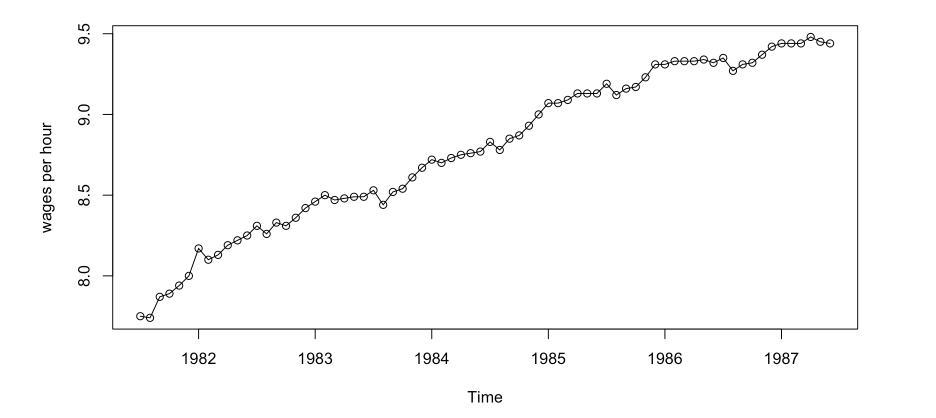
The data file wages contains monthly values of the average hourly wages (in dollars) for workers in the U.S. apparel and textile

products industry for July 1981 through June 1987.
a. Display and interpret the time series plot for these data.

b. Use least squares to fit a linear time trend to this time series. Interpret the regression output. Save the standardized residuals from the fit for further analysis.

c. Construct and interpret the time series plot of the standardized residuals from part (b).

d. Use least squares to fit a quadratic time trend to the wages time series. (i.e y(t)=βo+β1t+β2t^2+et). Interpret the regression output. Save the standardized residuals from the fit for further analysis.

e. Construct and interpret the time series plot of the standardized residuals from part (d).

Mathematics
1 answer:
Nataliya [291]2 years ago
5 0

Answer:

a. data(wages)

plot(wages, type='o', ylab='wages per hour')

Step-by-step explanation:

a.  Display and interpret the time series plot for these data.

#take data samples from wages

data(wages)

plot(wages, type='o', ylab='wages per hour')

see others below

b. Use least squares to fit a linear time trend to this time series. Interpret the regression output. Save the standardized residuals from the fit for further analysis.

#linear model

wages.lm = lm(wages~time(wages))

summary(wages.lm) #r square is correct

##  

## Call:

## lm(formula = wages ~ time(wages))

##  

## Residuals:

##      Min       1Q   Median       3Q      Max  

## -0.23828 -0.04981  0.01942  0.05845  0.13136  

##  

## Coefficients:

##               Estimate Std. Error t value Pr(>|t|)    

## (Intercept) -5.490e+02  1.115e+01  -49.24   <2e-16 ***

## time(wages)  2.811e-01  5.618e-03   50.03   <2e-16 ***

## ---

## Signif. codes:  0 '***' 0.001 '**' 0.01 '*' 0.05 '.' 0.1 ' ' 1

##  

## Residual standard error: 0.08257 on 70 degrees of freedom

## Multiple R-squared:  0.9728, Adjusted R-squared:  0.9724  

## F-statistic:  2503 on 1 and 70 DF,  p-value: < 2.2e-16

c. plot(y=rstandard(wages.lm), x=as.vector(time(wages)), type = 'o')

d. #we find Quadratic model trend

wages.qm = lm(wages ~ time(wages) + I(time(wages)^2))

summary(wages.qm)

##  

## Call:

## lm(formula = wages ~ time(wages) + I(time(wages)^2))

##  

## Residuals:

##       Min        1Q    Median        3Q       Max  

## -0.148318 -0.041440  0.001563  0.050089  0.139839  

##  

## Coefficients:

##                    Estimate Std. Error t value Pr(>|t|)    

## (Intercept)      -8.495e+04  1.019e+04  -8.336 4.87e-12 ***

## time(wages)       8.534e+01  1.027e+01   8.309 5.44e-12 ***

## I(time(wages)^2) -2.143e-02  2.588e-03  -8.282 6.10e-12 ***

## ---

## Signif. codes:  0 '***' 0.001 '**' 0.01 '*' 0.05 '.' 0.1 ' ' 1

##  

## Residual standard error: 0.05889 on 69 degrees of freedom

## Multiple R-squared:  0.9864, Adjusted R-squared:  0.986  

## F-statistic:  2494 on 2 and 69 DF,  p-value: < 2.2e-16

#time series plot of the standardized residuals

plot(y=rstandard(wages.qm), x=as.vector(time(wages)), type = 'o')
wages.qm = lm(wages ~ time(wages) + I(time(wages)^2))

summary(wages.qm)

##  

## Call:

## lm(formula = wages ~ time(wages) + I(time(wages)^2))

##  

## Residuals:

##       Min        1Q    Median        3Q       Max  

## -0.148318 -0.041440  0.001563  0.050089  0.139839  

##  

## Coefficients:

##                    Estimate Std. Error t value Pr(>|t|)    

## (Intercept)      -8.495e+04  1.019e+04  -8.336 4.87e-12 ***

## time(wages)       8.534e+01  1.027e+01   8.309 5.44e-12 ***

## I(time(wages)^2) -2.143e-02  2.588e-03  -8.282 6.10e-12 ***

## ---

## Signif. codes:  0 '***' 0.001 '**' 0.01 '*' 0.05 '.' 0.1 ' ' 1

##  

## Residual standard error: 0.05889 on 69 degrees of freedom

## Multiple R-squared:  0.9864, Adjusted R-squared:  0.986  

## F-statistic:  2494 on 2 and 69 DF,  p-value: < 2.2e-16

e. #time series plot of the standardized residuals

plot(y=rstandard(wages.qm), x=as.vector(time(wages)), type = 'o')
You might be interested in
Gabi is working on another backyard project. She is building a fence to keep deer out of her garden. One side of her garden is a
nydimaria [60]

Answer:

  • length: 14 feet , width: 43 feet, or
  • length: 86 feet, width: 7 feet

Both solutions are valid.

Explanation:

1. First assumption is that the shape of the fence is <u>rectangular</u>.

2. Second, assum the length parallel to the wall measure y feet, so the other two lengths, y, together with x will add up 100 feet

  • 2x + y = 100

3. The, the area of the fence will be:

  • length × width = xy = 600

4. Now you have two equation with two variables which you can solveL

  • Solve for y in the first equation: y = 100 - 2x
  • Substitute the value of y into the second equation: x (100 - 2x) = 600

5. Solve the last equation by completing squares:

  • Distributive property: 100x - 2x² = 600
  • Divide both sides by - 1: 2x² - 100x = - 600
  • Divide both sides by 2: x² - 50x = -300
  • Add the sequare of the half of 50 to both sides: x² - 50x + 625 = 325
  • Factor the left side: (x - 25)² = 325
  • Square root both sides: x - 25 = ± 18.028
  • Clear x: x = 25 ± 18.028
  • x = 43.028 ≈ 43 or x = 6.972 ≈ 7

Both values are valid,

If x = 43 , then y = 600/43 = 14

If x = 7, then y = 600/7 = 86

Thus, the lenght and width of the fence may be:

  • 43 feet (width) and 14 feet (length), or
  • 7  feet (width) and 86 feet (length).
3 0
2 years ago
If point C is inside AvB, then __+m CvB= m AvB
adelina 88 [10]

Answer: OPTION A

Step-by-step explanation:

It is important to remember the "Angle Addition Postulate" in order to solve this exercise.

You have this larger angle:

 \angle AVB

According to the "Angle Addition Postulate", if the point "C"  is in the interior of \angle AVB, then the measure of this angle can be obtained by adding the angle \angle AVC and the angle \angle CVB.

You can observe in the figure that:

 m\angle AVC=39\°\\\\\mangle CVB=23\°

Then you get that:

m\angle AVC+m\angle CVB=m\angle AVB\\\\39\°+23\°=62\°

Therefore, the correct answer is Option A.

3 0
2 years ago
Read 2 more answers
Allies plant has a height of 6meters. Radon’s plant grows 3/10 meters higher. How high does radon’s plant grow
kow [346]

The height of Radon plant is 6.3 meters

<em><u>Solution:</u></em>

Given that, Allies plant has a height of 6 meters

Radon’s plant grows \frac{3}{10} meters higher

To find: Height of Radon plant

From given information,

Height of Allies plant = 6 meters

Height of radon plant = \frac{3}{10} + Height of Allies plant

Substituting the known value,

\text{ Height of radon plant} = \frac{3}{10} + 6\\\\\text{ Height of radon plant} = \frac{3+60}{10}\\\\\text{ Height of radon plant} = \frac{63}{10}\\\\\text{ Height of radon plant} = 6.3

Thus Radon plant grows to height of 6.3 meters

7 0
2 years ago
The owner of a football team claims that the average attendance at games is over 74,900, and he is therefore justified in moving
Slav-nsk [51]

Answer:

Option c (Upper tailed) is the correct choice.

Step-by-step explanation:

Given that:

The average attendance is:

= 74,900

We will have to test:

⇒ H_0:\mu \leq \mu_0

or,

   H_0: \mu \leq 74,900

Verses,

⇒ H_1: \mu> \mu_0

or,

    H_1: \mu >74,900

The other given alternatives aren't connected to the given scenario. So the above is the correct one.

4 0
2 years ago
Choose the situation that represents a function. The number of raisins in an oatmeal raisin cookie is a function of the diameter
expeople1 [14]
Answer: The time is takes to cook a turkey is a function of the turkey's weight.

In a function, there is an input and there is an output. The idea of a function is that each individual input is changed into an output.

The time it takes to cook a turkey depends on the size of the turkey.
Smaller turkeys would take less time to cook and larger turkeys would take longer to cook.

So if you start with the turkeys weight, you could determine how long it would need to cook. This is an example of a function.
5 0
2 years ago
Read 2 more answers
Other questions:
  • A health club charges a $130 yearly membership fee and $3 for each day a member uses the health facilities. If the member paid $
    5·1 answer
  • Roxy has received the following quiz scores so far this year: 75, 88, 90, 96, 98, 100 Which box plot represents this data?
    12·2 answers
  • Mrs. Hernandez bought 18 pens for her class. Highlighters cost $3 each, and gel pens cost$2.50 each. She spent a total of $50. W
    12·1 answer
  • a piece of metal is 1.167 inch thick. how thick would it be if someone milled 0.012 off one side and 0.065 off the other side?
    5·1 answer
  • katelyn owns 140 shares of a stock that sells for $39 a share before a 3-for-2 split is announced. After the split, how many sha
    13·1 answer
  • Which model best fits the set of data shown on this graph?
    9·1 answer
  • Amy hikes down a slope to a lake that is 10.2 meters below the trail. Then Amy jumps into the lake, and swims 1.5 meters down. S
    5·2 answers
  • A professor has eight different tasks to assign, one to each of her eight teaching assistants. In how
    5·1 answer
  • Mrs. Thomas has $71.00 to purchase bottles of juice for her class. If the bottles of juice cost $3.55 each, how many bottles can
    5·2 answers
  • Find the height of a cylinder with a volume of 36π cm3 and a base with a radius of 3 cm.
    7·2 answers
Add answer
Login
Not registered? Fast signup
Signup
Login Signup
Ask question!
