answer.
Ask question
Login Signup
Ask question
All categories
  • English
  • Mathematics
  • Social Studies
  • Business
  • History
  • Health
  • Geography
  • Biology
  • Physics
  • Chemistry
  • Computers and Technology
  • Arts
  • World Languages
  • Spanish
  • French
  • German
  • Advanced Placement (AP)
  • SAT
  • Medicine
  • Law
  • Engineering
ddd [48]
2 years ago
3

An undeformed specimen of some alloy has an average grain diameter of 0.04 mm. You are asked to reduce its average grain diamete

r to 0.010 mm. Is it possible? If so, explain the procedure you would use to and the name the processes involved. If it is not possible then explain, why?.
Engineering
2 answers:
attashe74 [19]2 years ago
7 0

Answer:

Yes, it is possible

Explanation:

Yes, it is possible to reduce the average grain diameter of an undeformed alloy specimen from 0.040 mm to 0.010 mm.In order to do this, plastically deform the material at room temperature (i.e coldwork it), and then anneal at an elevated temperature in order to allow recrystallization and some grain growth to occur until the average grain diameter is 0.010 mm

lapo4ka [179]2 years ago
5 0

Answer:

It is possible

Explanation:

An alloy is made up by the combination/mixing of two or more metals elements for the purpose of making/producing a stronger metallic element which is often most resistant to corrosion.

An undeformed specimen of alloy can have its average grain diameter reduced from 0.04 mm to 0.01 mm through the process of annealing the Alloy. Annealing is the process of heating a metal or alloy elements at a specific temperature and then allowing it to cool off gradually.this process is used to alter the physical and sometimes the chemical properties of the metal . when the metal is annealed it makes it to become workable and once a alloy is workable its diameter can then be reduced through cold work.

cold work is the work carried out on a metal to either increase or decrease it physical properties ( in this case the diameter )when the metal is under ambient temperature

You might be interested in
three balls each have a mass m if a has a speed v just before a direct collision with B determine the speed of C after collision
ratelena [41]

Answer:

Vc2= V(l+e) ^2/4

Vg2= V(l-e^2)/4

Explanation:

Conservation momentum, when ball A strikes Ball B

Where,

M= Mass

V= Velocity

Ma(VA)1+ Mg(Vg)2= Ma(Va)2+ Ma(Vg)2

MV + 0= MVg2

Coefficient of restitution =

e= (Vg)2- (Va)2/(Va)1- (Vg)1

e= (Vg)2- (Va)2/ V-0

Solving equation 1 and 2 yield

(Va)2= V(l-e) /2

(Vg)2= V(l+e)/2

Conservative momentum when ball b strikes c

Mg(Vg)2+Mc(Vc)1 = Mg(Vg)3+Mc(Vc)2

=> M[V(l+e) /2] + 0 = M(Vg)3 + M(Vc) 2

Coefficient of Restitution,

e= (Vc)2 - (Vg)2/(Vg)2- (Vc)1

=> e= (Vc)2 - (Vg)2/V(l+e) /2

Solving equation 3 and 4,

Vc2= V(l+e) ^2/4

Vg2= V(l-e^2)/4

8 0
2 years ago
Read 2 more answers
A group of statisticians at a local college has asked you to create a set of functions that compute the median and mode of a set
iVinArrow [24]

Answer:

Functions to create a median and mode of a set of numbers

Explanation:

def median(list):

   if len(list) == 0:

       return 0

   list.sort()

   midIndex = len(list) / 2

   if len(list) % 2 == 1:

       return list[midIndex]

   else:

       return (list[midIndex] + list[midIndex - 1]) / 2

def mean(list):

   if len(list) == 0:

       return 0

   list.sort()

   total = 0

   for number in list:

       total += number

   return total / len(list)

def mode(list):

   numberDictionary = {}

   for digit in list:

       number = numberDictionary.get(digit, None)

       if number == None:

           numberDictionary[digit] = 1

       else:

           numberDictionary[digit] = number + 1

   maxValue = max(numberDictionary.values())

   modeList = []

   for key in numberDictionary:

       if numberDictionary[key] == maxValue:

           modeList.append(key)

   return modeList

def main():

   print "Mean of [1, 2, 3, 4, 5, 6, 7, 8, 9, 10]: ", mean(range(1, 11))

   print "Mode of [1, 1, 1, 1, 4, 4]:", mode([1, 1, 1, 1, 4, 4])

   print "Median of [1, 2, 3, 4]:", median([1, 2, 3, 4])

main()

3 0
2 years ago
Read 2 more answers
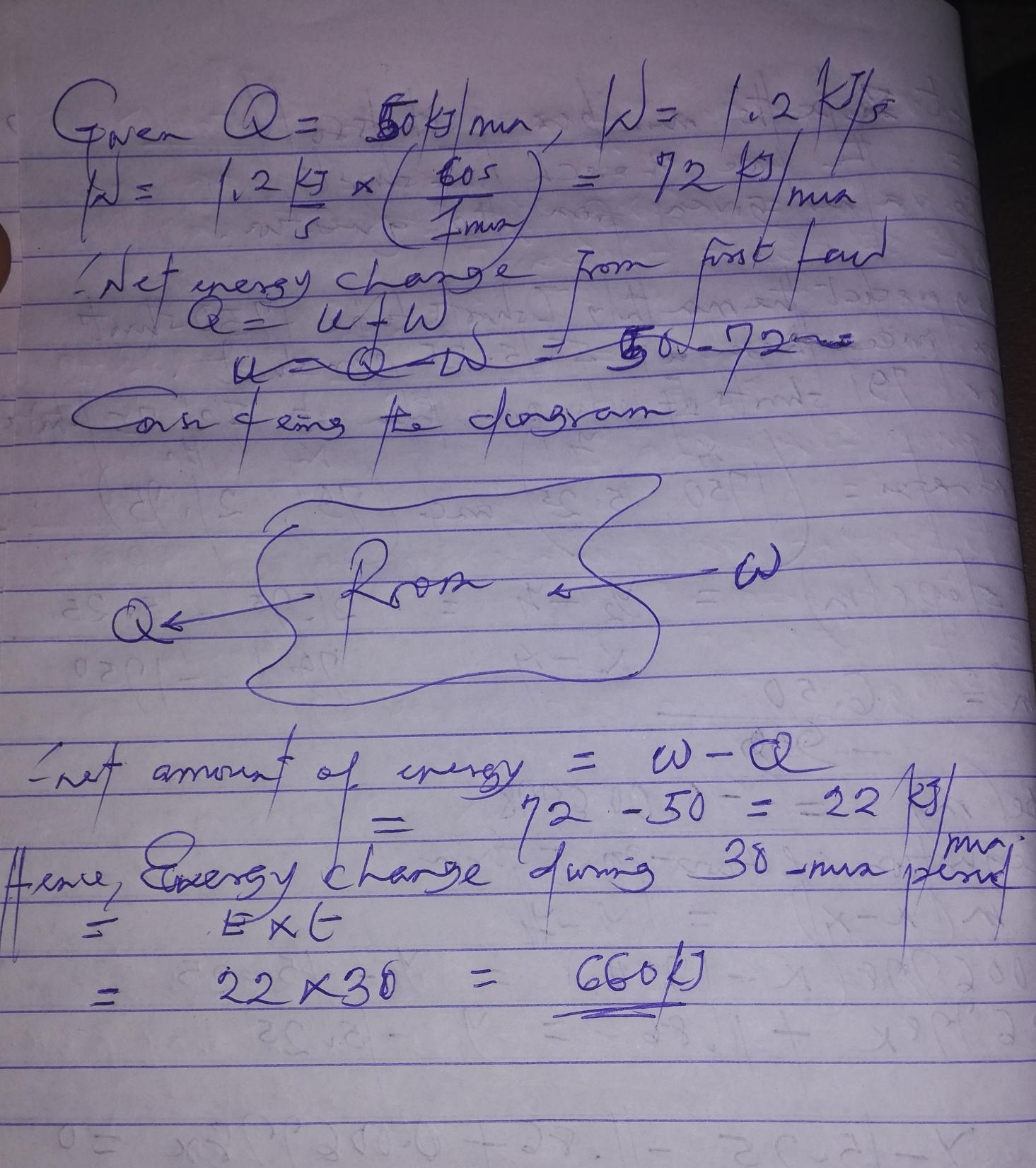
The air contained in a room loses heat to the surroundings at a rate of 50 kJ/min while work is supplied to the room by computer
Artemon [7]

Answer:

net amount of energy change of the air in the room during a 30-min period = 660KJ

Explanation:

The detailed calculation is as shown in the attached file.

4 0
2 years ago
Read 2 more answers
Laminar flow normally persists on a smooth flat plate until a critical Reynolds number value is reached. However, the flow can b
grandymaker [24]

Answer:

At L = 0.1 m

h⁻_lam = 11.004K   W/m^1.5

h⁻_turb = 7.8848K   W/m^1.8

At L = 1 m

h⁻_lam = 3.48K   W/m^1.5

h⁻_turb = 4.975K   W/m^1.8

Explanation:

Given that;

h_lam(x)= 1.74 W/m^1.5. Kx^-0.5

h_turb(x)= 3.98 W/m^1.8 Kx^-0.2

conditions for plates of length L = 0.1 m and 1 m

Now

Average heat transfer coefficient is expressed as;

h⁻ = 1/L ₀∫^L hxdx

so for Laminar flow

h_lam(x)= 1.74 . Kx^-0.5  W/m^1.5

from the expression

h⁻_lam = 1/L ₀∫^L 1.74 . Kx^-0.5   dx

= 1.74k / L { [x^(-0.5+1)] / [-0.5 + 1 ]}₀^L

= 1.74k/L = [ (x^0.5)/0.5)]⁰^L

= 1.74K × L^0.5 / L × 0.5

h⁻_lam= 3.48KL^-0.5

For turbulent flow

h_turb(x)= 3.98. Kx^-0.2 W/m^1.8

form the expression

1/L ₀∫^L 3.98 . Kx^-0.2   dx

= 3.98k / L { [x^(-0.2+1)] / [-0.2 + 1 ]}₀^L

= (3.98K/L) × (L^0.8 / 0.8)

h⁻_turb = 4.975KL^-0.2

Now at L = 0.1 m

h⁻_lam = 3.48KL^-0.5  =  3.48K(0.1)^-0.5  W/m^1.5

h⁻_lam = 11.004K   W/m^1.5

h⁻_turb = 4.975KL^-0.2 = 4.975K(0.1)^-0.2

h⁻_turb = 7.8848K   W/m^1.8

At L = 1 m

h⁻_lam = 3.48KL^-0.5  =  3.48K(1)^-0.5  W/m^1.5

h⁻_lam = 3.48K   W/m^1.5

h⁻_turb = 4.975KL^-0.2 = 4.975K(1)^-0.2

h⁻_turb = 4.975K   W/m^1.8

Therefore

At L = 0.1 m

h⁻_lam = 11.004K   W/m^1.5

h⁻_turb = 7.8848K   W/m^1.8

At L = 1 m

h⁻_lam = 3.48K   W/m^1.5

h⁻_turb = 4.975K   W/m^1.8

3 0
2 years ago
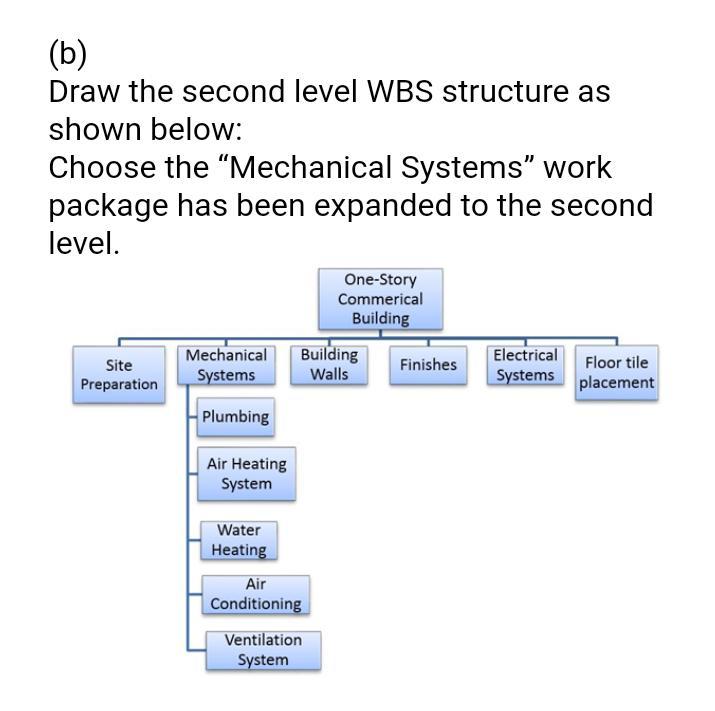
Develop a preliminary work breakdown structure (WBS) for a small one-story commercial building to be constructed on the site of
Zielflug [23.3K]

Answer:

The preliminary work breakdown structure will be divided into two steps, the first is to draw the first level and the second is to draw the second level.

Explanation:

Please look at attachment.

6 0
2 years ago
Read 2 more answers
Other questions:
  • Small droplets of carbon tetrachloride at 68 °F are formed with a spray nozzle. If the average diameter of the droplets is 200 u
    10·1 answer
  • Define a) Principal Plane b) Principal Stress c) anelasticity d) yield point e) ultimate tensile stress f) hardness g) toughness
    5·1 answer
  • A negative pressure respirator brings fresh air to you through a hose<br>A) True<br>B)False​
    15·2 answers
  • Your assignment is to write a menu driven program. The menu will be responded to using a switch statement. The menu options (cas
    6·1 answer
  • You are an electrician on the job. The electrical blueprint shows that eight 500-W lamps are to be installed on the same circuit
    11·1 answer
  • A pipe is insulated such that the outer radius of the insulation is less than the critical radius. Now the insulation is taken o
    11·1 answer
  • The following passage contains a fragment. Select the correct revision. Presley took the exuberance of gospel and added the freq
    7·1 answer
  • A commercial refrigerator with refrigerant-134a as the working fluid is used to keep the refrigerated space at -30C by rejecting
    13·1 answer
  • Q4. What happen when a steady potential is connected across the end points of the [3] conductor? Illustrate with an example.
    12·1 answer
  • 1. A _____ is applied to a wall or roof rafters to add strength and keep the building straight and plumb.
    9·1 answer
Add answer
Login
Not registered? Fast signup
Signup
Login Signup
Ask question!