answer.
Ask question
Login Signup
Ask question
All categories
  • English
  • Mathematics
  • Social Studies
  • Business
  • History
  • Health
  • Geography
  • Biology
  • Physics
  • Chemistry
  • Computers and Technology
  • Arts
  • World Languages
  • Spanish
  • French
  • German
  • Advanced Placement (AP)
  • SAT
  • Medicine
  • Law
  • Engineering
Mama L [17]
2 years ago
9

Two AISI 304 stainless steel plates 10 mm thick are subjected to a contact pressure of 1 bar under vacuum conditions for which t

here is an overall temperature drop of 100°C across the plates. What is the heat flux through the plates? What is the temperature drop across the contact plane?

Engineering
1 answer:
Travka [436]2 years ago
7 0

The heat flux through the plates is 36297.6 \mathrm{W} / \mathrm{m}^{2} and temperature drop across the contact plane is 56^{\circ} \mathrm{C}

<u>Explanation</u>:

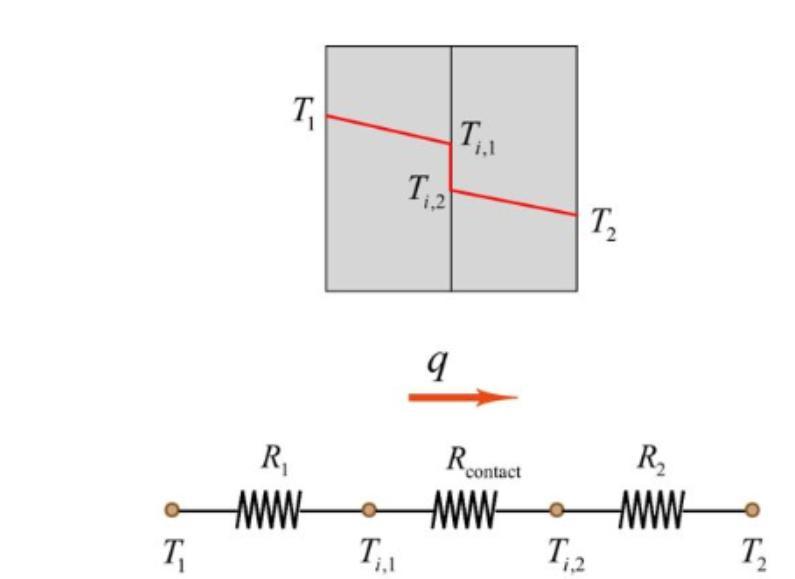
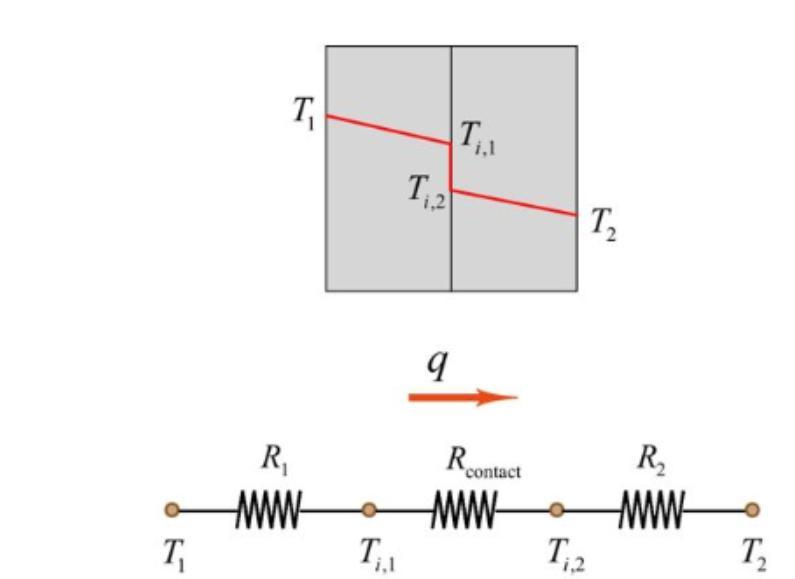
The thermal conduction resistance in stainless-steel plates,

R_{1}=R_{2}=\frac{L}{k}=\frac{10 \times 10^{-3}}{16.6 \times 1}=6.024 \times 10^{-4} \mathrm{m}^{2} \cdot \mathrm{K} / \mathrm{W}\\

From thermal contact resistance for metallic interfaces under vacuum condition table,

the average thermal contact resistance for stainless steel,

R_{\text {contact }}=15.5 \times 10^{-4} \mathrm{m}^{2} \cdot \mathrm{K} / \mathrm{W}

The total Thermal resistance,

R=R_{1}+R_{\text {conteet }}+R_{2}

=6.024 \times 10^{-4}+15.5 \times 10^{-4}+6.024 \times 10^{-4}

=27.55 \times 10^{-4} \mathrm{m}^{2} \cdot \mathrm{K} / \mathrm{W}

Heat flux through the plates,

q=\frac{T_{1}-T_{2}}{R}

=\frac{100}{27.55 \times 10^{-4}}

=36297.6 \mathrm{W} / \mathrm{m}^{2} \approx 36.3 \mathrm{kW} / \mathrm{m}^{2}

Temperature drop across the contact plates,

q=\frac{T_{i, 1}-T_{i, 2}}{R_{\text {contact }}}

T_{i, 1}-T_{i, 2} \approx 56^{\circ} \mathrm{C}

You might be interested in
(3) Calculate the heat flux through a sheet of brass 7.5 mm (0.30 in.) thick if the temperatures at the two faces are 150°Cand 5
bezimeni [28]

Answer:

a.) 1.453MW/m2,  b.)  2,477,933.33 BTU/hr  c.) 22,733.33 BTU/hr  d.) 1,238,966.67 BTU/hr

Explanation:

Heat flux is the rate at which thermal (heat) energy is transferred per unit surface area. It is measured in W/m2

Heat transfer(loss or gain) is unit of energy per unit time. It is measured in W or BTU/hr

1W = 3.41 BTU/hr

Given parameters:

thickness, t = 7.5mm = 7.5/1000 = 0.0075m

Temperatures 150 C = 150 + 273 = 423 K

                        50 C = 50 + 273 = 323 K

Temperature difference, T = 423 - 323 = 100 K

We are assuming steady heat flow;

a.) Heat flux, Q" = kT/t

K= thermal conductivity of the material

The thermal conductivity of brass, k = 109.0 W/m.K

Heat flux, Q" = \frac{109 * 100}{0.0075} = 1,453,333.33 W/m^{2} \\ Heat flux, Q" = 1.453MW/m^{2} \\

b.) Area of sheet, A = 0.5m2

Heat loss, Q = kAT/t

Heat loss, Q = \frac{109*0.5*100}{0.0075} = 726,666.667W

Heat loss, Q = 726,666.667 * 3.41 = 2,477,933.33 BTU/hr

c.) Material is now given as soda lime glass.

Thermal conductivity of soda lime glass, k is approximately 1W/m.K

Heat loss, Q=\frac{1*0.5*100}{0.0075} = 6,666.67W

Heat loss, Q = 6,666.67 * 3.41 = 22,733.33 BTU/hr

d.) Thickness, t is given as 15mm = 15/1000 = 0.015m

Heat loss, Q=\frac{109*0.5*100}{0.015} =363,333.33W

Heat loss, Q = 363,333.33 * 3.41 = 1,238,966.67 BTU/hr

5 0
2 years ago
CHALLENGE ACTIVITY 1.4.1: Basic syntax errors. Type the statements. Then, correct the one syntax error in each statement. Hints:
Lunna [17]

Answer:

Lets check each statement for the errors.

Explanation:

System.out.println("Predictions are hard.");

This statement has no syntax errors. When this statement is executed the following line will be displayed:

Predictions are hard.

System.out.print("Especially ');

This statement is missing the closing quotation mark. A single quotation mark is placed instead of double quotation mark in the statement.

The following error message will be displayed when this program statement will be compiled:

Main.java:15: error: unclosed string literal

String literals use double quotes. So to correct this syntax error, the statement should be changed as follows:

System.out.print("Especially");

The output of this corrected line is as following:

Especially

System.out.println("about the future.").

In this line a period . is placed at the end of the statement instead of a semicolon ; but according to the syntax rules statements should end in semicolons.

The error message displayed when this line is compiled is as following:

Main.java:15: error: ; expected

Main.java:15: error: not a statement

So in order to correct this syntax error the statement should be changed as following:

System.out.println("about the future.");    

The output of this corrected line is as following:

about the future

System.out.println("Num is: " - userName);

There is a syntax error in this statement because of - symbol used instead of +

+ symbol is used to join together a variable and a value a variable and another variable in a single print statement.

The error message displayed when this line is compiled is as following:

Main.java:13: error: bad operand types for binary operator '-'

So in order to correct this syntax error the statement should be changed as following:

System.out.println("Num is: " + userName);

This line will print two things one is the string Num is and the other is the value stored in userName variable.

So let userName= 5 then the output of this corrected line is as following:

Num is: 5

8 0
2 years ago
What is the physical significance of the Reynolds number?. How is defined for external flow over a plate of length L.
yanalaym [24]

Answer:

Re=\dfrac{\rho\ v\ l}{\mu }

Explanation:

Reynolds number:

  Reynolds number describe the type of flow.If Reynolds number is too high then flow is called turbulent flow and Reynolds is  low then flow is called laminar flow .

Reynolds number is a dimensionless number.Reynolds number given is the ratio of inertia force to the viscous force.

Re=\dfrac{F_i}{F_v}

For plate can be given as

Re=\dfrac{\rho\ v\ l}{\mu }

Where  ρ is the density of fluid , v is the average velocity of fluid and μ is the dynamic viscosity of fluid.

Flow on plate is a external flow .The values of Reynolds number for different flow given as

Reynolds\ number\is \ >\ 5 \times 10 ^5\ then\ flow\ will\ be\ turbulent.

Reynolds\ number\is \

7 0
2 years ago
Q3: Summation Write a recursive implementation of summation, which takes a positive integer n and a function term. It applies te
harina [27]

Answer:

Here is the recursive function summation:

def summation(n, term):      

   if n == 1:  

       return term(n)

   else:

       return term(n) + summation(n - 1, term)

Explanation:

The function summation() has two arguments where n is a positive integer and term is a function term. term has the lambda function which is a small function having an argument and an expression e.g lambda b: b+20

So the summation() function is a recursive function which returns sum of the first n terms in the sequence defined by term ( a lambda function).

If you want to check if this function works, you can call this function by passing values to it like given in the question.

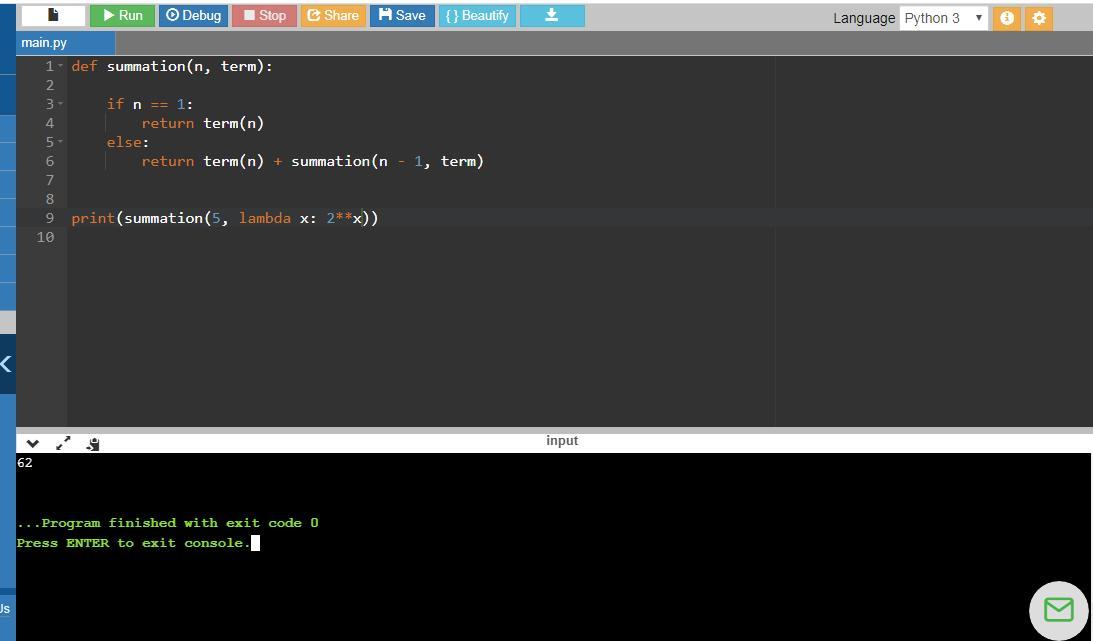
summation(5, lambda x: 2**x)

Here the value of n is 5 and the term is a lambda function x: 2**x

If you want to see the results of this function on output screen then use:

print(summation(5, lambda x: 2**x))

The print() function will print the results on screen.

This returns the sum of first 5 terms in sequence defined in the function x: 2**x

In recursive methods there are two cases: base case and recursive case. Base case is the stopping case which means that the recursion will stop when the base case/ base condition evaluates to true. The recursive case is when the function keeps calling itself so the recursive function keepsexecuting until the base case becomes true.

Here the base case is if n == 1:  So the recursive function calling itself until the value of n becomes 1.  

Recursive case is:

       return term(n) + summation(n - 1, term)

For the above example with n= 5 and term = x:2**x the recursions starts from n and adds all the terms of the series one by one and the value of n keeps decrementing by 1 at every recursive call.

When the value of n is equal to 1 the base case gets true and the recursion ends and the result of the sum is displayed in output.

This is how the summation() function works for the above function call:

2^1 + 2^2 + 2^3 + 2^4 + 2^5

n is 5 So this term function is called recursively 5 times and at every recursive call its value decreases by 1. Here the term function is used to compute 2 raise to power n. So in first recursive call the 2 raise to the power 5 is computed, then 5 is decremented and then in second recursive call to summation(), 2 raise to the power 4 is calculated, in third recursive call  to summation(), 2 raise to the power 3 is calculated, in fourth recursive call  to summation(), 2 raise to the power 2 is calculated, in fifth recursive call  to summation(), 2 raise to the power 1 is calculated, then the base condition is reached as n==1. So the recursion stops and the sum of the above computed power function results is returned which is 62.

2^1 + 2^2 + 2^3 + 2^4 + 2^5 = 62

The screen shot of recursive function along with the output of explained examples is attached.
6 0
2 years ago
Race conditions are possible in many computer systems. Consider an online auction system where the current highest bid for each
kumpel [21]

Answer:

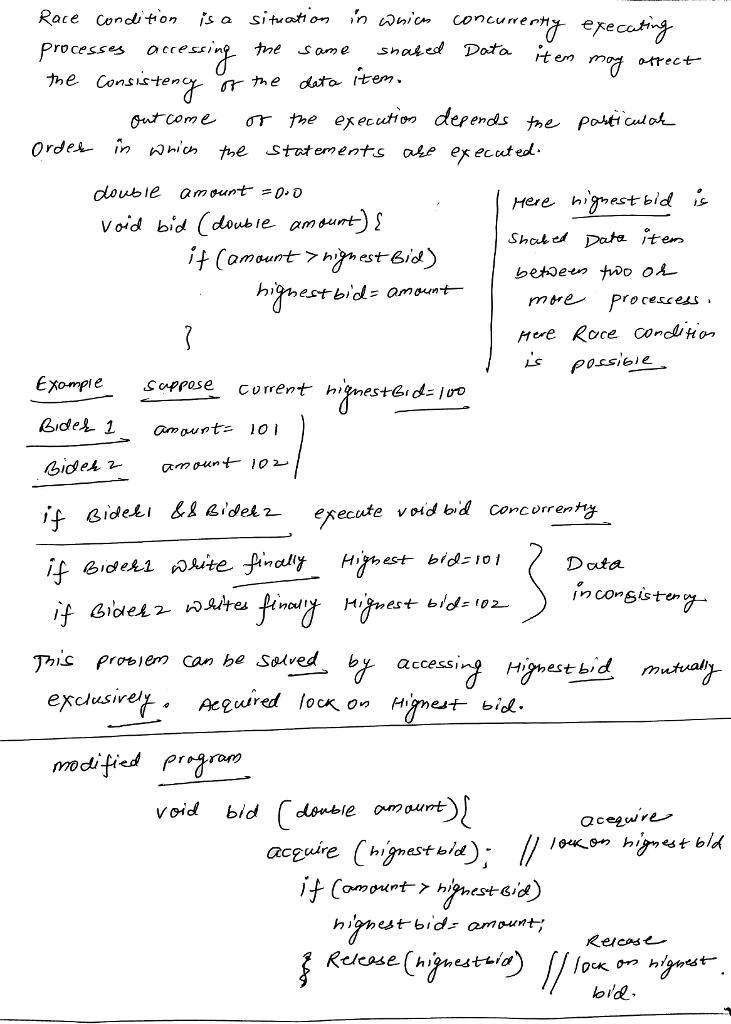
See attached picture.

Explanation:

5 0
2 years ago
Other questions:
  • Small droplets of carbon tetrachloride at 68 °F are formed with a spray nozzle. If the average diameter of the droplets is 200 u
    10·1 answer
  • Which of the following is NOT true about hydraulic valves? A. Directional control valves determine the path of a fluid in a give
    10·1 answer
  • Two metallic terminals protrude from a device. The terminal on the left is the positive reference for a voltage called vx (the o
    9·2 answers
  • At a certain college, 30% of the students major in engineering, 20% play club sports, and 10% both major in engineering and play
    14·1 answer
  • Consider a normal shock wave in air. The upstream conditions are given by M1=3, p1 = 1 atm, and r1 = 1.23 kg/m3. Calculate the d
    15·1 answer
  • The driving force for fluid flow is the pressure difference, and a pump operates by raising the pressure of a fluid (by converti
    13·1 answer
  • Can crushers help us recycle in a space efficient way which is good for saving the earth and for giving you more room in your ap
    7·1 answer
  • A thin-walled tube with a diameter of 12 mm and length of 25 m is used to carry exhaust gas from a smoke stack to the laboratory
    7·1 answer
  • a. (24 points) Describe the microstructure present in a 10110 steel after each step in each of the following heat treatments (no
    10·1 answer
  • Consider a steady developing laminar flow of water in a constant-diameter horizontal discharge pipe attached to a tank. The flui
    14·1 answer
Add answer
Login
Not registered? Fast signup
Signup
Login Signup
Ask question!