answer.
Ask question
Login Signup
Ask question
All categories
  • English
  • Mathematics
  • Social Studies
  • Business
  • History
  • Health
  • Geography
  • Biology
  • Physics
  • Chemistry
  • Computers and Technology
  • Arts
  • World Languages
  • Spanish
  • French
  • German
  • Advanced Placement (AP)
  • SAT
  • Medicine
  • Law
  • Engineering
ArbitrLikvidat [17]
2 years ago
13

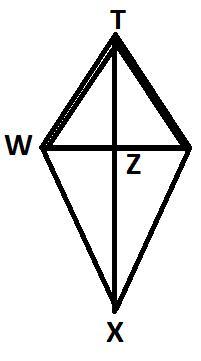
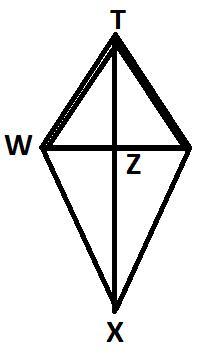
11. Given the kite shown below with TW=5 cm, TX = 12 cm and TZ = 4 cm.

Mathematics
1 answer:
aev [14]2 years ago
6 0

Answer: 39 cm

Step-by-step explanation:

Let's asume the kite is the shown in the attached figure, where TW=5 cm, TX=12 cm and TZ=4 cm.

Well, firstly we have to find the value of the unknown sides to calculate the perimeter, asuming both the top and the bottom part of the kite are isosceles triangles.

For the top part, we can use the Pithagoream Theorem for the triangle TWZ, where TZ=4 cm and TW=5 cm. Hence, we have to find WZ:

TW^{2}=TZ^{2}+WZ^{2}

Isolating WZ:

WZ=\sqrt{TW^{2}-TZ^{2}}=\sqrt{(5 cm)^{2}-(4 cm)^{2}}

WZ=3 cm

For the bottom part , we can use again the Pithagoream Theorem for the triangle WZX, where WZ=3 cm, ZX=8 cm. Hence, we have to find WX:

WX^{2}=WZ^{2}+ZX^{2}

WX=\sqrt{WZ^{2}+ZX^{2}}=\sqrt{(3 cm)^{2}+(8 cm)^{2}}

WX=8.54 cm

Now that we have all the sides, we can calculate the perimeter:

5cm + 5cm +8.54 cm + 8.54 cm=27.08 cm

And the option that is near this value is 39 cm.

You might be interested in
Convert to vertex form:<br><br> y=2x^2-8x+1
Bad White [126]
I’ll try and help u in 6 years
3 0
2 years ago
Solve the system using elimination. x + 2y = –6 3x + 8y = –20 (–4, –1) (–4, 4) (–1, –4) (3, 1)
Orlov [11]

x + 2y =  - 6 >  >  > 3x =  - 18 - 6y
- 18 - 6y + 8y =  - 20 >  >  > 2y =  - 2 >  > y =  - 1
so x=4
6 0
2 years ago
Read 2 more answers
Marissa wants to write an abbreviated set of directions for finding coordinates of a figure reflected across the y-axis. Which m
Sedaia [141]
The answer is the very first one! 
(x,y) --> (-x,y) 

It demonstrates a perfect reflection across the y-axis. 

Good Luck! 
7 0
2 years ago
Read 2 more answers
A sequence has a common ratio of Three-halves and f(5) = 81. Which explicit formula represents the sequence? f(x) = 24(Three-hal
Ede4ka [16]

Answer:

f(x)=16\, (\frac{3}{2} )^{x-1}

Step-by-step explanation:

Since we are given the common ratio (3/2), all we need to find to define the geometric sequence, is its multiplicative factor (a) that corresponds to the first term of the sequence - remember that all consecutive terms will be generated by multiplying this first value repeatedly by the common ratio (3/2) as shown below:  

f(1)=a\\f(2)=a\,*\,(\frac{3}{2} )\\f(3)=a\,*\,(\frac{3}{2} )^2\\f(4)=a\,*\,(\frac{3}{2} )^3\\f(5)=a\,*\,(\frac{3}{2} )^4

Since we are given the information that f(5)=81 we can use this to find the value of the first term:

f(5)=\,a\,*\,(\frac{3}{2} )^4\\81=\,a\,*(\frac{81}{16} )\\a\,*\,81=\,81\.*\,16\\a\,=\,16

Notice as well that the first term doesn't contain the common ratio, the second term contains the common ration (3/2) to the power one, the third one contains the common ratio to the power two, the fourth one contains it to the power three, and so forth. So the exponent at which the common ratio appears is always one unit less than the order (x) of the term in question. This concept helps us finalize the expression for the sequence's formula:

f(x)=16\,*\,(\frac{3}{2} )^{x-1}

6 0
2 years ago
Read 2 more answers
Which expression is equivalent to 144 Superscript three-halves? 216 1,728 RootIndex 3 StartRoot 12 EndRoot RootIndex 3 StartRoot
Afina-wow [57]

Question:

Which expression is equivalent to 144^(3/2)

Answer:

1728

Step-by-step explanation:

The options are not well presented. However, this is the solution to the question.

Given:

144^(3/2)

Required:

Find Equivalent.

We start my making use of the following law of logarithm.

A^(m/n) = (A^m)^1/n

So,

144^(3/2) = (144³)^½

Another law of indices is that

A^½ = √A

So,

144^(3/2) = (144³)^½ = √(144³)

144³ can be expanded as 144 * 144 * 144.

This gives

144^(3/2) = √(144 * 144 * 144)

The square root can then be splitted to

144^(3/2) = √144 * √144 * √144

144^(3/2) = 12 * 12 * 12

144^(3/2) = 1728.

Hence, the equivalent of 144^(3/2) is 1728

8 0
2 years ago
Read 2 more answers
Other questions:
  • One square has an area that is 10 cm2 larger than another. What is a reasonable domain for the area of the larger square?
    9·2 answers
  • Seth has a bank account which pays 1.01% interest, compounded quarterly. Seth withdraws $4,567 from the account every quarter fo
    13·2 answers
  • Identify whether the series summation of 12 open parentheses 3 over 5 close parentheses to the I minus 1 power from 1 to infinit
    15·1 answer
  • at a restaurant, Trevor decides to tip the server 16% of the bill. If he leaves $4.00 tip, which proportion could be used to fin
    14·2 answers
  • Which order pair is a solution to the system of linear equations -4+y=8 and x-5y=17?
    14·2 answers
  • The sum of three consecutive integers is -369
    9·2 answers
  • A zookeeper predicted that the weight of a newborn lion would be 2.8 pounds. when the zoo's lion gave birth, the newborn weighed
    14·2 answers
  • Based on a random sample of 25 units of product X, the average weight is 104 lbs. and the sample standard deviation is 10 lbs. W
    11·1 answer
  • On Monday, the ABC Company stock was at $12.80 per share. On Tuesday it gained $3.42, and then lost $9.70 on Wednesday. What is
    9·1 answer
  • Which expression is equivalent to the equation?
    5·1 answer
Add answer
Login
Not registered? Fast signup
Signup
Login Signup
Ask question!