answer.
Ask question
Login Signup
Ask question
All categories
  • English
  • Mathematics
  • Social Studies
  • Business
  • History
  • Health
  • Geography
  • Biology
  • Physics
  • Chemistry
  • Computers and Technology
  • Arts
  • World Languages
  • Spanish
  • French
  • German
  • Advanced Placement (AP)
  • SAT
  • Medicine
  • Law
  • Engineering
never [62]
2 years ago
11

Thirty-six grams of air in a piston–cylinder assembly undergo a Stirling cycle with a compression ratio of 7.5. At the beginning

of the isothermal compression, the pressure and volume are 1 bar and 0.03 m3, respectively. The temperature during the isothermal expansion is 1200 K. Assuming the ideal gas model and ignoring kinetic and potential energy effects, determine the net work, in kJ.
Engineering
1 answer:
MatroZZZ [7]2 years ago
8 0

Answer:

W = 6044.709 J

Explanation:

Given

Mass of air: m = 36.00 g

P₁/P₂ = 7.5

P₁ = 1 bar = 1 bar = 10⁵ Pa

V₁ = 0.03 m³

T = 1200 K

R = 8.314472 J/(mol*K)

W = ?

We have the get n (number of moles) as follows:

P*V = n*R*T  ⇒   n = P₁*V₁ / (R*T₁)

⇒   n = (10⁵ Pa)*(0.03 m³) / (8.314472 J/(mol*K)*1200 K)

⇒   n = 0.3 mol

Then, we apply the equation

W = n*R*T₁*Ln (P₁/P₂)

⇒   W = (0.3 mol)*(8.314472 J/(mol*K))*(1200 K)*Ln (7.5)

⇒   W = 6044.709 J

You might be interested in
Laminar flow normally persists on a smooth flat plate until a critical Reynolds number value is reached. However, the flow can b
grandymaker [24]

Answer:

At L = 0.1 m

h⁻_lam = 11.004K   W/m^1.5

h⁻_turb = 7.8848K   W/m^1.8

At L = 1 m

h⁻_lam = 3.48K   W/m^1.5

h⁻_turb = 4.975K   W/m^1.8

Explanation:

Given that;

h_lam(x)= 1.74 W/m^1.5. Kx^-0.5

h_turb(x)= 3.98 W/m^1.8 Kx^-0.2

conditions for plates of length L = 0.1 m and 1 m

Now

Average heat transfer coefficient is expressed as;

h⁻ = 1/L ₀∫^L hxdx

so for Laminar flow

h_lam(x)= 1.74 . Kx^-0.5  W/m^1.5

from the expression

h⁻_lam = 1/L ₀∫^L 1.74 . Kx^-0.5   dx

= 1.74k / L { [x^(-0.5+1)] / [-0.5 + 1 ]}₀^L

= 1.74k/L = [ (x^0.5)/0.5)]⁰^L

= 1.74K × L^0.5 / L × 0.5

h⁻_lam= 3.48KL^-0.5

For turbulent flow

h_turb(x)= 3.98. Kx^-0.2 W/m^1.8

form the expression

1/L ₀∫^L 3.98 . Kx^-0.2   dx

= 3.98k / L { [x^(-0.2+1)] / [-0.2 + 1 ]}₀^L

= (3.98K/L) × (L^0.8 / 0.8)

h⁻_turb = 4.975KL^-0.2

Now at L = 0.1 m

h⁻_lam = 3.48KL^-0.5  =  3.48K(0.1)^-0.5  W/m^1.5

h⁻_lam = 11.004K   W/m^1.5

h⁻_turb = 4.975KL^-0.2 = 4.975K(0.1)^-0.2

h⁻_turb = 7.8848K   W/m^1.8

At L = 1 m

h⁻_lam = 3.48KL^-0.5  =  3.48K(1)^-0.5  W/m^1.5

h⁻_lam = 3.48K   W/m^1.5

h⁻_turb = 4.975KL^-0.2 = 4.975K(1)^-0.2

h⁻_turb = 4.975K   W/m^1.8

Therefore

At L = 0.1 m

h⁻_lam = 11.004K   W/m^1.5

h⁻_turb = 7.8848K   W/m^1.8

At L = 1 m

h⁻_lam = 3.48K   W/m^1.5

h⁻_turb = 4.975K   W/m^1.8

3 0
2 years ago
The 30-kg gear is subjected to a force of P=(20t)N where t is in seconds. Determine the angular velocity of the gear at t=4s sta
tatyana61 [14]

Answer:

\omega =\frac{24}{1.14375}=20.983\frac{rad}{s}

Explanation:

Previous concepts

Angular momentum. If we consider a particle of mass m, with velocity v, moving under the influence of a force F. The angular  momentum about point O is defined as the “moment” of the particle’s linear momentum, L, about O. And the correct formula is:

H_o =r x mv=rxL

Applying Newton’s second law to the right hand side of the above equation, we have that r ×ma = r ×F =

MO, where MO is the moment of the force F about point O. The equation expressing the rate of change  of angular momentum is this one:

MO = H˙ O

Principle of Angular Impulse and Momentum

The equation MO = H˙ O gives us the instantaneous relation between the moment and the time rate of change of angular  momentum. Imagine now that the force considered acts on a particle between time t1 and time t2. The equation MO = H˙ O can then be integrated in time to obtain this:

\int_{t_1}^{t_2}M_O dt = \int_{t_1}^{t_2}H_O dt=H_0t2 -H_0t1

Solution to the problem

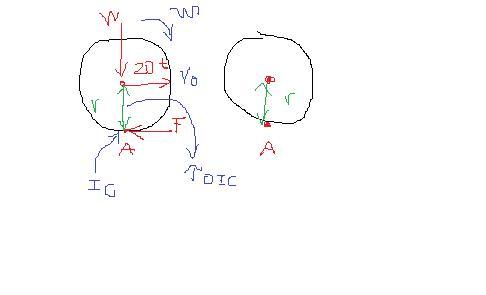
For this case we can use the principle of angular impulse and momentum that states "The mass moment of inertia of a gear about its mass center is I_o =mK^2_o =30kg(0.125m)^2 =0.46875 kgm^2".

If we analyze the staritning point we see that the initial velocity can be founded like this:

v_o =\omega r_{OIC}=\omega (0.15m)

And if we look the figure attached we can use the point A as a reference to calculate the angular impulse and momentum equation, like this:

H_Ai +\sum \int_{t_i}^{t_f} M_A dt =H_Af

0+\sum \int_{0}^{4} 20t (0.15m) dt =0.46875 \omega + 30kg[\omega(0.15m)](0.15m)

And if we integrate the left part and we simplify the right part we have

1.5(4^2)-1.5(0^2) = 0.46875\omega +0.675\omega=1.14375\omega

And if we solve for \omega we got:

\omega =\frac{24}{1.14375}=20.983\frac{rad}{s}

8 0
2 years ago
You should be extra careful during the hours of sunrise, sunset, and nighttime because _____. A. of increased law enforcement ac
torisob [31]

Answer:

B, its the only valid answer

5 0
2 years ago
A 20 dBm power source is connected to the input of a directional coupler having a coupling factor of 20 dB, a directivity of 35
lukranit [14]

Answer:

P_O = 0.989 watt = 19.9 dBm

Explanation:

Given data:

P_1 power = 20 dBm  = 0.1 watt

coupling factor is 20dB

Directivity = 35 dB

We know that

coupling factor = 10 log \frac{P_1}{P_f}

solving for  final power

20 = 10 log\frac{P_1}{P_f}

2 = log \frac{P_1}{P_f}

100 = \frac{0.1}{P_f}

P_f = 0.001 watt = 0 dBm

Directivity D =  10 \frac{P_f}{P_b}

35 = 10 \frac{0.001}{P_b}

P_b = 3.162 \times 10^{-7} wattt

output Power  = P_1 -P_f - P_b

                       = 0.1 - 0.001 - 3.162 \times 10^{-7}

P_O = 0.989 watt = 19.9 dBm

6 0
2 years ago
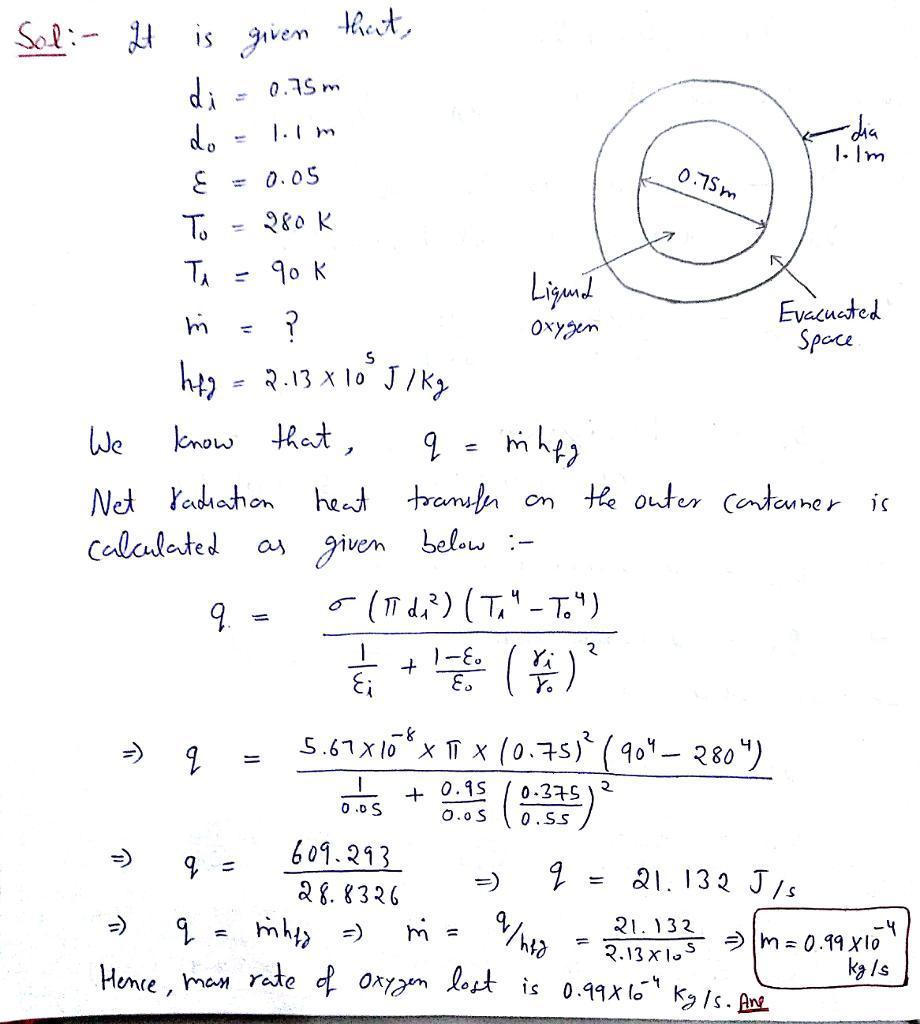
Liquid oxygen is stored in a thin-walled, spherical container 0.75 m in diameter, which is enclosed within a second thin-walled,
nadezda [96]

Answer:

Explanation:

the solution is well stated

3 0
2 years ago
Other questions:
  • An electrical utility delivers 6.25E10 kWh of power to its customers in a year. What is the average power required during the ye
    15·1 answer
  • At an impaired driver checkpoint, the time required to conduct the impairment test varies (according to an exponential distribut
    6·1 answer
  • Air at 40°C flows over a long, 25-mm-diameter cylinder with an embedded electrical heater. In a series of tests, measurements we
    11·1 answer
  • What properties should the head of a carpenter’s hammer possess? How would you manufacture a hammer head?
    6·1 answer
  • Refrigerant-134a at 400 psia has a specific volume of 0.1384 ft3/lbm. Determine the temperature of the refrigerant based on (a)
    6·1 answer
  • Steam at 40 bar and 500o C enters the first-stage turbine with a volumetric flow rate of 90 m3 /min. Steam exits the turbine at
    9·1 answer
  • "From the earth to the moon". In Jules Verne’s 1865 story with this title, three men went to the moon in a shell fired from a gi
    5·1 answer
  • Which requirement is an appropriate reason for a business to use information technology (IT) tools
    9·1 answer
  • While at a concert you notice five people in the crowd headed in the same direction. Your tendency to group them is due to? *
    10·1 answer
  • Tech A says that proper footwear may include both leather and steel-toed shoes. Tech B says that when working in the shop, you o
    15·1 answer
Add answer
Login
Not registered? Fast signup
Signup
Login Signup
Ask question!