answer.
Ask question
Login Signup
Ask question
All categories
  • English
  • Mathematics
  • Social Studies
  • Business
  • History
  • Health
  • Geography
  • Biology
  • Physics
  • Chemistry
  • Computers and Technology
  • Arts
  • World Languages
  • Spanish
  • French
  • German
  • Advanced Placement (AP)
  • SAT
  • Medicine
  • Law
  • Engineering
pshichka [43]
2 years ago
9

This is the chemical formula for methyl acetate: CH32CO2. Calculate the mass percent of hydrogen in methyl acetate. Round your a

nswer to the nearest percentage. %
Chemistry
1 answer:
WITCHER [35]2 years ago
8 0

<u>Answer:</u> The mass percent of hydrogen in methyl acetate is 8 %

<u>Explanation:</u>

The given chemical formula of methyl acetate is CH_3COOCH_3

To calculate the mass percentage of hydrogen in methyl acetate, we use the equation:

\text{Mass percent of hydrogen}=\frac{\text{Mass of hydrogen}}{\text{Mass of methyl acetate}}\times 100

Mass of hydrogen = (6 × 1) = 6 g

Mass of methyl acetate = [(3 × 12) + (6 × 1) + (2 × 16)] = 74 g

Putting values in above equation, we get:

\text{Mass percent of hydrogen}=\frac{6g}{74g}\times 100=8.10\%=8\%

Hence, the mass percent of hydrogen in methyl acetate is 8 %

You might be interested in
A sample of oxygen gas was found to effuse at a rate equal to two times that of an unknown gas. what is the molar mass (in g/mol
inn [45]
<span>128 g/mol Using Graham's law of effusion we have the formula: r1/r2 = sqrt(m2/m1) where r1 = rate of effusion for gas 1 r2 = rate of effusion for gas 2 m1 = molar mass of gas 1 m2 = molar mass of gas 2 Since the atomic weight of oxygen is 15.999, the molar mass for O2 = 2 * 15.999 = 31.998 Now let's subsitute the known values into Graham's equation and solve for m2. r1/r2 = sqrt(m2/m1) 2/1 = sqrt(m2/31.998) 4/1 = m2/31.998 127.992 = m2 So the molar mass of the unknown gas is 127.992 g/mol. Rounding to 3 significant figures gives 128 g/mol</span>
4 0
2 years ago
How much heat is absorbed/released when 25.00 g of NH3(g) reacts in the presence of excess O2(g) to produce NO(g) and H2O(l) acc
Novay_Z [31]

Answer:

429.4 kJ are absorbed in the endothermic reaction.

Explanation:

The balanced chemical equation tells us that 1168 kJ of heat are absorbed in the reaction when 4 mol of NH₃ (g) react with 5 mol O₂ (g).

So what we need is to calculates how many moles represent 25 g NH₃(g) and calculate the heat absorbed. (NH₃ is the limiting reagent)

Molar Mass NH₃  = 17.03 g/mol

mol NH₃ = 25.00 g/ 17.03 g/mol = 1.47 mol

1168 kJ /4 mol NH₃  x 1.47 mol  NH₃ =  429.4 kJ

6 0
2 years ago
How many grams of Cr can be produced by the reaction of 44.1 g of Cr2O3 with 35.0 g of Al according to the following chemical eq
allsm [11]

Answer:

30.17 grams of Cr can be produced by the reaction of 44.1 g of Cr₂O₃ with 35.0 g of Al.

19.33 grams of the excess react will remain once the reaction goes to completion.

Explanation:

You know:

2 Al + Cr₂O₃ → Al₂O₃ + 2 Cr

By stoichiometry of the reaction (that is, the relationship between the amount of reagents and products in a chemical reaction), the following amounts of the compounds participating in the reaction react and are produced:

  • Al: 2 moles
  • Cr₂O₃: 1 mole
  • Al₂O₃: 1 mole
  • Cr: 2 moles

Being:

  • Al: 27 g/mole
  • Cr: 52 g/mole
  • O: 16 g/mole

the molar mass of the compounds participating in the reaction is:

  • Al: 27 g/mole
  • Cr₂O₃: 2*52 g/mole + 3 *16 g/mole= 152 g/mole
  • Al₂O₃: 2*27 g/mole + 3 *16 g/mole= 102 g/mole
  • Cr: 52 g/mole

Then, by stoichiometry of the reaction, the amounts of reagents and products that participate in the reaction are:

  • Al: 2 moles* 27 g/mole= 54 g
  • Cr₂O₃: 1 mole* 152 g/mole= 152 g
  • Al₂O₃: 1 mole* 102 g/mole= 102 g
  • Cr: 2moles*52 g/mole= 104 g

First, you must determine the limiting reagent. The limiting reagent is one that is consumed first in its entirety, determining the amount of product in the reaction. When the limiting reagent is finished, the chemical reaction will stop.

Then, for this you must apply the following rule of three: if 54 grams of Al react with 152 grams of Cr₂O₃ by stoichiometry of the reaction, 35 grams of Al with how much mass of Cr₂O₃ will react?

mass of Cr_{2} O_{3} =\frac{35 grams of Al*152 gramsof Cr_{2} O_{3}}{54 grams of Al}

mass of Cr₂O₃= 98.52 grams

But 98.52 grams of Cr₂O₃ are not available, 44.1 grams are available. Since you have less moles than you need to react with 35 grams of Al, the compound Cr₂O₃ will be the limiting reagent.

To determine the amount of Cr that can be produced, you use the amount of limiting reagent available and apply the following rule of three: if by stoichiometry 152 grams of Cr₂O₃ produce 104 grams of Cr, 44.1 grams of Cr₂O₃ how much mass of Cr does it produce?

mass of Cr =\frac{104 grams of Cr*44.1 grams of Cr_{2} O_{3}}{152 grams of Cr_{2} O_{3}}

mass of Cr= 30.17 grams

<u><em>30.17 grams of Cr can be produced by the reaction of 44.1 g of Cr₂O₃ with 35.0 g of Al.</em></u>

As Al is the excess reagent, you must first calculate the amount of mass that reacts with 44.1 grams of Cr₂O₃ using the following rule of three: if 152 grams of Cr₂O₃ react with 54 grams of Al, 44.1 grams of Cr₂O₃ with how much mass of Al reaction to?

mass of Al =\frac{54 grams of Al*44.1 gramsnof Cr_{2} O_{3}}{152 gramsnof Cr_{2} O_{3}l}

mass of Al=15.67 grams

With 35 grams being the amount of Al available, the amount of Al that will remain in the reaction after all the limiting reagent reacts and the reaction is complete is calculated by:

mass of excess= 35 grams - 15.67 grams= 19.33 grams

<em><u>19.33 grams of the excess react will remain once the reaction goes to completion.</u></em>


6 0
2 years ago
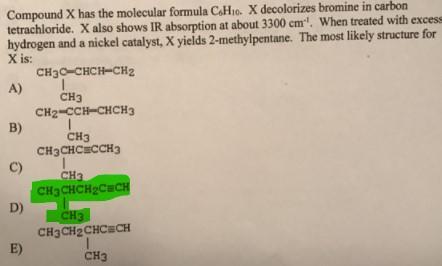
Compound X has the molecular formula C6H10. X decolorizes bromine in carbon tetrachloride. X also shows IR absorption at about 3
pychu [463]

Answer:

The correct answer is - option D. (check image)

Explanation:

Alkynes and alkenes both decolorized bromine in carbon tetrachloride. The absorption of the IR at about 3300 cm-1 for the X here that are found in the terminal alkynes absorption range only. In presence of excess hydrogen and a nickel catalyst, x gives the  2-methyl pentane.

The most likely structure for X is: CH3-CH3-ch-CH2-C≡CH

3 0
1 year ago
A piper delivers 9.98 g of water at 19 degrees Celsius. What does the pipet deliver
leva [86]

Answer:

the volume = 9.99 ml

Explanation:

in your Q we need to calculate the volume does the pipet deliver so , we are going to use this formula:

the volume = mass / density

here we need to know the density of water at a certain temperature 19 degrees Celsius ,so I used an external source   to get the density of water at 19 degrees Celsius because it is changing with different temperatures

where mass here = 9.98 g

and  the density of water at  temperature 19 degrees Celsius=  0.998405mL

-1

by substitution :

the volume = 9.98 g / 0.998405mL

-1

                   ≅ 9.996 ml = 10 ml

5 0
2 years ago
Read 2 more answers
Other questions:
  • The combustion of propane (c3h8) produces co2 and h2o: c3h8 (g) + 5o2 (g) → 3co2 (g) + 4h2o (g) the reaction of 2.5 mol of o2 wi
    13·1 answer
  • In a sample consisting of 1.00 mol nabr and 0.300 mol ki, what is the mass percent of iodine? (a) 24.9% (b) 32.6% (c) 47.2% (d)
    10·1 answer
  • Six moles of an ideal gas are in a cylinder fitted at one end with a movable piston. the initial temperature of the gas is 27.0c
    7·1 answer
  • You are riding a bicycle home from school. You average 5 meters per second and you are headed south. What motion can you determi
    15·1 answer
  • Soda drinks bubble when the bottle is opened because:
    11·1 answer
  • Consider the following reaction: A2 + B2 → 2AB ΔH = –321 kJ Bond energy (A2) = 1/2AB Bond energy (B2) =393 kJ/mol. What is the n
    7·1 answer
  • Which of the following species is not formed through a termination reaction in the chlorination of methane? Which of the followi
    10·1 answer
  • Olive oil has a density of 0.92g/ml. How much would 1.0 Liter of olive oil weigh in grams?
    10·1 answer
  • Can you reverse grey hair?​
    10·1 answer
  • Q1) A vapor-compression refrigeration system operates on the cycle of Fig. 9.1. The refrigerant is 1,1,1,2-Tetrafluoroethane. Gi
    12·1 answer
Add answer
Login
Not registered? Fast signup
Signup
Login Signup
Ask question!