answer.
Ask question
Login Signup
Ask question
All categories
  • English
  • Mathematics
  • Social Studies
  • Business
  • History
  • Health
  • Geography
  • Biology
  • Physics
  • Chemistry
  • Computers and Technology
  • Arts
  • World Languages
  • Spanish
  • French
  • German
  • Advanced Placement (AP)
  • SAT
  • Medicine
  • Law
  • Engineering
White raven [17]
2 years ago
10

An Arnold cell is to be operated as a pseudo-steady-state cell to determine the gas diffusivity of benzene in air at 308 K and 1

.0 atm. The 20-cm-long tube, with an inner diameter of 1.0 cm, is initially loaded with liquid benzene to a depth of 1.0 cm from the bottom of the tube. The tube and the liquid are maintained at a constant temperature of 308 K. At this temperature, benzene exerts a vapor pressure of 0.195 atm. Air is continually blown over the top of the tube, removing any of the vaporized benzene vapor; the gas space within the tube is essentially stagnant. At 308 K, liquid benzene’s density is 0:85 g/cm3.
a. It was determined that 72.0 h were required to completely evaporate the benzene initially loaded into the tube. Estimate the binary gas-phase diffusion coefficient for benzene in air using these data.
Engineering
1 answer:
GarryVolchara [31]2 years ago
6 0

Answer:

D=1.0x10^-5 m^2/s

Explanation:

the data given by the exercise are as follows:

T=308 K

d=1 cm

PA=0.195 atm

pL=0.85 g/cm^3

The expression for binary gas-phase diffusion coefficient is equal to:

D=\frac{\frac{pL*yB}{MA(\frac{t1^{2}-t2^{2}  }{2} } }{c(yA1-yA2}

yB=\frac{1-0.805}{ln(\frac{1}{0.805}) }=0.89

C=\frac{P}{RT}=\frac{1}{82.06*308}=3.95x10^{-5} mol/cm^{2}

substituting the values ​​in the diffusion equation:

D=9.6x10^{-6} m^{2}/s

from Appendix J-1 from Welty:

298 K, D=9.62x10^-5 m^2/s

At 308 K, we have the following:

D=9.62x10^{-5}(\frac{308}{298})^{3/2}=1.0x10^{-5}m^{2}/s

You might be interested in
air at 600 kPa, 330 K enters a well-insulated, horizontal pipe having a diameter of 1.2 cm and exits at 120 kPa, 300 K. Applying
notsponge [240]

Answer:

a) 251.31 m/s and 55.29 m/s

b) The mass flow rate is 0.0396 kg/s

c) The rate of entropy production is 0.0144 kW/K

Explanation:

a) The steady state is:

mi = mo

\frac{A_{i}V_{i}  }{v_{i} } =\frac{A_{o}V_{o}  }{v_{o} } \\V_{i} =V_{o}(\frac{v_{i}}{v_{o}} )=V_{o}(\frac{T_{i}P_{o} }{T_{o}P_{i} } )=V_{o}(\frac{330*120}{300*600}) =0.22V_{o}

The energy balance is:

h_{i}+\frac{V_{i}^{2} }{2} =h_{2}+\frac{V_{o}^{2} }{2} \\h_{i}-h_{o}+(\frac{V_{i}^{2}-V_{o}^{2}  }{2} )=0\\V_{o}=\sqrt{\frac{2(h_{i}-h_{o})}{0.9516} } =\sqrt{\frac{2*(330.24-300.19)x10^{3} }{0.9516} } =251.31m/s

Vi = 0.22 * 251.31 = 55.29 m/s

b) The mass flow rate is:

m=\frac{A_{o}V_{o}}{v_{o}} =\frac{\pi d^{2}V_{o}P_{o} }{4RT_{o}} =\frac{\pi *(0.012^{2})*251.31*120x10^{3}  }{4*287*300} =0.0396kg/s

c) The entropy produced is equal to:

\frac{Q}{T} +S_{gen} =m(s_{2} -s_{1} )\\0+S_{gen} =m(s_{2} -s_{1} )\\S_{gen} =m(s_{2} -s_{1} )\\S_{gen}=0.0396*(c_{p} ln\frac{T_{o}}{T_{i}} -Rln\frac{P_{o}}{P_{i}} )=0.0396*(1.004ln\frac{300}{330} -0.287ln\frac{120}{600} )=0.0144kW/K

3 0
2 years ago
Water at 200C flows through a pipe of 10 mm diameter pipe at 1 m/s. Is the flow Turbulent ? a. Yes b. No
Degger [83]

Answer:

Yes, the flow is turbulent.

Explanation:

Reynolds number gives the nature of flow. If he Reynolds number is less than 2000 then the flow is laminar else turbulent.

Given:

Diameter of pipe is 10mm.

Velocity of the pipe is 1m/s.

Temperature of water is 200°C.

The kinematic viscosity at temperature 200°C is 1.557\times10^{-7}m2/s.

Calculation:

Step1

Expression for Reynolds number is given as follows:

Re=\frac{vd}{\nu}

Here, v is velocity, \nu is kinematic viscosity, d is diameter and Re is Reynolds number.

Substitute the values in the above equation as follows:

Re=\frac{vd}{\nu}

Re=\frac{1\times(10mm)(\frac{1m}{1000mm})}{1.557\times10^{-7}}

Re=64226.07579

Thus, the Reynolds number is 64226.07579. This is greater than 2000.

Hence, the given flow is turbulent flow.

5 0
2 years ago
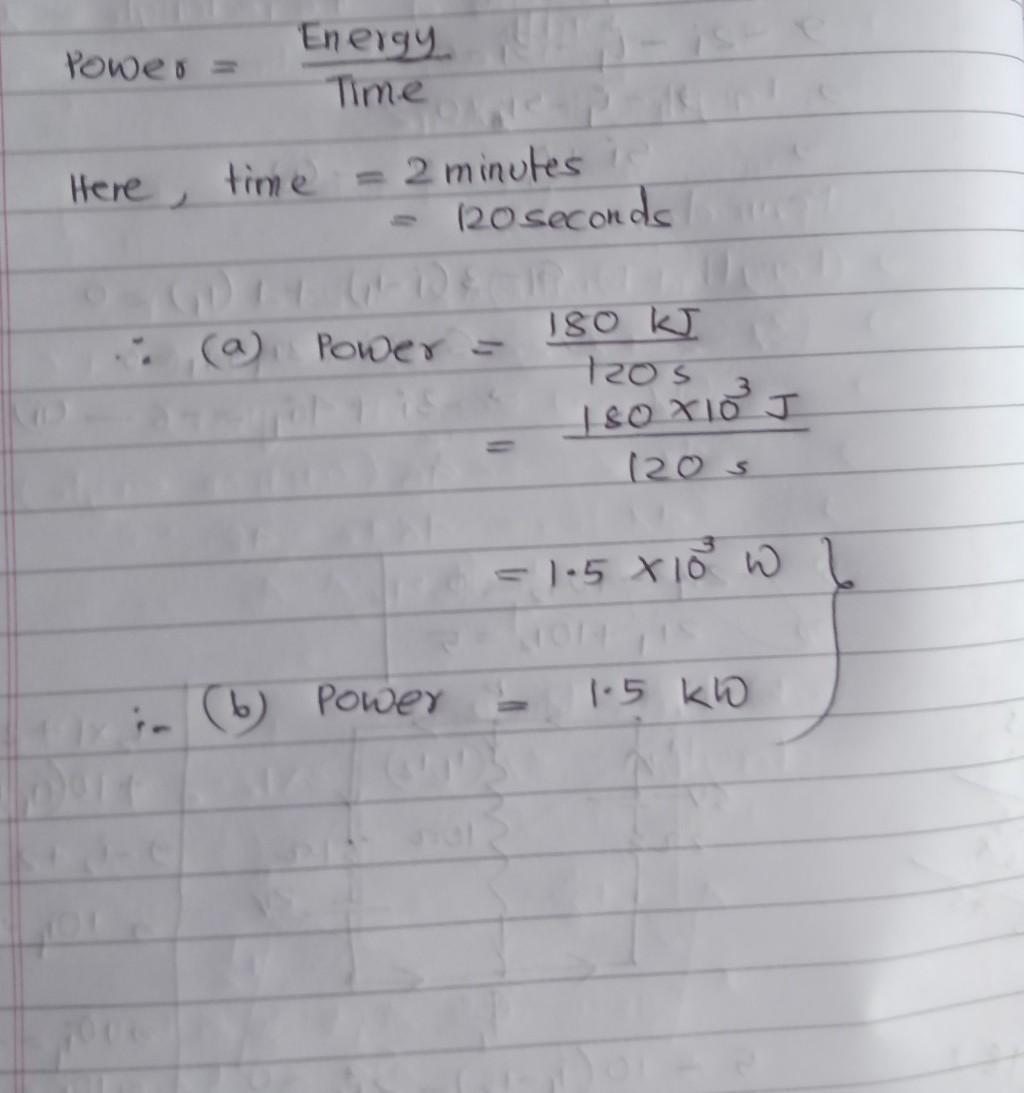
The electrical energy used by an air conditioner for 2 minutes is 180 kJ. Calculate the power of this air conditioner in the fol
ELEN [110]

Answer:

I hope it is correct.....

5 0
2 years ago
In which of the following branches of engineering is the practice not restricted?
fgiga [73]

Answer:

a) civil engineering.

Explanation:

Civil engineering is a professional engineering program that deals with the construction, design, and maintenance of all the natural and man-made environments including dams, buildings, railways, and roads.

Civil engineering is the branch of engineering that is the practice not restricted because civil engineer is not restricted to academic profession but practice in designing and construction can make someone a professional civil engineer.

Hence, the correct answer is "a)."

6 0
2 years ago
Read 2 more answers
CHALLENGE ACTIVITY 1.4.1: Basic syntax errors. Type the statements. Then, correct the one syntax error in each statement. Hints:
Lunna [17]

Answer:

Lets check each statement for the errors.

Explanation:

System.out.println("Predictions are hard.");

This statement has no syntax errors. When this statement is executed the following line will be displayed:

Predictions are hard.

System.out.print("Especially ');

This statement is missing the closing quotation mark. A single quotation mark is placed instead of double quotation mark in the statement.

The following error message will be displayed when this program statement will be compiled:

Main.java:15: error: unclosed string literal

String literals use double quotes. So to correct this syntax error, the statement should be changed as follows:

System.out.print("Especially");

The output of this corrected line is as following:

Especially

System.out.println("about the future.").

In this line a period . is placed at the end of the statement instead of a semicolon ; but according to the syntax rules statements should end in semicolons.

The error message displayed when this line is compiled is as following:

Main.java:15: error: ; expected

Main.java:15: error: not a statement

So in order to correct this syntax error the statement should be changed as following:

System.out.println("about the future.");    

The output of this corrected line is as following:

about the future

System.out.println("Num is: " - userName);

There is a syntax error in this statement because of - symbol used instead of +

+ symbol is used to join together a variable and a value a variable and another variable in a single print statement.

The error message displayed when this line is compiled is as following:

Main.java:13: error: bad operand types for binary operator '-'

So in order to correct this syntax error the statement should be changed as following:

System.out.println("Num is: " + userName);

This line will print two things one is the string Num is and the other is the value stored in userName variable.

So let userName= 5 then the output of this corrected line is as following:

Num is: 5

8 0
2 years ago
Other questions:
  • A hydrogen-filled balloon to be used in high altitude atmosphere studies will eventually be 100 ft in diameter. At 150,000 ft, t
    7·1 answer
  • The critical resolved shear stress for iron is 27 MPa (4000 psi). Determine the maximum possible yield strength for a single cry
    12·1 answer
  • Sea water with a density of 1025 kg/m3 flows steadily through a pump at 0.21 m3 /s. The pump inlet is 0.25 m in diameter. At the
    8·1 answer
  • A thin-walled tube with a diameter of 12 mm and length of 25 m is used to carry exhaust gas from a smoke stack to the laboratory
    7·1 answer
  • A rectification column is fed 100 kg mol/h of a mixture of 50 mol % benzene and 50 mol % toluene at 101.32 kPa abs pressure. The
    5·1 answer
  • The velocity distribution for laminar flow between parallel plates is given by u umax = 1 − ( 2y h ) 2 Where h is the distance s
    15·1 answer
  • Toeboards are usually ___ inches high and used on landings and balconies.
    8·1 answer
  • What should always be done before beginning any diagnosis?
    9·1 answer
  • 1. A _____ is applied to a wall or roof rafters to add strength and keep the building straight and plumb.
    9·1 answer
  • A surface grinding operation is used to finish a flat plate that is 5.50 in wide and 12.500 in long. The starting thickness is 1
    9·1 answer
Add answer
Login
Not registered? Fast signup
Signup
Login Signup
Ask question!