answer.
Ask question
Login Signup
Ask question
All categories
  • English
  • Mathematics
  • Social Studies
  • Business
  • History
  • Health
  • Geography
  • Biology
  • Physics
  • Chemistry
  • Computers and Technology
  • Arts
  • World Languages
  • Spanish
  • French
  • German
  • Advanced Placement (AP)
  • SAT
  • Medicine
  • Law
  • Engineering
BartSMP [9]
2 years ago
12

Add a new field named LoanPayment using the Expression Builder. Insert the Pmt function to determine the monthly payment for a 2

-year loan, paid monthly, with a 5% yearly interest rate. The present value is 25000 minus the savings balance. For example, if the purchase price were 25000, with 5000 in savings to put toward the purchase, your present value would be 20000. Ensure the number displays as a positive number.

Business
1 answer:
pogonyaev2 years ago
7 0

Solution and Explanation:

Step 1:  Start Access. Open the downloaded Access file named exploring_a03_Grader_a1.accdb.

Step 2:  Assume that there is a table Loans with the following attributes as shown in the screenshot.

Step 3:  Create a query using Query Design. From the Clients table, display the client’s FirstName and LastName. From the Accounts table, select the Savings Balance and OpenDate. Sort the query by savings balance in descending order.

   Add a calculated field named AccountTime that calculates the number of days each client’s accounts have been open. Assume today’s date is 12/31/2017. Recall dates must be enclosed in # to denote to Access it is a date. Format the results in General Number format. Save the query as Account Longevity, and close the query.

Step 4: Create a query using Query Design. From the Clients table, display the client first name and last name. From the Accounts table, select the savings balance.

   Add appropriate grouping, so the client’s total retirement account savings balances are displayed. Add a sort so the highest total savings balances are displayed first.

Step 5:  Switch to Datasheet view. Add a totals row displaying the count of the last name and the average of total savings balances. Save the query as Total Balances By Client and close the query.

Step 6:  Create a copy of the Total Balances By Client query. Name the query Total Balances By State. Open the query in Design view and remove the client name from the query. Add grouping by the client’s state.

   Sort by the client’s state in Ascending order and remove the sort on the savings balance. Add criteria so clients with retirement account savings balances of $10,000 or more are factored in to the query. Save and close the query.

Step 7:   Create a new query using Query Design. From the Clients table, select the client first name, last name, and state. From the Accounts table, select the Savings Balance. Add criteria so only customers with balances under $15,000 are displayed.

Step 8:  Enter the sample data (one record) as shown in the screenshot.

As present value is given as 25000, loan amount is taken as 25000.

As savings balance is given as 5000, savings balance is taken as 5000.

Step 9: SS

Step 10:  Then an expression builder is opened as shown in the screenshot:

Step 11:  Then enter the expression pmt(0.5/12, 2*12, - (Loan Amount] – [Savings balance]), 0, 0) as shown in the screenshot.

You might be interested in
Last year, Twins Company reported $750,000 in sales (25,000 units) and a net operating income of $25,000. At the break-even poin
PolarNik [594]

Answer:

Variable Cost per unit = $9 per unit

so correct option is C. Variable expense per unit is $9

Explanation:

given data

sales = 25,000 units

Company reported sale = $750,000

net operating income = $25,000

total contribution margin = $500000

top find out

Based on information the company reported

solution

we know that here contribution at the break even point is  500000

so that the fixed cost will be 500000 because break even point

fixed cost = contribution and net income is 0

by this data we find the variable expense that is

variable expenses = Company reported Sales  - Fixed Cost - Net Operating Income    ..........................1

variable expenses =  $750,000 - $500000 - $25000

variable expenses = $225000

and Variable Cost per unit = \frac{225000}{25000}

Variable Cost per unit = $9 per unit

so correct option is C. Variable expense per unit is $9

7 0
2 years ago
If lynx corp. estimates its bad debt to be 1% of net credit sales, what will be the balance in the allowance for doubtful accoun
hodyreva [135]
<span>Using the numbers as written in the corresponding question, you would subtract 20,000 from 100,000 to get your amount of net profit. The 100k and the 20k are original sales figures, with the 100 being total sales and the 20 being sales returns. After subtracting the total returns you are left with net profit of 80k. You would then multiply the 80k by 1% to get your amount for bad debts. The total would be $800 of bad debt expenses (debts)..</span>
4 0
2 years ago
Grand Lips produces a lip balm used for​ cold-weather sports. The balm is manufactured in a single processing department. No lip
77julia77 [94]

Answer:

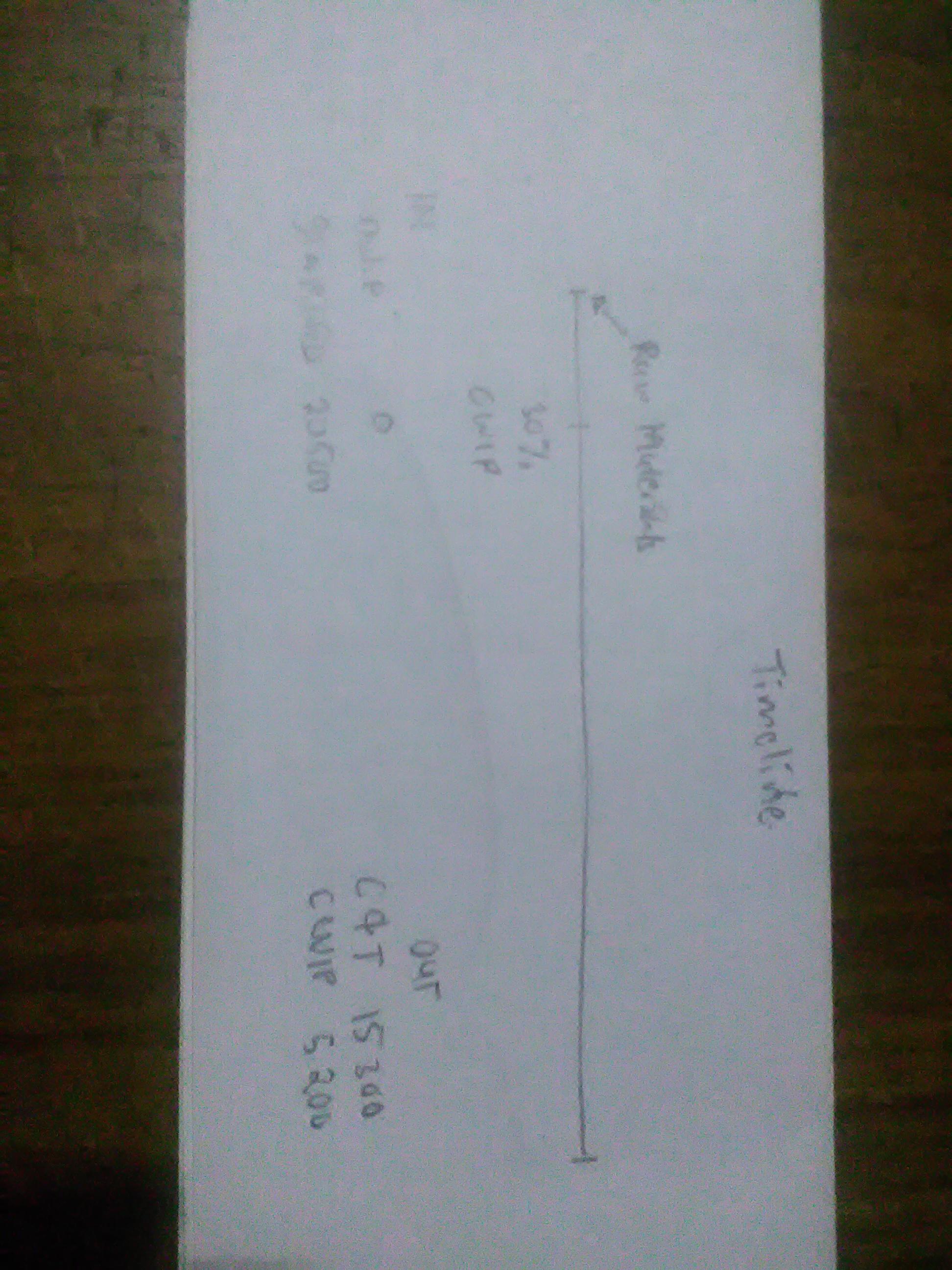
a. see attachment

b.

total equivalent units : Materials = 30,500 units and Conversion Costs = 16,860

cost per equivalent unit : Materials = $0.14 and Conversion Costs = $0.30

c.

(a) units completed and transferred to Finished Goods = $6,732

(b) units still in process at June 30 = $1,196

d.

<u>Journals</u>

Work In Process :Direct Materials $4,305 (debit)

Raw Materials $4,305 (credit)

<em>Being Raw Materials used in Production</em>

Work In Process :Direct Labor  $3,320 (debit)

Salaries Payable $3,320  (credit)

<em>Being Labor used in Production</em>

Work In Process ; Overheads $1,738 (debit)

Overheads $1,738 (credit)

<em>Being Overheads Assigned to Production</em>

Finished Goods $6,732 (debit)

Work In Process $6,732 (credit)

<em>Being Units transferred to Finished Goods</em>

Explanation:

<u>Calculation of Equivalent units of Production in respect with Raw Materials and Conversion Costs</u>

1. Materials

Ending Work In Process (5,200 × 100%)                                         5,200

Completed and Transferred Out (15,300 × 100%)                         15,300

Equivalent units of Production in respect with Raw Materials     30,500

2. Conversion Costs

Ending Work In Process (5,200 × 30%)                                            1,560

Completed and Transferred Out (15,300 × 100%)                         15,300

Equivalent units of Production in respect with Conversion Cost 16,860

<u>Calculation of Cost per Equivalent unit of production  in respect with Raw Materials and Conversion Costs</u>

Unit Cost = Total Cost ÷ Total Equivalent units

1. Materials

Unit Cost =  $4,305 ÷ 30,500

                = $0.14

2. Conversion Costs

Unit Cost =  ($3,320 + $1,738) ÷ 16,860

                = $0.30

3. Total unit cost

Total unit cost = Material Cost + Conversion Cost

                        = $0.14 + $0.30

                        = $0.44

<u>Calculation of costs assigned to (a) units completed and transferred to Finished Goods and (b) units still in process at June 30.</u>

(a) units completed and transferred to Finished Goods

Total Cost = units completed and transferred out × total unit cost

                 = 15,300 × $0.44

                 = $6,732

(b) units still in process at June 30.

Total Cost = Materials Cost + Conversion Cost

                 = $0.14 × 5,200 + $0.30 × 1,560

                 = $1,196

8 0
2 years ago
George is an employee at a company that provides information technology solutions to other firms. Recognizing his potential to i
Damm [24]

The answer to the question is competition.

It seems that George is set up by his company to become a competition to the customers’ of the company. This is because George is told to develop a new smart phone application so that his company will have a unique competitive advantage from the other firms. This would lead to his company’s better performance in the future.

3 0
2 years ago
8. A pension fund manager is considering three mutual funds, a stock fund with expected return of 15% and standard deviation of
iragen [17]

Answer:

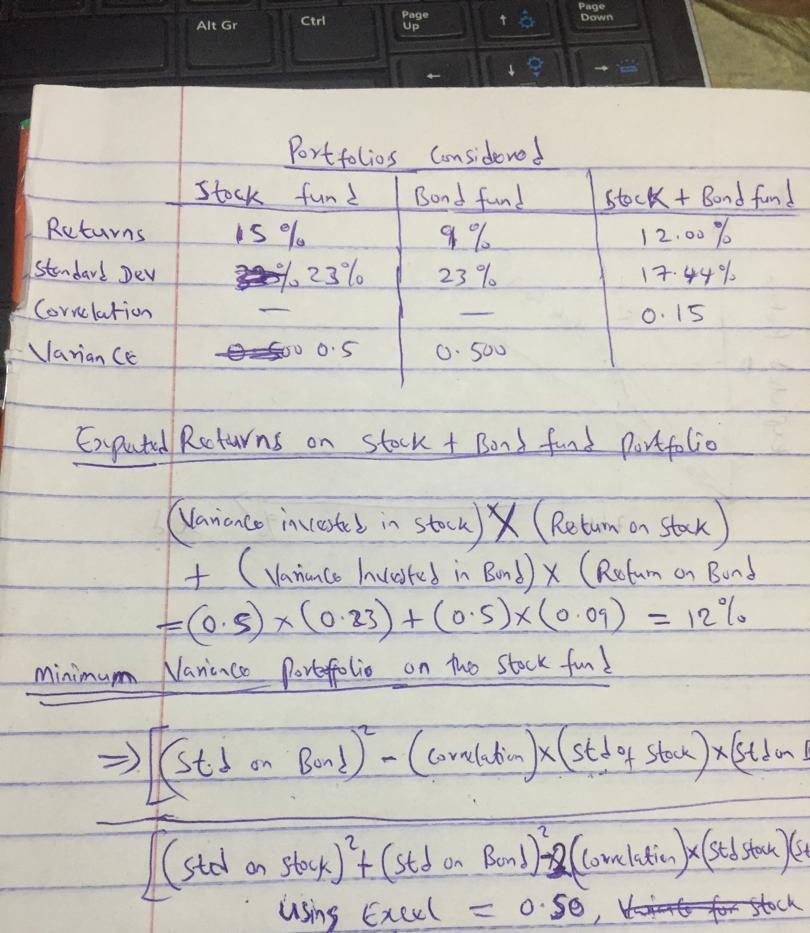
The lowest risk combination is at : expected return = 12%

                                                         standard deviation = 17.44%

Explanation:

Three mutual funds

stock fund : 15% expected return,  23% standard deviation

Bond fund : 9% expected return , 23% standard deviation

money market : sure rate of 5.5%

correlation between stock and bond fund = 0.15

variance for stock fund = 0.5 ( solved using excel )

variance for bond fund = 1 - variance for stock = 1 - 0.5 = 0.500

attached below is the table and

6 0
2 years ago
Other questions:
  • A population gathers plants and animals for survival. They need at least 360 units of​ energy, 300 units of​ protein, and 8 hide
    8·1 answer
  • When the price of erasers increases from $1.50 to $2.50, the quantity demanded of pencils is unchanged. The cross-price elastici
    14·1 answer
  • Tesla, a vehicle manufacturer, incurs the following costs. (1) Classify each cost as either a product or a period cost. If a pro
    14·1 answer
  • Which of these is NOT a safe skill to employ in the presence of road workers?
    13·1 answer
  • A benchmark market value index is comprised of three stocks. Yesterday the three stocks were priced at $30, $38, and $90. The nu
    13·1 answer
  • Ziva is an organic lettuce farmer, but she also spends part of her day as a professional organizing consultant. As a consultant,
    8·1 answer
  • . At year-end, Barr Co. had shipped $12,500 of merchandise FOB destination to Lee Co. Which company should include the $12,500 o
    8·1 answer
  • Elizabeth Pie Company has been in business for 50 years and has developed a large group of loyal restaurant customers. Giant Bak
    5·1 answer
  • Harding Company is in the process of purchasing several large pieces of equipment from Danning Machine Corporation. Several fina
    13·1 answer
  • The following is the ending balances of accounts at December 31, 2016, for the Weismuller Publishing Company.
    5·1 answer
Add answer
Login
Not registered? Fast signup
Signup
Login Signup
Ask question!