answer.
Ask question
Login Signup
Ask question
All categories
  • English
  • Mathematics
  • Social Studies
  • Business
  • History
  • Health
  • Geography
  • Biology
  • Physics
  • Chemistry
  • Computers and Technology
  • Arts
  • World Languages
  • Spanish
  • French
  • German
  • Advanced Placement (AP)
  • SAT
  • Medicine
  • Law
  • Engineering
sveticcg [70]
2 years ago
6

Grand Lips produces a lip balm used for​ cold-weather sports. The balm is manufactured in a single processing department. No lip

balm was in process on May 31​, and Grand started production on 20,500 lip balm tubes during June. Direct materials are added at the beginning of the​ process, but conversion costs are incurred evenly throughout the process. Completed production for June totaled 15,300 units. The June 30 work in process was 30​% of the way through the production process. Direct materials costing $4,305 were placed in production during June​, and direct labor of $3,320 and manufacturing overhead of $1,738 were assigned to the process.
Required:
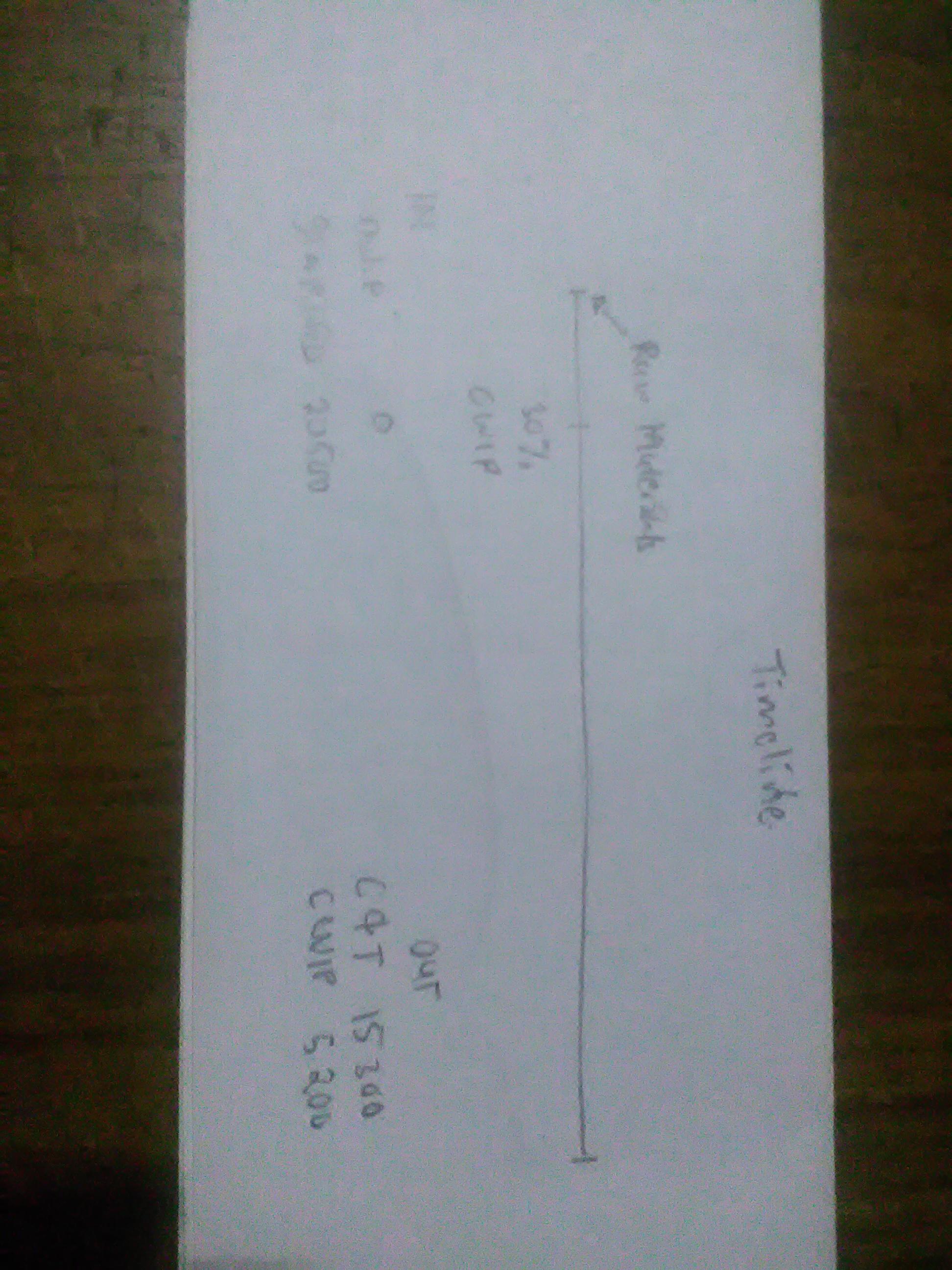
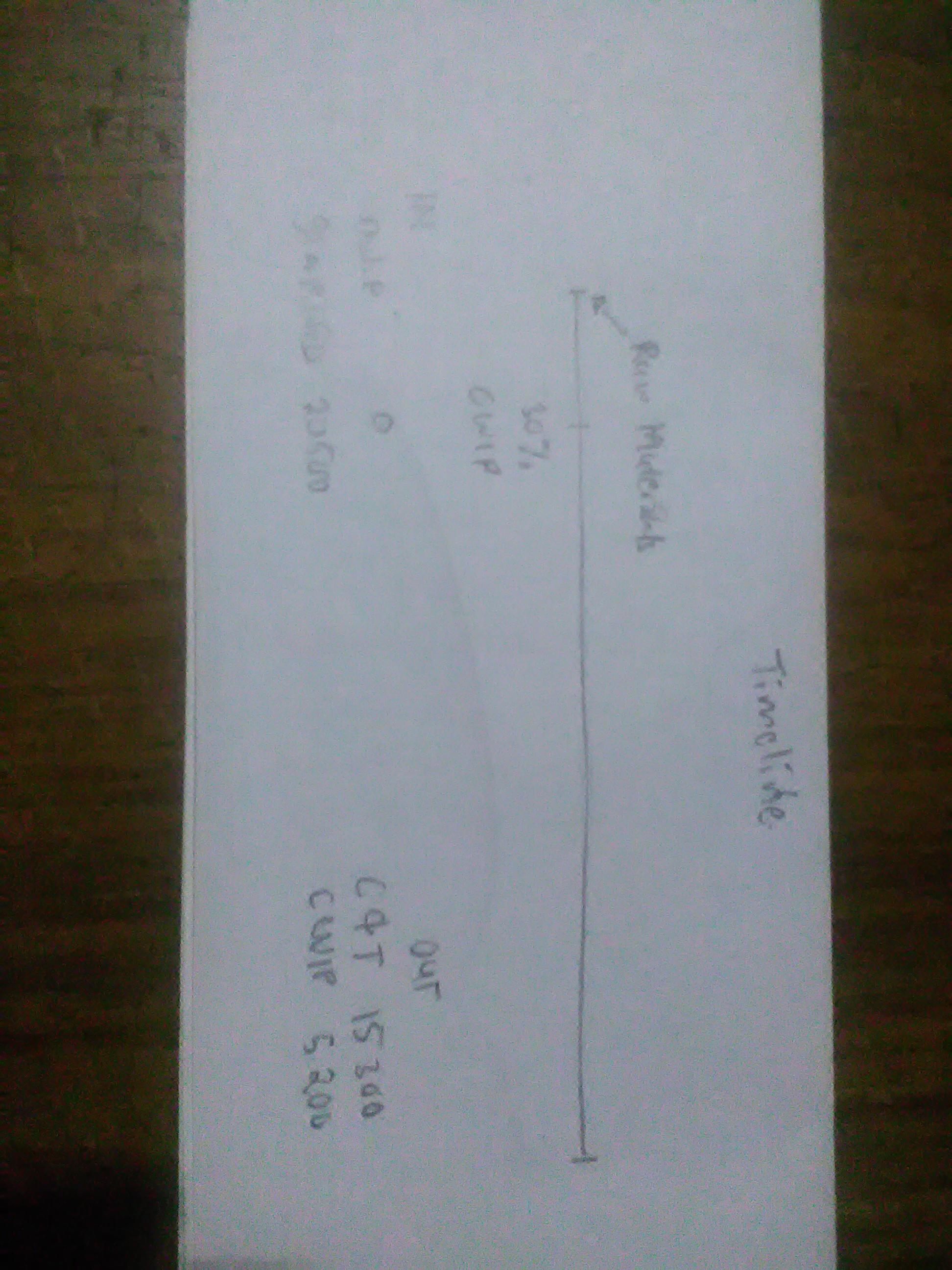
a. Draw a time line for Great Lips.
b. use the time line to help you compute the total equivalent units and the cost per equivalent unit for June.
c. Assign total costs to (a) units completed and transferred to Finished Goods and (b) units still in process at June 30.
d. Prepare a T-account for Work in Process Inventory to show activity during June, including the June 30 balance.

Business
1 answer:
77julia77 [94]2 years ago
8 0

Answer:

a. see attachment

b.

total equivalent units : Materials = 30,500 units and Conversion Costs = 16,860

cost per equivalent unit : Materials = $0.14 and Conversion Costs = $0.30

c.

(a) units completed and transferred to Finished Goods = $6,732

(b) units still in process at June 30 = $1,196

d.

<u>Journals</u>

Work In Process :Direct Materials $4,305 (debit)

Raw Materials $4,305 (credit)

<em>Being Raw Materials used in Production</em>

Work In Process :Direct Labor  $3,320 (debit)

Salaries Payable $3,320  (credit)

<em>Being Labor used in Production</em>

Work In Process ; Overheads $1,738 (debit)

Overheads $1,738 (credit)

<em>Being Overheads Assigned to Production</em>

Finished Goods $6,732 (debit)

Work In Process $6,732 (credit)

<em>Being Units transferred to Finished Goods</em>

Explanation:

<u>Calculation of Equivalent units of Production in respect with Raw Materials and Conversion Costs</u>

1. Materials

Ending Work In Process (5,200 × 100%)                                         5,200

Completed and Transferred Out (15,300 × 100%)                         15,300

Equivalent units of Production in respect with Raw Materials     30,500

2. Conversion Costs

Ending Work In Process (5,200 × 30%)                                            1,560

Completed and Transferred Out (15,300 × 100%)                         15,300

Equivalent units of Production in respect with Conversion Cost 16,860

<u>Calculation of Cost per Equivalent unit of production  in respect with Raw Materials and Conversion Costs</u>

Unit Cost = Total Cost ÷ Total Equivalent units

1. Materials

Unit Cost =  $4,305 ÷ 30,500

                = $0.14

2. Conversion Costs

Unit Cost =  ($3,320 + $1,738) ÷ 16,860

                = $0.30

3. Total unit cost

Total unit cost = Material Cost + Conversion Cost

                        = $0.14 + $0.30

                        = $0.44

<u>Calculation of costs assigned to (a) units completed and transferred to Finished Goods and (b) units still in process at June 30.</u>

(a) units completed and transferred to Finished Goods

Total Cost = units completed and transferred out × total unit cost

                 = 15,300 × $0.44

                 = $6,732

(b) units still in process at June 30.

Total Cost = Materials Cost + Conversion Cost

                 = $0.14 × 5,200 + $0.30 × 1,560

                 = $1,196
You might be interested in
A property was purchased two years ago for $300,000; the investor just sold the property for $379,000. What was the percentage o
ikadub [295]

Answer:

percentage of profit is 26.3%

Explanation:

given data

purchase property cost = $300,000

time = 2 year ago

sold  property = $379,000

solution

we get here percentage of profit in relation to the cost

first we get here percentage value increase  that is

percentage value increase = \frac{379000}{300000}

percentage value increase = 1.263

percentage value increase = 126.3%

so here 1 in 1.263 represent you the original cost

so profit % = 1 - 1.263

profit % = 26.3%

3 0
2 years ago
Sally promotes her sunscreen product by claiming that with just one
victus00 [196]

Answer:illegal

Explanation:

8 0
2 years ago
Current assets and current liabilities for Brayden Company are as follows: 20Y9 20Y8 Current assets $498,600 $532,400 Current li
GuDViN [60]

Answer:

Working Capital -2019  =$229300

Working Capital -2018 = $230900

Explanation:

Working capital is the operating capital of the business that is used in the day to day running or the business and is a metric for the liquidity of the business. It is necessary for the operations of the business and is calculated as the difference between the current assets and the current liabilities.

Working Capital = Current Assets - Current Liabilities

Working Capital -2019 = 498600 - 269300  =$229300

Working Capital -2018 = 532400 - 301500  = $230900

4 0
2 years ago
A particular product line is most likely to be dropped when: Group of answer choices its total fixed costs are more than its con
Snezhnost [94]

Answer:

A particular product line is most likely to be dropped when:

  • its total fixed costs are more than its contribution margin
  • its variable costs are more than its fixed costs
  • its unavoidable fixed costs are more than its contribution margin.

Explanation:

The aim of every producer is to maximize profit and to make this possible, the cost of producing a particular product should fall below the contribution margin.

In the case that the gross profit is always negative due to high cost of production, further production should be discouraged.

The decision to drop a particular product line is usually reached when:

  • Its total fixed costs are more than its contribution margin: Here, the company will run at a loss. It is sustainable to continue production..
  • Its variable costs are more than its fixed costs: This is also an unfavorable situation that does not sustain mass production. Therefore, further production should discontinue.
  • its unavoidable fixed costs are more than its contribution margin: At this rate, profit cannot be maximized. It is a lose-lose situation for the company.
8 0
2 years ago
Which of the following circumstances must be present for departmental overhead allocation to be favored over a traditional overh
Dafna1 [17]

Answer:

B. Each​ product, or​ job, uses the department to a different extent.

Explanation:

Departmental overhead rates uses a standard charge that is based on produced units attributed to a department.

Costs are applied with high precision.

When this model is used, the standard rate is multiplied by the number of units produced in the department, so there is no over allocation of resources.

For example if we consider the hours a machine operates. With a standard rate of $10 per hour, machine operation of 6 hours will give $10* 6 hours= $60

5 0
2 years ago
Other questions:
  • Choosing firm goals for your business
    10·2 answers
  • Elana works an average of 60 hours each week. she wants to have a great work-life balance. how can she improve her social/emotio
    11·1 answer
  • At the end of the week, Carla receives her paycheck and goes directly to the bank after work to make a deposit into her savings
    12·1 answer
  • Kaitlin has $10,000 of savings that she may deposit with her local bank. Kaitlin wants to earn a real rate of return of at least
    15·1 answer
  • Netflix is an internet television network that currently boasts the worldâs largest paying membership (Source: 2015 Netflix inve
    12·2 answers
  • The Namibian government has assigned ownership rights of many endangered species to local communities, who have in turn sold hun
    8·1 answer
  • The balance sheet of Flo's Restaurant showed total assets of $600,000, liabilities of $160,000 and stockholders’ equity of $540,
    10·1 answer
  • For each of the following cases determine the ending balance in the inventory account. (Hint: First, determine the total cost of
    6·1 answer
  • The following changes took place last year in Pavolik Company’s balance sheet accounts:
    6·1 answer
  • Journalize the following transactions for Lucite Company. Assume 360 days per year.
    9·1 answer
Add answer
Login
Not registered? Fast signup
Signup
Login Signup
Ask question!