answer.
Ask question
Login Signup
Ask question
All categories
  • English
  • Mathematics
  • Social Studies
  • Business
  • History
  • Health
  • Geography
  • Biology
  • Physics
  • Chemistry
  • Computers and Technology
  • Arts
  • World Languages
  • Spanish
  • French
  • German
  • Advanced Placement (AP)
  • SAT
  • Medicine
  • Law
  • Engineering
Black_prince [1.1K]
2 years ago
6

Correctly classify each of the following compound as highly soluble or insoluble in water. 1. NaCl 2. CH3Cl 3. CH3OH 4. KOH 5. C

6H6 6. C6H14 7. KNO3 8. CCl4 9. NaSO4 10. CH3CH2OH 11. CH2Cl2 12. CH3COOH

Chemistry
2 answers:
Anna35 [415]2 years ago
8 0
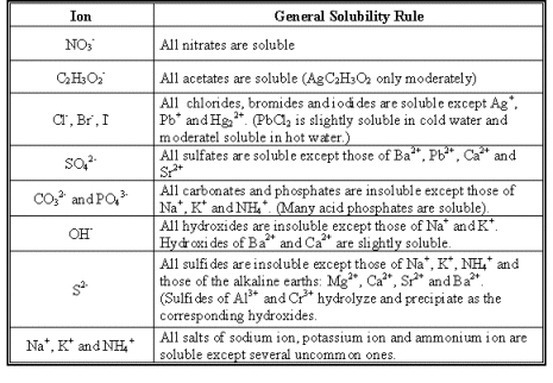
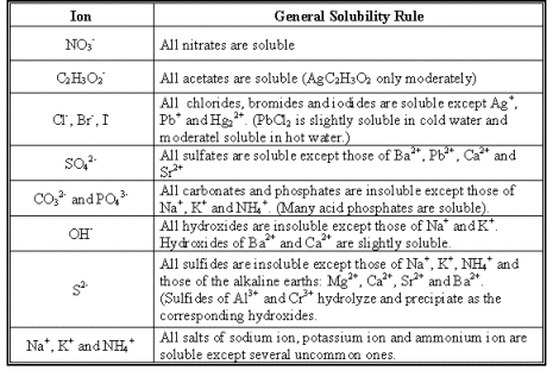
There are solubility rules for inorganic compounds in water as shown in the picture attached. For organic compounds, we use the concept of polarity.

1. NaCl: Since NaCl is a chloride and Na is not included in the list of insoluble, therefore, NaCl is<em> </em><em>highly soluble</em>.

2. CH₃Cl: This compound is organic. Since the electonegativity between C and Cl is great, it tends to be polar. Because water is also polar, this is <em>highly soluble.</em>

3. CH₃OH: This is an alcohol. Alcohols with short chains of hydrocarbon are <em>highly soluble </em>in water because of hydrogen bonding (-OH).

4. KOH: From the table, KOH is <em>highly soluble</em>. In fact, this is a strong solid which readily dissociates in water.

5.  C₆H₆ is the benzene ring. This is a nonpolar molecule, so you would expect this to be<em> insoluble</em> with water.

6. C₆H₁₄ is hexane which is a long chain of hydrocarbons. Because there is no point of hydrogen bonding, this is nonpolar, and therefore,<em> insoluble</em> in water.

7. KNO₃ is <em>h</em><em>ighly soluble</em> because all nitrates are soluble.

8. CCl₄ is an organic compound. Individually, C-Cl bonds are polar. But because there are 4 of them, they cancel out. As a result, there is a balance of partial charges which makes it nonpolar. Thus, this is <em>insoluble in water</em>.

9. NaSO₄: from the table, this is <em>highly soluble</em>.

10. <span>CH</span>₃<span>CH</span>₂<span>OH: Although it is composed of the nonpolar hydrocarbon chain, the OH group is much stronger such that it is <em>highly soluble</em> in water.

11. CH</span>₂Cl₂: This is polar because there is an imbalance due to the C-H and C-Cl bonds. Thus, it is <em>highly soluble</em> in water.

12. CH₃COOH is a carboxylic acid which is even more soluble than alcohols. Thus, this is <em>highly soluble </em>in water.

PtichkaEL [24]2 years ago
8 0

NaCl, KOH, \text{KNO}_3, \text{NA}_2\text{SO}_4, \text{CH}_3\text{Cl}, \text{CH}_2\text{Cl}_2, \text{CH}_3\text{OH}, \text{CH}_3\text{CH}_2\text{OH}  and \text{CH}_3\text{COOH} are highly soluble in water whereas \text{C}_6\text{H}_6, {\text{C}_6\text{H}_14}, and {\text{CC}}{{\text{l}}_{\text{4}}} are highly insoluble in water.

Further explanation:

Solubility is the property of substance as a result of which it has a tendency to dissolve in other substances. “Like dissolves like” is a general principle that is used to predict whether the substance is soluble in the given solvent or not.

Water is a polar molecule and it has \text{H}^+ and \text{OH}^- ions in it. So ionic and polar compounds are highly soluble in water whereas the covalent and organic compounds are highly insoluble in water.

NaCl, KOH, {\text{KN}}{{\text{O}}_{\text{3}}} and {\text{N}}{{\text{a}}_{\text{2}}}{\text{S}}{{\text{O}}_{\text{4}}} are ionic compounds that are composed of their respective ions. Water is a polar compound and therefore all these compounds are highly soluble in water.

{{\text{C}}_{\text{6}}}{{\text{H}}_{\text{6}}} and {{\text{C}}_{\text{6}}}{{\text{H}}_{{\text{14}}}} are non-polar hydrocarbons so these are highly insoluble in water.

{\text{C}}{{\text{H}}_3}{\text{Cl}} and {\text{C}}{{\text{H}}_{\text{2}}}{\text{C}}{{\text{l}}_{\text{2}}} are polar covalent compounds and water is also polar. So these are highly soluble in water.

{\text{CC}}{{\text{l}}_{\text{4}}} is a covalent compound so it cannot form ions and therefore it is highly insoluble in water.

{\text{C}}{{\text{H}}_{\text{3}}}{\text{OH}} and {\text{C}}{{\text{H}}_{\text{3}}}{\text{C}}{{\text{H}}_{\text{2}}}{\text{OH}} are alcohols that contains a highly electronegative oxygen atom that is capable to form hydrogen bonds with the hydrogen atom of water molecule. Therefore both these compounds are highly soluble in water.

{\text{C}}{{\text{H}}_{\text{3}}}{\text{COOH}} is polar due to presence of hydroxyl group in it and therefore it is highly soluble in water.

Therefore, NaCl, KOH, {\text{KN}}{{\text{O}}_{\text{3}}}, {\text{N}}{{\text{a}}_{\text{2}}}{\text{S}}{{\text{O}}_{\text{4}}}, {\text{C}}{{\text{H}}_3}{\text{Cl}}, {\text{C}}{{\text{H}}_{\text{2}}}{\text{C}}{{\text{l}}_{\text{2}}}, {\text{C}}{{\text{H}}_{\text{3}}}{\text{OH}}, {\text{C}}{{\text{H}}_{\text{3}}}{\text{C}}{{\text{H}}_{\text{2}}}{\text{OH}}  and {\text{C}}{{\text{H}}_{\text{3}}}{\text{COOH}} are highly soluble in water whereas {{\text{C}}_{\text{6}}}{{\text{H}}_{\text{6}}} , {{\text{C}}_{\text{6}}}{{\text{H}}_{{\text{14}}}} , and {\text{CC}}{{\text{l}}_{\text{4}}} are highly insoluble in water.

Learn more:

  1. Identification of ionic bonding: brainly.com/question/1603987
  2. What type of bond exists between phosphorus and chlorine? brainly.com/question/81715

Answer details:

Grade: High School

Chapter: Ionic and covalent compounds

Subject: Chemistry

Keywords: NaCl, KOH, KNO3, CH3OH, CH3CH2OH, CH3COOH, C6H6, C6H14, CCl4, CH3Cl, Na2SO4, CH2Cl2, soluble, insoluble, water.
You might be interested in
The heat of vaporization (∆Hvap) of the element mercury (Hg) is 59.0 kJ/mol. If the vapor pressure of Hg is 0.0017 torr at 25°C,
astra-53 [7]

Answer:

Tb Hg = 656.726 K

Explanation:

normal boiling point (Tb):

Clasius-Clapeyron's law:

  • Tb = [(RLn(Po)/ΔHv) + (1/To)]∧(-1)

∴ R = 8.314 J/K.mol

∴To = 25°C ≅ 298 K

∴ Po = 0.0017 torr = 2.24 E-6 atm

∴ ΔHv = 59.0 KJ/mol = 59000 J/mol

⇒ Tb = [(8.314 J/K.mol)Ln(2.24 E-6))/(59000 J/mol)) + (1/298 K)]∧(-1)

⇒ Tb = [- 1.833 E-3 K-1 + 3.355 E-3 K-1 ]∧(-1)

⇒ Tb = [1.523 E-3]∧(-1)

⇒ Tb = 656.726 K

6 0
2 years ago
Three units put together in different patterns essentially make
V125BC [204]
The answer is everything.
3 0
2 years ago
Read 2 more answers
A 1.00 l solution contains 3.50×10⁻⁴ m cu(no3)2 and 1.75×10⁻³ m ethylenediamine (en). the kf for cu(en)22+ is 1.00×10²⁰. what is
Alik [6]
<span>Answer: A 1.00 L solution containing 3.00x10^-4 M Cu(NO3)2 and 2.40x10^-3 M ethylenediamine (en). contains 0.000300 moles of Cu(NO3)2 and 0.00240 moles of ethylenediamine by the formula Cu(en)2^2+ 0.000300 moles of Cu(NO3)2 reacts with twice as many moles of en = 0.000600 mol of en so, 0.00240 moles of ethylenediamine - 0.000600 mol of en reacted = 0.00180 mol en remains by the formula Cu(en)2^2+ 0.000300 moles of Cu(NO3)2 reacts to form an equal 0.000300 moles of Cu(en)2^2+ Kf for Cu(en)2^2+ is 1x10^20. so 1 Cu+2 & 2 en --> Cu(en)2^2+ Kf = [Cu(en)2^2+] / [Cu+2] [en]^2 1x10^20. = [0.000300] / [Cu+2] [0.00180 ]^2 [Cu+2] = [0.000300] / (1x10^20) (3.24 e-6) Cu+2 = 9.26 e-19 Molar since your Kf has only 1 sig fig, you might be expected to round that off to 9 X 10^-19 Molar Cu+2</span>
4 0
2 years ago
A piston containing 0.120moles of methane gas, CH4, has a volume of 2.12liters. If methane is added until the volume is increase
earnstyle [38]

Answer:

2.83 g

Explanation:

At constant temperature and pressure, Using Avogadro's law

\frac {V_1}{n_1}=\frac {V_2}{n_2}

Given ,  

V₁ = 2.12 L

V₂ = 3.12 L

n₁ = 0.120 moles

n₂ = ?

Using above equation as:

\frac{2.12}{0.120}=\frac{3.12}{n_2}

2.12n_2=0.12\cdot \:3.12

2.12n_2=0.3744

n_2=\frac{0.3744}{2.12}

n_2=0.17660

n₂ = 0.17660 moles

Molar mass of methane gas = 16.05 g/mol

So, Mass = Moles*Molar mass = 0.17660 * 16.05 g = 2.83 g

<u>2.83 g  are in the piston.</u>

8 0
2 years ago
A chemist is working on a reaction represented by this chemical equation:
erastova [34]

Answer is: A. 1.81 mol.

Balanced chemical reaction: FeCl₂ + 2KOH → Fe(OH)₂ + 2KCl.

n(FeCl₂) = 4.15 mol; amount of iron(II) chloride.

n(KOH) = 3.62 mol; amount of potassium hydroxide, limiting reactant.

From chemical reaction: n(KOH) : n(Fe(OH)₂) = 2 : 1.

n(Fe(OH)₂) = n(KOH) ÷ 2.

n(Fe(OH)₂) = 3.62 mol ÷ 2.

n(Fe(OH)₂) = 1.81 mol; amount of iron(II) hydroxide.

6 0
2 years ago
Read 2 more answers
Other questions:
  • Uranium–232 has a half–life of 68.9 years. A sample from 206.7 years ago contains 1.40 g of uranium–232. How much uranium was or
    12·2 answers
  • Rank the size of a change in temperature of one degree Fahrenheit, one degree Celsius, and one kelvin. In other words, if a ther
    6·1 answer
  • Consider the reaction: 2clf3(g) + 2nh3(g) → n2(g) + 6hf(g) + cl2(g) when calculating the δh°rxn, why is the δhf° for n2 not impo
    9·1 answer
  • The enthalpy change for converting 1.00 mol of ice at -25.0 ∘c to water at 90.0∘c is ________ kj. the specific heats of ice, wat
    7·1 answer
  • The isotopes of an element all have the same __(atomic, mass) __number, but they have different __(atomic,mass)__numbers.
    6·1 answer
  • A 0.944 M solution of glucose, C6H12O6, in water has a density of 1.0624 g/mL at 20∘C. What is the concentration of this solutio
    10·1 answer
  • A sample of gas with an initial volume of 28.4 Liters at a pressure of 725 mmHg and a temperature of 305 K is compressed to a vo
    9·1 answer
  • A car uses 12.5 L of gasoline to travel a distance of 275 km. Convert this into units of miles per gallon (mi/gal).
    14·1 answer
  • The acids and bases shown right cover a range of pH values. Use what you know about acids, bases, and concentration to label the
    6·2 answers
  • Calculate the wavelength of a photon of green light that has a frequency (v) of 5.76x10^14 s^-1
    9·1 answer
Add answer
Login
Not registered? Fast signup
Signup
Login Signup
Ask question!
