answer.
Ask question
Login Signup
Ask question
All categories
  • English
  • Mathematics
  • Social Studies
  • Business
  • History
  • Health
  • Geography
  • Biology
  • Physics
  • Chemistry
  • Computers and Technology
  • Arts
  • World Languages
  • Spanish
  • French
  • German
  • Advanced Placement (AP)
  • SAT
  • Medicine
  • Law
  • Engineering
Deffense [45]
2 years ago
11

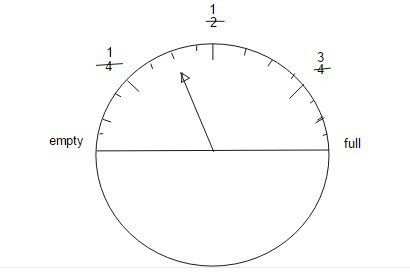
The Diagram Shows a Fuel gauge in a Car.

Mathematics
2 answers:
lesya692 [45]2 years ago
6 0

Answer:

Part a) \frac{3}{8}

Part b) 30\ liters

Step-by-step explanation:

Part a)  What fraction does the Gauge show?

we know that

Each division in the Fuel gauge represent the fraction \frac{1}{16}

so

To find what fraction the gauge shows multiply 6 by \frac{1}{16}

6*\frac{1}{16}=\frac{6}{16}=\frac{3}{8}

Part b) The fuel tank holds 48 litres when it is full. How many Litres must be added to fill the tank?

we know that

The tank has \frac{3}{8} of its total capacity

so

To fill the tank must be added 1-\frac{3}{8}=\frac{5}{8}

therefore

Multiply \frac{5}{8} by 48\ liters

48*\frac{5}{8}=30\ liters

salantis [7]2 years ago
5 0
The fuel gauge shows  3/8  full.  (actually  6/16  but simplified)

So the other  5/8  of the tank is empty.

In order to fill the tank, you'll have to pour in  5/8  of  48 liters.

Can you handle it from there ?
You might be interested in
Jason hires groundskeepers. They work an average of 60 hours per month. If seven groundskeepers are hired at $12/hour, what is t
Kamila [148]
Multiply the cost per hour by 60 to find the cost for a groundskeeper
cost = 12 × 60
cost = 720
The cost for each groundskeeper is $720

Find the cost for seven groundkeepers
Multiply cost for each groundskeeper by 7
cost = 720 × 7
cost = 5,040

The monthly labor cost for seven groundskeepers is $5,040
5 0
2 years ago
What is the rule used to transform ΔABC to its image?
Allushta [10]

Answer:

D

Step-by-step explanation:

Under a reflection in the x- axis

a point (x, y ) → (x, - y )

That is the x- coordinate remains unchanged while the y- coordinate is the negative of the original y- coordinate.

Given

A(- 3, 5 ) → A'(- 3, - 5 )

B(2, 8 ) → B'(2, - 8)

C(- 4, - 5 ) → C'(- 4, 5 )

The rule for reflection in the x- axis has been applied here → D

6 0
2 years ago
The inside diameter of a randomly selected piston ring is a random variable with mean value 13 cm and standard deviation 0.08 cm
sweet-ann [11.9K]

Answer:

a) P(12.99 ≤ X ≤ 13.01) = 0.3840

b) P(X ≥ 13.01) = 0.3075

Step-by-step explanation:

To solve this question, we need to understand the normal probability distribution and the cental limit theorem.

Normal probability distribution

Problems of normally distributed samples are solved using the z-score formula.

In a set with mean \mu and standard deviation \sigma, the zscore of a measure X is given by:

Z = \frac{X - \mu}{\sigma}

The Z-score measures how many standard deviations the measure is from the mean. After finding the Z-score, we look at the z-score table and find the p-value associated with this z-score. This p-value is the probability that the value of the measure is smaller than X, that is, the percentile of X. Subtracting 1 by the pvalue, we get the probability that the value of the measure is greater than X.

Central Limit Theorem

The Central Limit Theorem estabilishes that, for a normally distributed random variable X, with mean \mu and standard deviation \sigma, the sampling distribution of the sample means with size n can be approximated to a normal distribution with mean \mu and standard deviation s = \frac{\sigma}{\sqrt{n}}.

For a skewed variable, the Central Limit Theorem can also be applied, as long as n is at least 30.

In this problem, we have that:

\mu = 13, \sigma = 0.08

(a) Calculate P(12.99 ≤ X ≤ 13.01) when n = 16.

Here we have n = 16, s = \frac{0.08}{\sqrt{16}} = 0.02

This probability is the pvalue of Z when X = 13.01 subtracted by the pvalue of Z when X = 12.99.

X = 13.01

Z = \frac{X - \mu}{\sigma}

By the Central Limit Theorem

Z = \frac{X - \mu}{s}

Z = \frac{13.01 - 13}{0.02}

Z = 0.5

Z = 0.5 has a pvalue of 0.6915

X = 12.99

Z = \frac{X - \mu}{s}

Z = \frac{12.99 - 13}{0.02}

Z = -0.5

Z = -0.5 has a pvalue of 0.3075

0.6915 - 0.3075 = 0.3840

P(12.99 ≤ X ≤ 13.01) = 0.3840

(b) How likely is it that the sample mean diameter exceeds 13.01 when n = 25?

P(X ≥ 13.01) =

This is 1 subtracted by the pvalue of Z when X = 13.01. So

Z = \frac{X - \mu}{s}

Z = \frac{13.01 - 13}{0.02}

Z = 0.5

Z = 0.5 has a pvalue of 0.6915

1 - 0.6915 = 0.3075

P(X ≥ 13.01) = 0.3075
7 0
2 years ago
Read 2 more answers
For two events A and B, a student calculates that P(A and B) = 0.46 and P(B|A) = 0.31. Explain how you can tell that the student
ololo11 [35]
Conditional probability formula is:P ( A and B ) = P ( A ) · P ( B / A )0.46 = P ( A ) · 0.31P ( A ) = 0.46 : 0.31P ( A ) = 1.48And this is impossible because 0 ≤ P ( A ) ≤ 1The student obviously made a mistake.

3 0
2 years ago
Given: EL- tangent, EK- secant <br> Prove: EJ·LK = EL·LJ
drek231 [11]

Answer:

This is possible.

Step-by-step explanation:

We can say that m<E=m<E, because of the Reflexive Property

Then, we have angles JKL and ELJ, which are equal through the peripheral angle theorem.

With these two angles, we can say that triangles ELK and EJL are similar, by the Angle-Angle Postulate (AA).

Then we can create this ratio through the Corresponding Parts of Similar Triangles Theorem, (CPST), \frac{LK}{LJ} =\frac{EL}{EJ}.

With this ratio, we can cross multiply to get the desired result

EJ·LK=EL·LJ

Hope this helps with your RSM problem

Yup, i caught ya.

3 0
2 years ago
Other questions:
  • Karen had 2 spools of wire. Each spool had 15 7/8 yards of wire. Karen used 3 yards of wire from each spool. How many yards of w
    9·2 answers
  • Justify 2.010010001.....is an irrational number
    10·2 answers
  • Which absolute value function has a graph that is wider than the parent function, f(x) = |x|, and is translated to the right 2 u
    14·3 answers
  • A probability experiment consists of rolling a a 6 6​-sided die. find the probability of the event below. rolling a number with
    5·1 answer
  • The gold bar has a trapezium cross-sectional area. Gold has a density of 19.3 grams per cm3. Work out the mass of the gold bar.
    14·2 answers
  • 8.5b−3.4∙(13a−3.2b)+a
    8·1 answer
  • The number that is x more than 2x+1
    14·2 answers
  • The answers for the math worksheet why did the lion eat the tightrope walker
    14·1 answer
  • For questions 2-5, the number of pieces in a regular bag of Skittles is approximately normally distributed with a mean of 38.4 a
    9·1 answer
  • Emery looks out their apartment window to the building across the way. The building isknown to be 42 feet tall. The angle of dep
    9·1 answer
Add answer
Login
Not registered? Fast signup
Signup
Login Signup
Ask question!
