answer.
Ask question
Login Signup
Ask question
All categories
  • English
  • Mathematics
  • Social Studies
  • Business
  • History
  • Health
  • Geography
  • Biology
  • Physics
  • Chemistry
  • Computers and Technology
  • Arts
  • World Languages
  • Spanish
  • French
  • German
  • Advanced Placement (AP)
  • SAT
  • Medicine
  • Law
  • Engineering
Kobotan [32]
2 years ago
3

For the NACA 2412 airfoil, the lift coefficient and moment coefficient about the quarter-chord at −6◦ angle of attack are −0.39

and −0.045, respectively. At 4◦ angle of attack, these coefficients are 0.65 and −0.037, respectively.
Calculate the location of the aerodynamic center.
Engineering
1 answer:
seropon [69]2 years ago
8 0

Answer:

Location of aerodynamic centre is; X_ac = 0.242c

Explanation:

We are given;

First Lift coefficient; C_L1 = -0.39

First Moment Coefficient about the quarter-chord; C_mc/4 = -0.045

First Angle of attack; α_1 = -6°

2nd Lift coefficient; C_L2 = 0.65

2nd Moment Coefficient about the quarter-chord; C'_mc/4 = -0.037

2nd Angle of attack; α_2 = 4°

Now, the formula for location of chord at aerodynamic centre is given as;

X_ac = -(m/α) + 0.25

Used 0.25 because moment is about quarter chord which is 1/4

Where;

m is slope of moment coefficient curve

α is lift curve slope

Now, formula for lift curve slope is given as;

m = (C_L2 - C_L1)/(α_2 - α_1)

Now, plugging in the relevant values to get;

α = (0.65 - (-0.39))/(4 - (-6))

α = (0.65 + 0.39)/(4+6)

α = (1.04)/10

α = 0.104 per°

Now formula to calculate slope of moment coefficient curve is given as;

m = [(C'_mc/4) - (C_mc/4)]/(α_2 - α_1)

Thus, plugging in relevant values, we have;

m = [-0.037 - (-0.045)]/(4 - (-6))

m = [-0.037 + 0.045)]/(4 + 6)

m = 0.008/10 = 0.0008 per°

Now, plugging the relevant values into X_ac = -(m/α) + 0.25 ;we have;

X_ac = -(0.0008/0.104) + 0.25

X_ac = -0.00769 + 0.25

X_ac = 0.2423c ≈ 0.242c

You might be interested in
What is the damped natural frequency (in rad/s) of a second order system whose undamped natural frequency is 25 rad/s and has a
TiliK225 [7]

Answer:

damped natural frequency = 23.84 rad/s

Explanation:

given data

damping ratio = 0.3

undamped natural frequency = 25 rad/s

to find out

damped natural frequency of a second order system

solution

we know that if damping ratio is = 0

then it is undamped system

and if damping ratio is > 1

then it is overdamped system

and  and if damping ratio is ≈ 1

then it is critical damped system

so damped natural frequency of a second order system formula is

damped natural frequency = wn × \sqrt{1-r^2}

here wn is undamped natural frequency and r is damping ratio

damped natural frequency = 25 × \sqrt{1-0.3^2}

damped natural frequency = 23.84 rad/s

3 0
2 years ago
If you have power steering and you are able to __________, you should have your vehicle checked out by a qualified technician.
svp [43]

Answer: drive

Explanation:

The best word that would fit this sentence is drive. A vehicle owner should know how to drive, and they can get their vehicle checked by a qualified technician. The best word that would fit this sentence is drive. If you have power steering and you are able to <u>drive</u>, you should have your vehicle checked by a qualified technician.

8 0
2 years ago
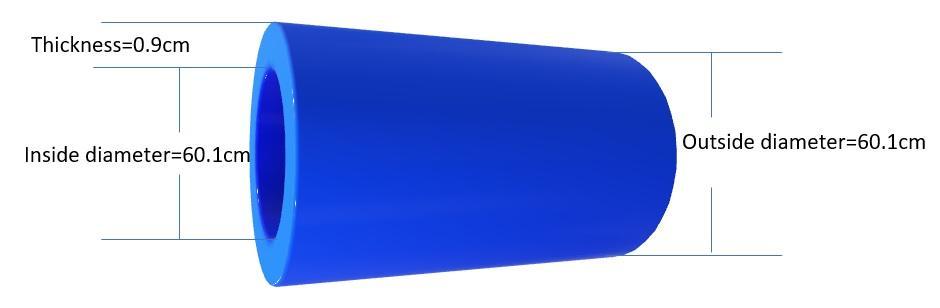
Water is flowing in a metal pipe. The pipe OD (outside diameter) is 61 cm. The pipe length is 120 m. The pipe wall thickness is
Yuki888 [10]

Answer:

1113kN

Explanation:

The ouside diameter OD of the pipe is 61cm and the thickness T is 0.9cm, so the inside diameter ID will be:

Inside Diameter = Outside Diameter - Thickness

Inside Diameter = 61cm - 0.9cm = 60.1cm

Converting this diameter to meters, we have:

60.1cm*\frac{1m}{100cm}=0.601m

This inside diameter is useful to calculate the volume V of water inside the pipe, that is the volume of a cylinder:

V_{water}=\pi  r^{2}h

V_{water}=\pi (\frac{0.601m}{2})^{2}*120m

V_{water}=113.28m^{3}

The problem gives you the water density d as 1.0kg/L, but we need to convert it to proper units, so:

d_{water}=1.0\frac{Kg}{L}*\frac{1L}{1000cm^{3}}*(\frac{100cm}{1m})^{3}

d_{water}=1000\frac{Kg}{m^{3}}

Now, water density is given by the equation d=\frac{m}{V}, where m is the water mass and V is the water volume. Solving the equation for water mass and replacing the values we have:

m_{water}=d_{water}.V_{water}

m_{water}=1000\frac{Kg}{mx^{3}}*113.28m^{3}

m_{water}=113280Kg

With the water mass we can find the weight of water:

w_{water}=m_{water} *g

w_{water}=113280kg*9.8\frac{m}{s^{2}}

w_{water}=1110144N

Finally we find the total weight add up the weight of the water and the weight of the pipe,so:

w_{total}=w_{water}+w_{pipe}

w_{total}=1110144N+2500N

w_{total}=1112644N

Converting this total weight to kN, we have:

1112644N*\frac{0.001kN}{1N}=1113kN

7 0
2 years ago
Poles are values of Laplace transform variable, s, that make denominator of transfer function zero. Zeros are values of Laplace
Ostrovityanka [42]

Answer:

Zero 1 = -1

Zero 2 = -3

Pole 1 = 0

Pole 2 = -2

Pole 3 = -4

Pole 4 = -6

Gain = 4

Explanation:

For any given transfer function, the general form is given as

T.F = k [N(s)] ÷ [D(s)]

where k = gain of the transfer function

N(s) is the numerator polynomial of the transfer function whose roots are the zeros of the transfer function.

D(s) is the denominator polynomial of the transfer function whose roots are the poles of the transfer function.

k [N(s)] = 4s² + 16s + 12 = 4[s² + 4s + 3]

it is evident that

Gain = k = 4

N(s) = (s² + 4s + 3) = (s² + s + 3s + 3)

= s(s + 1) + 3 (s + 1) = (s + 1)(s + 3)

The zeros are -1 and -3

D(s) = s⁴ + 12s³ + 44s² + 48s

= s(s³ + 12s² + 44s + 48)

= s(s + 2)(s + 4)(s + 6)

The roots are then, 0, -2, -4 and -6.

Hope this Helps!!!

3 0
2 years ago
A thermometer requires 1 minute to indicate 98% of the response to a unit step input. Assuming the thermometer to be a first ord
Rama09 [41]

Answer:

Time constant = 15.34 seconds

The thermometer shows an error of 0.838°

Explanation:

Given

t = 1 minute = 60 seconds

c(t) = 98% = 0.98

According to the question, the thermometer is a first order system.

The first order system transfer function is given as;

C(s)/R(s) = 1/(sT + 1).

To calculate the time constant, we need to calculate the step response.

This is given as

r(t) = u(t) --- Take Laplace Transformation

R(s) = 1/s

Substitute 1/s for R(s) in C(s)/R(s) = 1/(sT + 1).

We have

C(s)/1/s = 1/(sT + 1)

C(s) = 1/(sT + 1) * 1/s

C(s) = 1/s - 1/(s + 1/T) --- Take Inverse Laplace Transformation

L^-1(C(s)) = L^-1(1/s - 1/(s + 1/T))

Since, e^-t <–> 1/(s + 1) --- {L}

1 <–> 1/s {L}

So, the unit response c(t) = 1 - e^-(t/T)

Substitute 0.98 for c(t) and 60 for t

0.98 = 1 - e^-(60/T)

0.98 - 1 = - e^-(60/T)

-0.02 = - e^-(60/T)

e^-(60/T) = 0.02

ln(e^-(60/T)) = ln(0.02)

-60/T = -3.912

T = -60/-3.912

T = 15.34 seconds

Time constant = 15.34 seconds

The error signal is given as

E(s) = R(s) - C(s)

Where the temperature changes at the rate of 10°/min; 10°/60 s = 1/6

So.

E(s) = R(s) - 1/6 C(s)

Calculating C(s)

C(s) = 1/s - 1/(s + 1/T)

C(s) = 1/s - 1/(s + 1/15.34)

Remember that R(s) = 1/s

So, E(s) becomes

E(s) = 1/s - 1/6(1/s - 1/(s + 1/15.34))

E(s) = 1/s - 1/6(1/s - 1/(s + 0.0652)

E(s) = 1/s - 1/6s + 1/(6(s+0.0652))

E(s) = 5/6s + 1/(6(s+0.0652))

E(s) = 0.833/s + 1/(6(s+0.0652)) ---- Take Inverse Laplace Transformation

e(t) = 1/6e^-0.652t + 0.833

For a first order system, the system attains a steady state condition when time is 4 times of Time constant.

So,

Time = 4 * 15.34

Time = 61.36 seconds

So, e(t) becomes

e(t) = 1/6e^-0.652t + 0.833

e(t) = 1/(6e^-0.652(61.36)) + 0.833

e(t) = 0.83821342824942664566211

e(t) = 0.838 --- Approximated

Hence, the thermometer shows an error of 0.838°

4 0
2 years ago
Read 2 more answers
Other questions:
  • A joining process in which a filler metal is melted and distributed by capillary action between faying surfaces, the base metals
    12·1 answer
  • Steam flows at steady state through a converging, insulated nozzle, 25 cm long and with an inlet diameter of 5 cm. At the nozzle
    11·1 answer
  • What is the PW (at i 5%) of SuperTool's new test equipment? The development cost is $1.2M. Net revenues will begin at $300,000 f
    9·1 answer
  • Determine F12 and F21 for the following configurations: (a) A long semicircular duct with diameter of 0.1 meters: (b) A hemisphe
    10·1 answer
  • 6.8.1: Function pass by pointer: Transforming coordinates. Define a function CoordTransform() that transforms its first two inpu
    9·1 answer
  • Write cout statements with stream manipulators that perform the following:
    8·1 answer
  • ) A given system has four sensors that can produce an output of 0 or 1. The system operates properly when exactly one of the sen
    9·1 answer
  • Q4. What happen when a steady potential is connected across the end points of the [3] conductor? Illustrate with an example.
    12·1 answer
  • Q10. Select the correct option for the following questions – (10 points, 2 each) a. After an edge dislocation has passed through
    15·1 answer
  • What are practical considerations you might encounter when you increase the moment of inertia (I) while keeping the cross-sectio
    13·1 answer
Add answer
Login
Not registered? Fast signup
Signup
Login Signup
Ask question!