answer.
Ask question
Login Signup
Ask question
All categories
  • English
  • Mathematics
  • Social Studies
  • Business
  • History
  • Health
  • Geography
  • Biology
  • Physics
  • Chemistry
  • Computers and Technology
  • Arts
  • World Languages
  • Spanish
  • French
  • German
  • Advanced Placement (AP)
  • SAT
  • Medicine
  • Law
  • Engineering
11111nata11111 [884]
2 years ago
3

When calcium carbonate is added to hydrochloric acid, calcium chloride, carbon dioxide, and water are produced. CaCO3(s)+2HCl(aq

)⟶CaCl2(aq)+H2O(l)+CO2(g) How many grams of calcium chloride will be produced when 25.0 g of calcium carbonate is combined with 14.0 g of hydrochloric acid? mass of CaCl2 :

Chemistry
2 answers:
mart [117]2 years ago
7 0

Answer:

Mass of CaCl₂ produced from the reaction = 21.31 g

Explanation:

The balanced equation for the reaction

CaCO₃(s) + 2HCl(aq) ⟶ CaCl₂(aq) + H₂O(l) + CO₂(g)

How many grams of calcium chloride will be produced when 25.0 g of calcium carbonate is combined with 14.0 g of hydrochloric acid

First of, we need to recognize the limiting reagent in this reaction.

The limiting reagent is the reagent that is totally used up in the chemical reaction; it determines the amount of other reactants that react and the amount of products that will be formed.

To know the limiting reagent, we convert the masses of the reactants given to number of moles.

Number of moles = (mass)/(molar mass)

25.0 g of calcium carbonate

Molar mass of CaCO₃ = 100.0869 g/mol

Number of moles of CaCO₃ present at the start of the reaction = (25/100.0869) = 0.250 moles

14.0 g of hydrochloric acid

Molar mass of HCl = 36.46 g/mol

Number of moles of HCl present at the start of the reaction = (14/36.45) = 0.384 moles

But from the stoichiometric balance of the reaction,

1 mole of CaCO₃ reacts with 2 moles of HCl

If CaCO₃ was the limiting reagent,

0.25 moles of CaCO₃ at the start of the reaction would require 0.50 moles of HCl; which is more than the available number of moles of HCl available at the start of the reaction (0.384 moles)

So, CaCO₃ isn't the limiting reagent.

If HCl is the limiting reagent,

0.384 moles of HCl would require 0.192 moles of CaCO₃ to react with. This is within the limit of CaCO₃ present at the start of the reaction. (0.250 moles)

Hence, HCl is the limiting reagent, it is the reactant that is used up in the reaction and determines the amount of products formed.

Again, from the stoichiometric balance of the reaction,

2 moles of HCl gives 1 mole of CaCl₂

0.384 moles of HCl will give (0.384/2) moles of CaCl₂; that is, 0.192 moles of CaCl₂

We then convert this number of moles to mass.

Mass = (number of moles) × (molar mass)

Molar mass of CaCl₂ = 110.98 g/mol

Mass of CaCl₂ produced by the reaction = 0.192 × 110.98 = 21.30816 g = 21.31 g

Hope this Helps!!!

Andrew [12]2 years ago
7 0

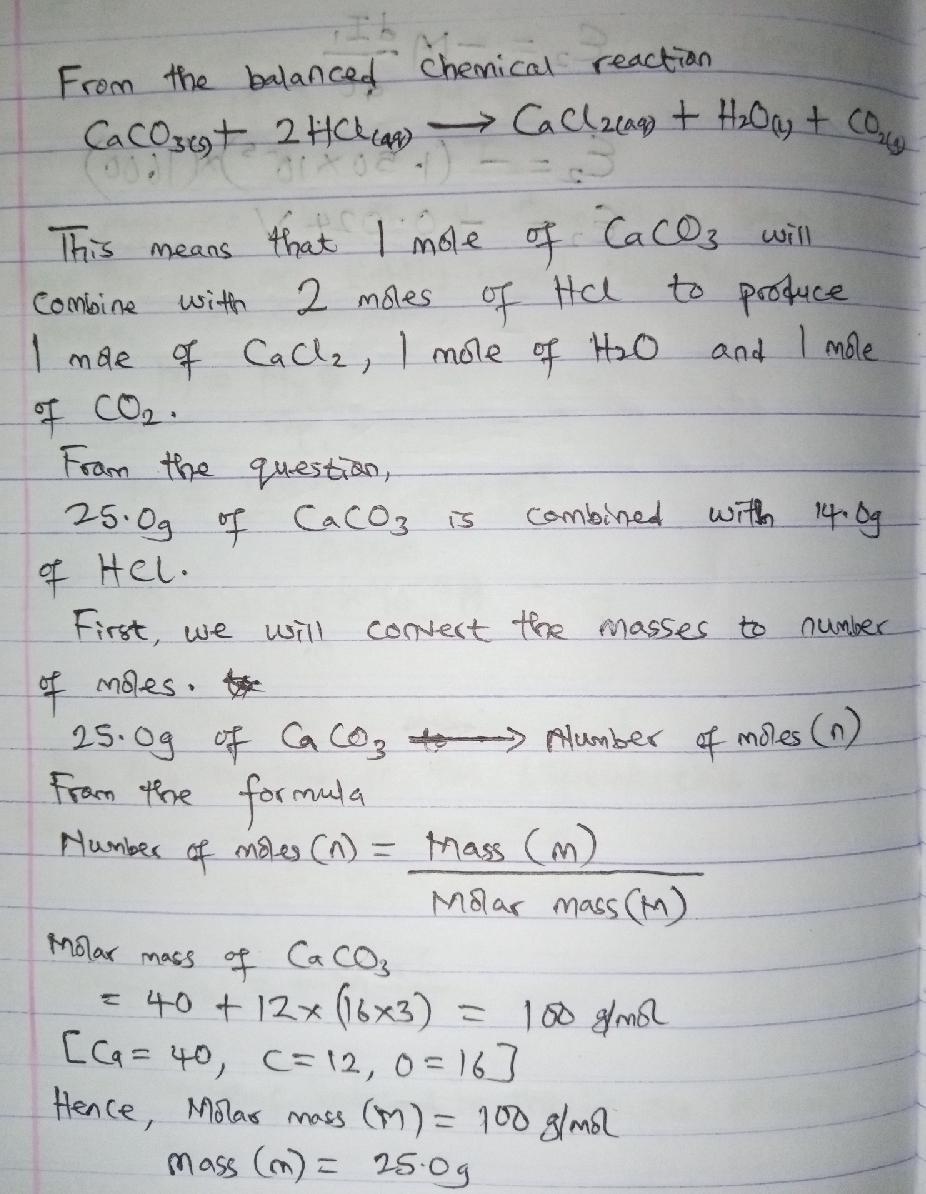
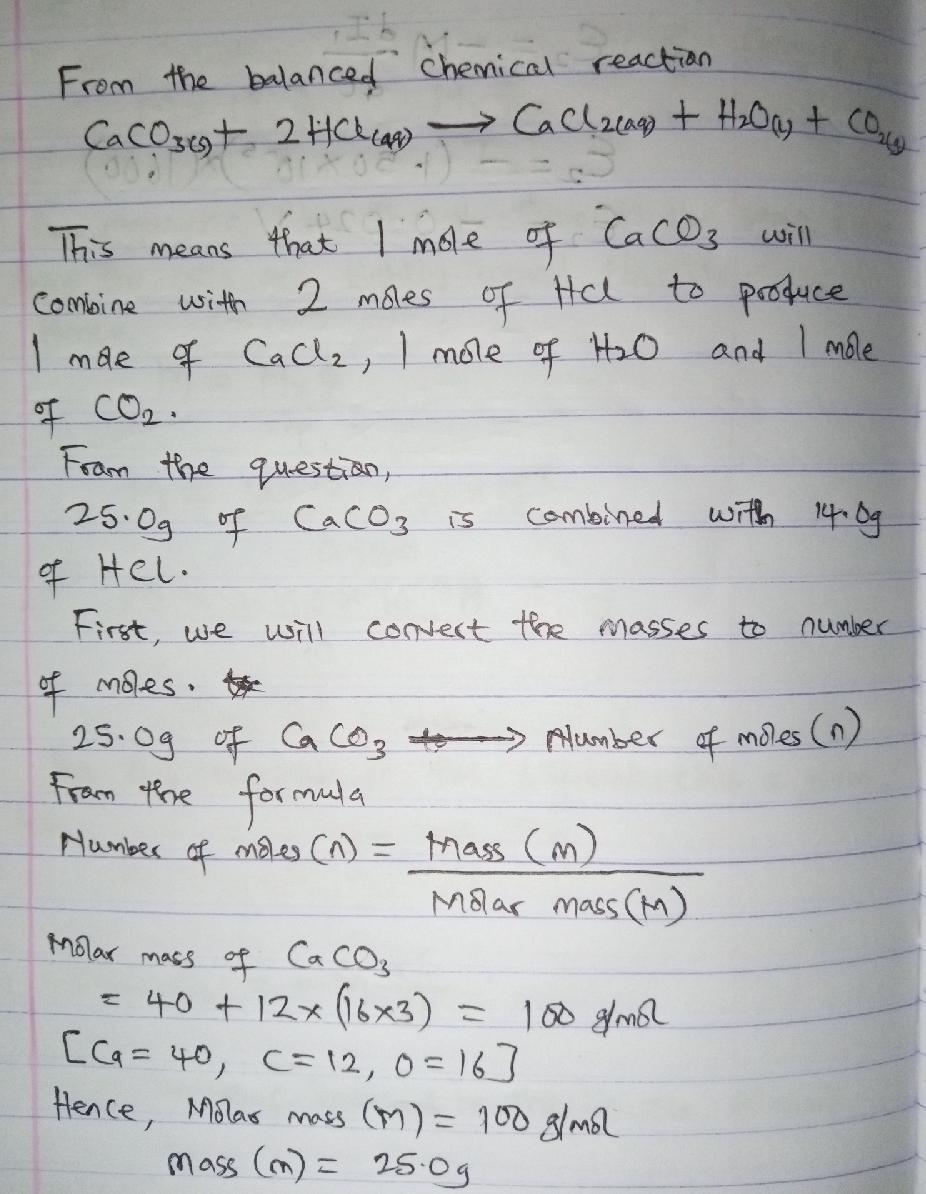
Answer: 21.09g of Calcium chloride is produced

Explanation: Please see the attachments below

You might be interested in
How many hydrogen bonds can CH2O make to water
VladimirAG [237]
Hydrogen bonds are not like covalent bonds. They are nowhere near as strong and you can't think of them in terms of a definite number like a valence. Polar molecules interact with each other and hydrogen bonds are an example of this where the interaction is especially strong. In your example you could represent it like this: 

<span>H2C=O---------H-OH </span>

<span>But you should remember that the H2O molecule will be exchanging constantly with others in the solvation shell of the formaldehyde molecule and these in turn will be exchanging with other H2O molecules in the bulk solution. </span>

<span>Formaldehyde in aqueous solution is in equilibrium with its hydrate. </span>

<span>H2C=O + H2O <-----------------> H2C(OH)2</span>
5 0
2 years ago
NH4NO3, whose heat of solution is 25.7 kJ/mol, is one substance that can be used in cold pack. If the goal is to decrease the te
makvit [3.9K]

Answer:

There are necessaries 35,2g of NH₄NO₃ per 100,0g of water to decrease the temperature of the solution from 25,0°C to 5,0°C

Explanation:

To decrease the temperature of the solution there are necessaries:

4,184J/g°C×(5,0°C-25,0°C)×(100,0g+X) = -Y

8368J + 83,68J/gX = Y <em>(1)</em>

Where x are grams of NH₄NO₃ you need to add and Y is the energy that you need to decrease the heat.

Also, the energy Y will be:

Y = 25700J/mol×\frac{1mol}{80,043g}X

Y = 321J/g X <em>(2)</em>

Replacing (2) in (1)

8368J + 83,68J/g X = 321J/g X

8363J = 237,32J/gX

<em>X = 35,2g</em>

<em />

Thus, there are necessaries 35,2g of NH₄NO₃ per 100,0g of water to decrease the temperature of the solution from 25,0°C to 5,0°C

I hope it helps!

6 0
2 years ago
The melting point of water is 0°C at 1 atm pressure because under these conditions:
Tems11 [23]

Answer:

The correct answer is option C, that is, ΔS and ΔSsurr for the process H2O (s) ⇒ H2O(l) are equal in magnitude and opposite in sign.

Explanation:

The temperature at which solid state of water get transformed into liquid state is termed as the melting point of 0 °C. It can be shown by the reaction:  

H2O (s) ⇒ H2O (l)

The degree of randomness of a molecule is known as entropy. With the transformation of ice into liquid state, there is an increase in randomness. Thus, the value of entropy becomes positive as shown:  

Entropy change (ΔSsys) = ΔSproduct - ΔSreactant

= (69.9 - 47.89) J mol/K

= 22.0 J mol/K

Therefore, the value of entropy change is positive.  

Now the value of entropy for surrounding ΔSsurr will be,  

ΔSsurr = -ΔHfusion/T  

= -6012 j/mol/273

= -22.0 J/molK

Hence, the value of ΔSsurr and ΔSsys exhibit same magnitude with opposite sign.  

8 0
2 years ago
The successive ionization energies of a certain element are I1= 577.9 kJ/mol, I2 = 1820 kJ/mol, I3= 2750 kJ/mol, I4 = 11,600 kJ/
Maksim231197 [3]

Answer:

Aluminium

Explanation:

Ionization energy is the amount of energy needed to remove an electron from a gaseous atom to form a gaseous ion.

The difference between the third and fourth ionization energies is great. This indicates a group III element which is in the third period.

This element is Aluminium (Al)

6 0
2 years ago
The differential cross section for scattering 6.5-MeV alpha particles at 120° off a silver nucleus is about 0.5 barns/sr. If a t
Burka [1]

Answer:

Nsc=30

Explanation:

The solid angle subtended by the counter is

d=0.1mm2/(1cm)2=(10)3 sr

d=(10)10x10.5gcm3x10-4cm/108x1.6610x10-24gx0.510-24cm2x10-3=30

8 0
2 years ago
Other questions:
  • Compute 4.659×10⁴−2.14×10⁴. Round the answer appropriately.
    13·2 answers
  • Convert 5.0x10^24 molecules to liters.
    11·1 answer
  • How many molecules are in 79g of fe2o3
    12·1 answer
  • Carbon monoxide (CO) gas reacts with oxygen (O2) gas to produce carbon dioxide (CO2) gas. If 1.00 L of carbon monoxide reacts wi
    10·2 answers
  • You are given three bottles labeled a, b, and
    10·1 answer
  • Which description correctly characterizes the acidity or basicity of a solution? The higher the pH is, the more the hydroxide io
    14·2 answers
  • g Select the irreversible reactions of glycolysis. conversion of glucose to glucose 6‑phosphate by hexokinase conversion of gluc
    15·1 answer
  • Identify the most common reaction conditions for the dehydration of 2,3-dimethyl-2-pentanol.Select all that apply.A. The presenc
    8·1 answer
  • A solution is prepared by adding 6.24 g of benzene (C 6H 6, 78.11 g/mol) to 80.74 g of cyclohexane (C 6H 12, 84.16 g/mol). Calcu
    8·1 answer
  • 1. Given the image below, which calculation will NOT give you the correct average atomic mass?
    10·1 answer
Add answer
Login
Not registered? Fast signup
Signup
Login Signup
Ask question!